
Sea Hunt performance data: speed, fuel burn and range by model
In this article
Sea Hunt boats with Yamaha power get their best miles per gallon on plane, usually around 3,000 to 3,500 RPM in Yamaha's tests, and burn roughly three to four times as much fuel per hour near wide open throttle. The tables below give speed, fuel burn and miles per gallon by RPM for each model listed here with a Yamaha bulletin (Yamaha also has bulletins for the Gamefish 28 and BX 28, not tabulated here). Your numbers will differ with load, trim, prop and sea state, so plan range by thirds.
Find your boat in the first table, then jump to its section for speed and fuel figures from its Yamaha bulletin, with the engine and test date in each caption. Below the model tables: how to read a bulletin, cruise vs wide open throttle (WOT), what changes the numbers, and range by thirds. Current boats are on the Sea Hunt page.
Which Sea Hunt models are covered here?
| Model | Length | Beam | Max power | Fuel | Bulletin engine |
|---|---|---|---|---|---|
| Gamefish 25 | 25′ 8″ | 9′ 2″ | 400 hp | 145 gal | Twin F150 |
| Gamefish 27 CB | 27′ 6″ | 9′ 6″ | 500 hp | 180 gal | Twin F200 |
| Gamefish 30 CB | 30′ 2″ | 9′ 9″ | 700 hp | 230 gal | Twin F350 |
| Ultra 255 SE | 24′ 11″ | 8′ 9″ | 350 hp | 120 gal | Single F350 |
| Ultra 265 SE | 26′ 5″ | 9′ 2″ | 400 hp | 145 gal | No Yamaha bulletin |
| BX 22 BR | 22′ 10″ | 8′ 5″ | 250 hp | 53 gal | Single F200 |
| BX 25 FS | 25′ 3″ | 8′ 6″ | 350 hp | 68 gal | Single F350 |
Length, beam, max power and fuel from our model pages. Max power is the total the transom is rated for. Last column: the engine setup Yamaha tested for that model's bulletin.
Max power is the most horsepower the hull is rated for; the bulletin engine is what Yamaha tested, which may be smaller. The Gamefish 25 is rated for 400 hp but was tested with twin 150s. With a different engine, expect different numbers and ask us whether a closer test exists. Range depends on tank size and MPG together: the BX 22 BR carries 53 gallons to the Gamefish 30 CB's 230 but gets more than twice the MPG at cruise.
What makes a Sea Hunt fuel efficient?
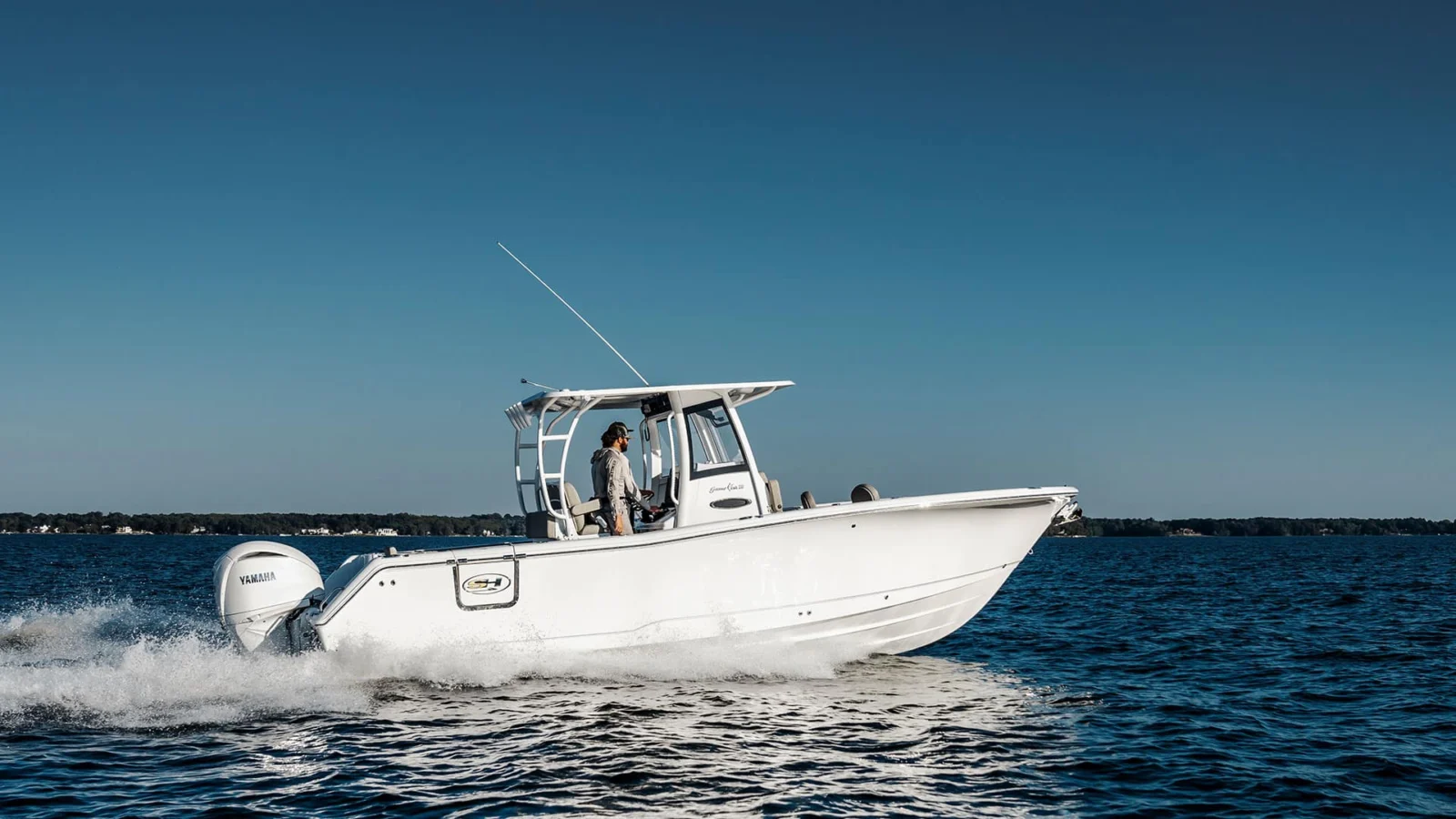
A Sea Hunt's fuel economy starts with the hull. The True Carolina Bow Flare and a sharp entry deadrise let the boat cut through a chop instead of slamming over it, and the hull is designed with more running surface per foot, so it gets on plane and stays there with less effort. Each model's engines and props are matched through the Yamaha Power Match System, so the boat isn't carrying more or less power than it needs. The tables below show what that adds up to, model by model.
Looking for the most fuel-efficient boat in general? Hull shape, weight and the speed you cruise at matter more than the name on the side. A light, single-engine bay boat will beat a twin-engine offshore boat on miles per gallon, and any boat burns far more running near full throttle than at a steady cruise. Compare the miles-per-gallon column in the model rows below, then match it against the tank size and the water you run.
Sea Hunt Gamefish: speed, fuel burn and range
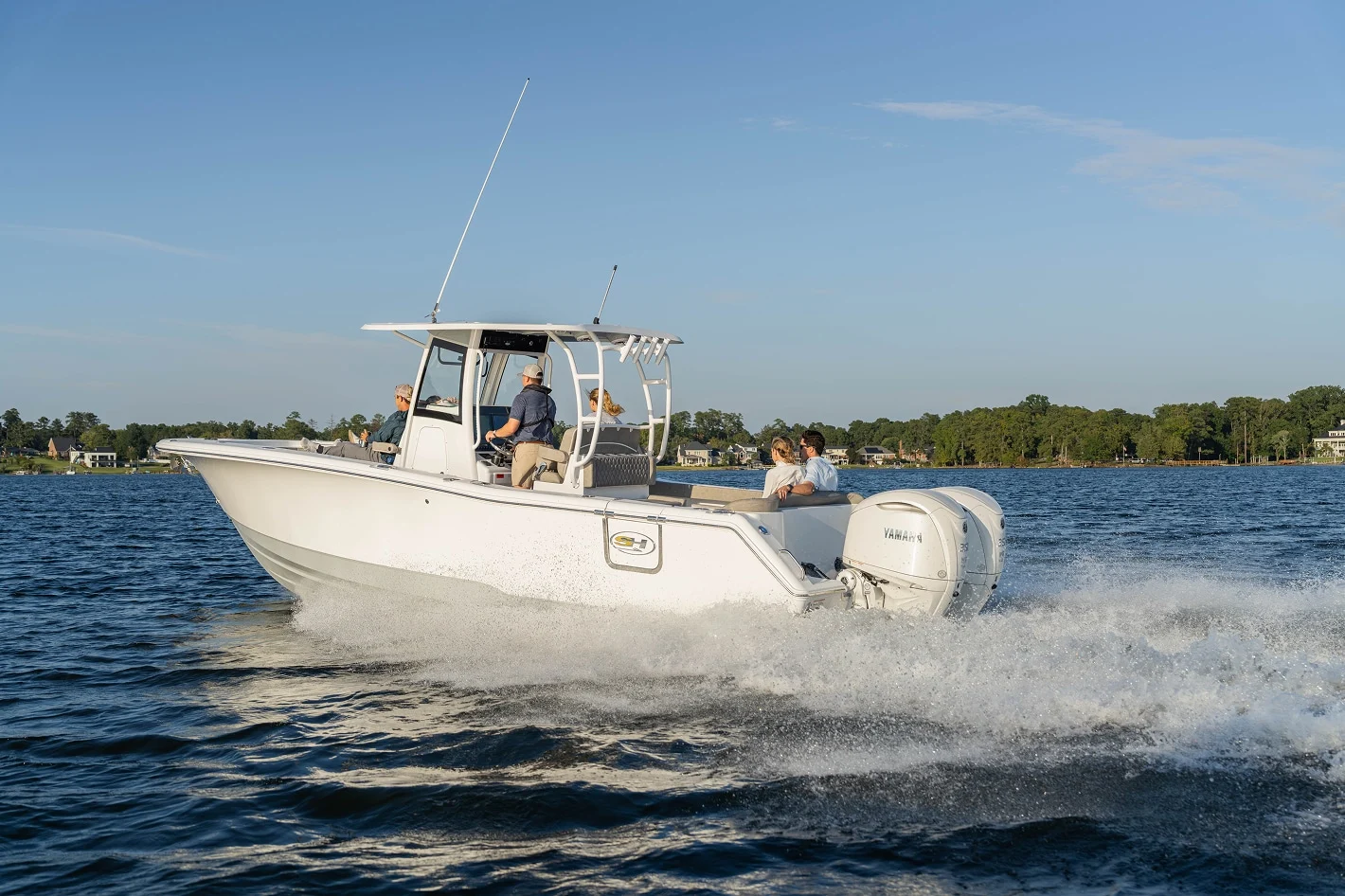
Sea Hunt's offshore fishing series. All three tested models carry twin Yamahas and land near 2.1 MPG at 3,500 RPM, though the 30 CB runs about 12 mph faster there and its efficient band starts lower, at 3,000 RPM.
Gamefish 25
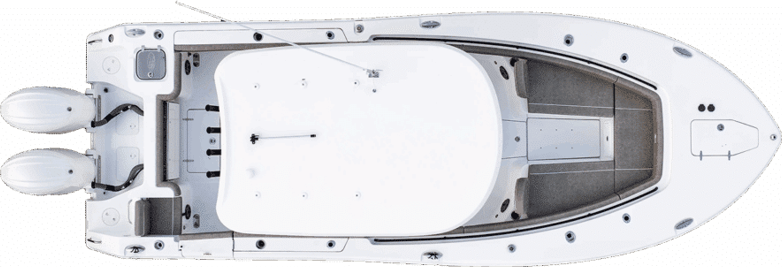
The smallest Gamefish was tested with twin F150s. Its 145 gallons at 2.13 MPG is about 309 miles on a full tank in test conditions, roughly 100 out by the rule of thirds. Its full curve is below; the bulletin section uses it as the worked example.
| RPM | MPH | GPH | MPG |
|---|---|---|---|
| 1,000 | 4.9 | 1.7 | 2.88 |
| 1,500 | 7.2 | 2.9 | 2.48 |
| 2,000 | 8.8 | 4.9 | 1.80 |
| 2,500 | 9.7 | 6.6 | 1.47 |
| 3,000 | 14.8 | 9.0 | 1.64 |
| 3,500 | 23.4 | 11.0 | 2.13 |
| 4,000 | 28.7 | 13.6 | 2.11 |
| 4,500 | 34.0 | 16.7 | 2.04 |
| 5,000 | 38.8 | 22.4 | 1.73 |
| 5,500 | 43.0 | 29.3 | 1.47 |
| 5,900 | 47.0 | 30.0 | 1.57 |
Yamaha bulletin: Sea Hunt Gamefish 25, twin F150XSA2, tested 26-Jul-2025. Time to plane 5.0 seconds; 0-30 mph 9.3 seconds.
Older figures you may see online (25.3 mph at 3,500 RPM) come from Yamaha's 2019 twin F150XCA test of the earlier 26′ 0″, 144-gallon hull. The table above is for the current hull. Yamaha has no twin F200 bulletin for the Gamefish 25.
Gamefish 27 CB
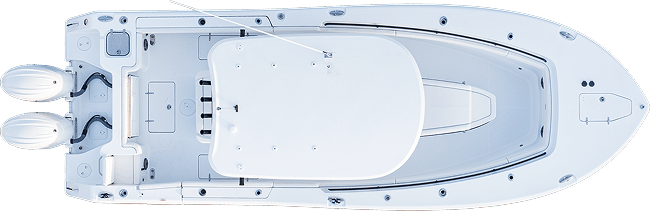
The 27 CB moves up to twin F200s and 180 gallons, tested with 90 gallons aboard at 8,850 lb. Its efficient band is 3,500 to 4,000 RPM (2.07 and 2.02 MPG), a cruise of roughly 25 to 31 mph. A full tank works out to about 373 miles, about 124 for the outbound third.
| RPM | MPH | GPH | MPG |
|---|---|---|---|
| 3,500 | 25.3 | 12.2 | 2.07 |
| 5,000 | 41.5 | 26.8 | 1.55 |
Yamaha bulletin: twin F200XSA2, tested 13-May-2025.
Looking for twin 250s? Yamaha's twin F250XSB2 bulletin (13-May-2025) is for the Gamefish 27 FS, not the CB: 33.2 mph at 3,500 RPM (16.1 gph, 2.06 mpg) and 48.3 mph at 5,000 RPM (34.9 gph, 1.38 mpg).
Gamefish 30 CB
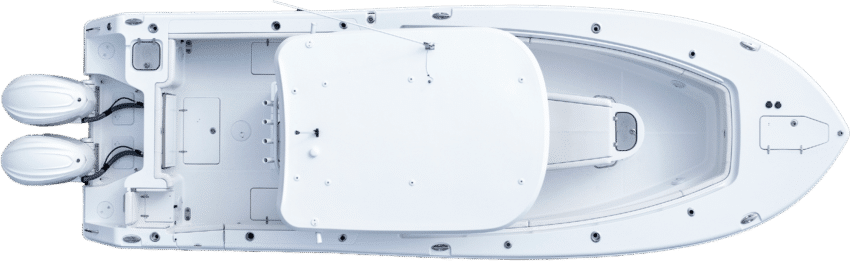
The biggest Gamefish ran twin F350s with 90 of its 230 gallons aboard. It holds 2.09 MPG at both 3,000 and 3,500 RPM, so you can cruise anywhere from about 30 to 36 mph for the same fuel per mile. Full-tank range at that rate is about 481 miles, roughly 160 out by thirds, enough margin for a Gulf Stream run from Jupiter.
| RPM | MPH | GPH | MPG |
|---|---|---|---|
| 3,500 | 35.9 | 17.2 | 2.09 |
| 5,500 | 57.2 | 48.2 | 1.19 |
Yamaha bulletin: twin F350XSA2, tested 30-May-2024.
Sea Hunt Ultra: speed, fuel burn and range
Sea Hunt's family center console line. The tested 255 SE runs a single F350, which is the main reason it beats the twin-engine Gamefish boats on MPG.
Ultra 255 SE
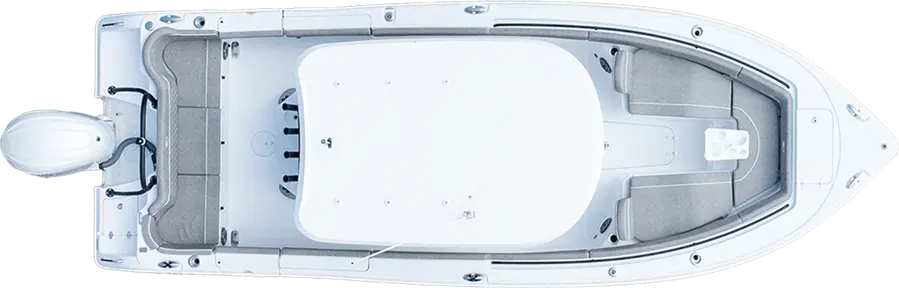
Yamaha tested the 255 SE at 6,129 lb with 60 of its 120 gallons aboard, on a cool November day in 5 to 10 mph of wind. Its best on-plane row is 3.38 MPG at 27.9 mph, and it still returns 2.78 MPG at 38 mph. A full tank at the best rate covers about 406 miles, roughly 135 outbound.
| RPM | MPH | GPH | MPG |
|---|---|---|---|
| 3,500 | 27.9 | 8.3 | 3.38 |
| 4,500 | 38.2 | 13.8 | 2.78 |
Yamaha bulletin: single F350XSA2, tested 14-Nov-2023.
Ultra 265 SE
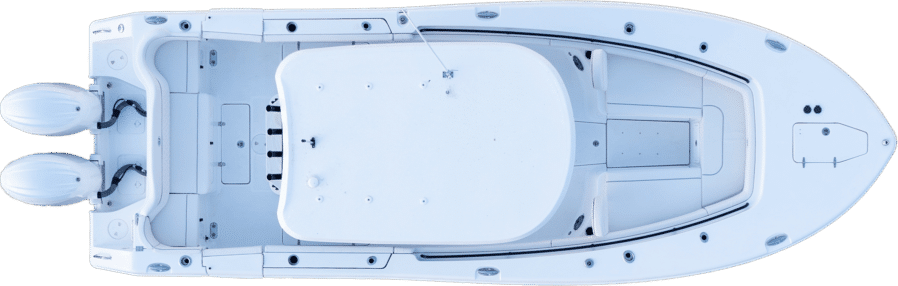
Yamaha has not published a performance bulletin for the Ultra 265 SE. It is longer and wider than the 255 SE, rated for 400 hp and carries 145 gallons, so the 255 SE's figures are a starting point, not a substitute. Until a bulletin appears, ask us for the engine setup you're considering and we'll tell you what data exists.
Sea Hunt BX: speed, fuel burn and range
Sea Hunt's bay boat series posts the best MPG on this page, thanks to light hulls and single engines. Small tanks (53 and 68 gallons) keep range close to the bigger boats.
BX 22 BR
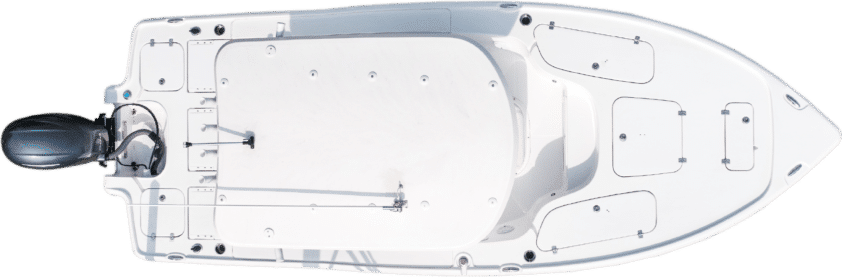
The oldest current-model test here, run in 2018 with an F200XB, a hard top and a 6-inch jack plate at half a tank. It made 5.24 MPG at 24.9 mph: about 278 miles from a full 53 gallons, roughly 93 outbound.
| RPM | MPH | GPH | MPG |
|---|---|---|---|
| 3,500 | 24.9 | 4.8 | 5.24 |
| 5,000 | 38.8 | 11.6 | 3.35 |
Yamaha bulletin: single F200XB, tested 18-Jun-2018 (when Sea Hunt listed the beam as 8′ 4″).
The BX 22 BR's standard engine today is a Yamaha F150XC; the F200 tested here is an option. Inshore, count idle time too: the bulletin shows 0.8 gph at 1,000 RPM.
BX 25 FS
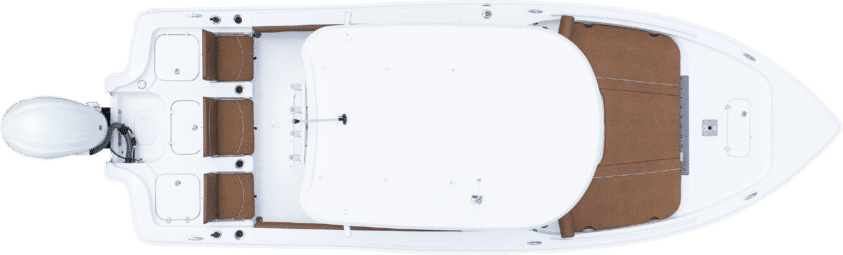
The 25 FS ran a single F350 with 35 gallons aboard and a 10-inch jack plate, in 10 to 15 mph of wind. Its best row, 4.02 MPG at 33 mph, works out to about 273 miles on 68 gallons, about 91 for the outbound third.
| RPM | MPH | GPH | MPG |
|---|---|---|---|
| 3,000 | 26.3 | 6.8 | 3.87 |
| 3,500 | 33.0 | 8.2 | 4.02 |
| 5,000 | 48.0 | 18.1 | 2.65 |
Yamaha bulletin: single F350XSA2, tested 13-May-2025.
What about older models like the Escape 27 and 28?
Sea Hunt has discontinued the Escape line, but owners and used-boat shoppers still look these up. Yamaha tested both, so their figures are below. For a current boat, the Ultra and BX series are the closest alternatives.
| Model | Engine (test date) | RPM | Speed | Fuel burn | MPG |
|---|---|---|---|---|---|
| Escape 27 | Single Yamaha XF425USB2 (14-Jan-2021) | 3,500 | 27.3 mph | 10.7 gph | 2.55 |
| Escape 27 | Same test | 5,000 | 43.5 mph | 23.3 gph | 1.87 |
| Escape 28 | Twin Yamaha F300XSB2 (2-Aug-2022) | 3,000 | 28.1 mph | 12.1 gph | 2.32 |
| Escape 28 | Same test | 5,500 | 54.9 mph | 42.3 gph | 1.30 |
Yamaha performance bulletins. Escape 27: 27′ 4″, 144 gal. Escape 28: 28′ 6″, 180 gal.
Read these the same way as the current boats, with one caution: a used Escape may not carry the engine it was tested with. The Escape 27 bulletin used a single XF425, Yamaha's big V8, while the Escape 28 used twin F300s, and repowers are common on boats this age.
If you're shopping one, ask for the engine model, prop size and hours, and check WOT RPM on a sea trial against Yamaha's published range for that engine. Our used-boat buying guide covers the rest.
How do you read a Yamaha performance bulletin?
A Yamaha performance bulletin is a one-page test report for one boat with one engine package, published on Yamaha's website and searchable by boat maker. The top half describes the setup and the bottom half is the data. The setup tells you how far the numbers will travel to your own boat.
- Weight and load. The Gamefish 25 ran at 8,124 lb with 60 of its 145 gallons, four batteries, test gear and two people.
- Propeller. Series, diameter and pitch. The Gamefish 25 ran 14-1/4 x 18 stainless props; a different prop gives a different curve.
- Gear ratio and mounting height. How the engine was rigged. Both affect top speed and trim.
- Test conditions. Temperature, elevation and wind. The Gamefish 25 ran in 0 to 5 mph of wind on an 87°F day.
The data gives a row for every 500 RPM from idle to WOT: miles per hour (MPH), gallons per hour (GPH) and miles per gallon (MPG). These are statute miles; divide MPG by 1.15 if you plan in nautical miles. Time to plane and 0-to-30 mph time sit at the bottom.
The Gamefish 25 curve in the Gamefish section shows three zones. At idle it makes 4.9 mph on 1.7 gph. From 2,000 to 3,000 RPM the hull is climbing onto plane: burn more than doubles while speed barely rises, and MPG bottoms out at 1.47. That's the plowing zone; don't cruise there. From 3,500 to 4,500 RPM it holds 2.13 to 2.04 MPG while speed climbs from 23 to 34 mph. That flat stretch is your cruise band. Yamaha's notice says bulletin data is approximate, a guideline only, and that weight, wind, water, temperature, humidity, elevation, bottom paint and options all change real results.
Cruise vs wide open throttle: where is the sweet spot?
Every Sea Hunt bulletin tells the same story: the last 1,500 RPM buy speed at a steep price in fuel. This table pulls the best on-plane row and the WOT row from each bulletin.
| Model (engines) | Best cruise MPG | At | WOT speed | WOT burn |
|---|---|---|---|---|
| Gamefish 25 (2 x F150) | 2.13 | 3,500 RPM, 23.4 mph | 47.0 mph at 5,900 | 30.0 gph |
| Gamefish 27 CB (2 x F200) | 2.07 | 3,500 RPM, 25.3 mph | 50.5 mph at 5,950 | 41.0 gph |
| Gamefish 30 CB (2 x F350) | 2.09 | 3,000-3,500 RPM, 29.9-35.9 mph | 62.8 mph at 6,050 | 60.9 gph |
| Ultra 255 SE (1 x F350) | 3.38 | 3,500 RPM, 27.9 mph | 52.8 mph at 6,100 | 31.4 gph |
| BX 22 BR (1 x F200) | 5.24 | 3,500 RPM, 24.9 mph | 48.0 mph at 6,000 | 18.3 gph |
| BX 25 FS (1 x F350) | 4.02 | 3,500 RPM, 33.0 mph | 58.9 mph at 6,000 | 30.5 gph |
From each model's Yamaha bulletin (dates in the model sections below). Best cruise MPG is the best on-plane row; idle rows are left out.
Take the Gamefish 30 CB: 35.9 mph on 17.2 gph at 3,500 RPM, 62.8 mph on 60.9 gph at WOT. About 75 percent more speed costs three and a half times the fuel per hour, and MPG halves, from 2.09 to 1.03.
Bulletins test WOT mostly because WOT RPM is how you check the prop. The full-throttle range for the F150, F200 and F350 is 5,000 to 6,000 RPM. If your boat can't reach that range with a typical load, the prop may have too much pitch or the boat is carrying more weight than it was set up for.
Sea state usually picks your cruise speed. The on-plane band is wide, so backing off 500 RPM in a chop costs little range; dropping below plane costs a lot.
How do load, bottom growth and props change the numbers?
Bulletin boats run light: two people, partial tanks (35 to 90 gallons), no ice, tackle or bait. Here's what moves your numbers.
- Load. Gasoline weighs about 6.1 pounds per gallon. Filling the Gamefish 30 CB from the tested 90 gallons to 230 adds about 850 pounds; add two anglers, ice and a full livewell and you're well over 1,000 pounds above the test. Expect cruise MPG below the bulletin.
- Bottom growth. Florida's warm water fouls a hull in a slip fast, and growth adds drag. The first sign is a boat that won't reach its normal WOT RPM. Yamaha lists bottom paint among its variables; a boat on a lift, in dry stack or on a trailer stays closest to bulletin numbers.
- Prop and trim. More pitch lowers RPM; less pitch revs higher and pulls a heavy load out of the hole. The right prop puts WOT inside 5,000 to 6,000 RPM with your usual load. Check for dinged blades after any brush with an oyster bar. After planing, trim up gradually until speed peaks at a fixed RPM.
- Conditions. Head seas, current against you and hot, humid air all cost fuel.
How do you plan fuel range by thirds?
The U.S. Coast Guard Auxiliary's rule: one-third of your fuel going out, one-third getting back, one-third in reserve. The reserve covers a head sea on the way home, a detour around a storm or a tow for a friend.
- Find your cruise RPM.Use the row with the best MPG, usually mid-RPM, not WOT.
- Multiply fuel by MPG.Fuel capacity × MPG is the most a full tank could cover in test conditions.
- Take a third, then adjust.A full crew, rough water or a dirty bottom cut range. Your fuel-flow gauge is the real number.
Example: a Gamefish 27 CB leaves Port Canaveral with 180 gallons. A third is 60 gallons, about 124 miles at the bulletin's 2.07 MPG. With four anglers and a building southeast breeze, your readout might show 1.7 MPG, and 60 gallons buys about 100 miles. Turn around when fuel used, not the clock, says so.
Track fuel in gallons, not by the needle. America's Boating Club warns that boat gas gauges are notoriously inaccurate; learn yours by noting how many gallons it takes to fill.
These are test figures, not a promise. Load, weather, trim and prop change them. Plan offshore trips around your own gauges and a fuel reserve.
Ask us for the bulletin
Tell us the model and engine you're looking at, and we'll send the performance bulletin for that setup.
Questions we hear
How does the Sea Hunt Gamefish 25 perform with twin 200s?
Yamaha hasn't published a twin F200 bulletin for the Gamefish 25. Its current bulletin (26-Jul-2025) uses twin F150XSA2s: 23.4 mph at 3,500 RPM on 11.0 gph (2.13 MPG) and 47.0 mph at WOT. The 400 hp rating means twin 200s can be fitted, and they'd add top-end speed, but the only twin F200 data for a similar Gamefish is the 27 CB's: 25.3 mph and 2.07 MPG at 3,500 RPM. Ask us for real-world figures on a specific rig.
Is there a Yamaha performance bulletin for the Sea Hunt Ultra 265 SE?
Not yet. Yamaha has bulletins for the Ultra 255 SE (single F350XSA2, 14-Nov-2023) but none for the 265 SE. The 265 SE is longer, rated for 400 hp and carries 145 gallons, so the 255 SE's 3.38 MPG at 27.9 mph is a reference point, not a prediction. If you're comparing engine packages on a 265 SE, talk to us and we'll share whatever test data exists.
How fast is a Sea Hunt Gamefish 27 with twin 250s?
Yamaha's twin F250XSB2 bulletin (13-May-2025) is for the Gamefish 27 FS. It shows 33.2 mph at 3,500 RPM on 16.1 gph (2.06 MPG) and 48.3 mph at 5,000 RPM on 34.9 gph. The 27 CB was tested with twin F200s instead: 25.3 mph at 3,500 RPM and 50.5 mph at WOT. Check which hull and engine a figure belongs to before comparing.
What is the most fuel-efficient speed on a Sea Hunt?
In Yamaha's tests, the best on-plane miles per gallon comes at about 3,000 to 3,500 RPM on every Sea Hunt model listed here. That's roughly 23 to 36 mph depending on the boat. Efficiency stays close to its best for another 500 to 1,000 RPM, then falls away toward WOT. The worst zone is just below plane, around 2,000 to 3,000 RPM, where the hull plows.
How far can a Sea Hunt go on a tank of gas?
Multiply fuel capacity by cruise MPG. With bulletin figures, that's about 309 miles for a Gamefish 25, 481 for a Gamefish 30 CB, 406 for an Ultra 255 SE and 278 for a BX 22 BR. Those are test-condition maximums. Real loads cut them, and safe planning uses only a third of the tank for the outbound leg.
How do you get better fuel economy on a Sea Hunt?
1. Trim the engines and tabs until the boat runs level, with the bow just high enough to stay dry. 2. Find your best cruise on the fuel-flow display: Yamaha Command Link gauges show gallons per hour, so watch the number as you change RPM and settle where miles per gallon peaks. 3. Keep the prop and the bottom clean; growth and a dinged blade both cost fuel. 4. Don't overload the boat: carry the fuel, water and gear the trip needs, not everything you own. More detail is in the load, bottom and props section above.