Sea Hunt hull technology: how the hull is built and why it rides the way it does
In this article
Every Sea Hunt hull pairs a True Carolina Bow Flare with a sharp entry deadrise. Sea Hunt says its hulls carry more running surface per foot than competitors' and calls them the driest riding boats in the industry. The hull and deck are hand-laid fiberglass. No boat is guaranteed to stay afloat when swamped, so carry a life jacket for everyone and keep the bilge pump working. Sea Hunt's Ten-Year Hull Limited Warranty covers structural defects in the fiberglass.
Most of what you feel on a boat comes from the hull: how wet you get running into the wind, how hard the bow lands in a short chop, and how steady the deck stays when two people lean over the same rail to land a fish. Electronics, seats and shade can change after you buy. The hull you buy is the ride you keep. This guide explains what Sea Hunt builds into its hulls and answers the questions shoppers search most: is there wood in it, is it foam filled, and can it sink. Want the boats themselves? See all Sea Hunt boats.
What hull technology does Sea Hunt use?
| Feature | What it is | What it means for you |
|---|---|---|
| True Carolina Bow Flare | Its signature bow shape and the core of its dry-ride claim | Less spray over the bow when you run into a chop |
| Sharp entry deadrise | A sharp V where the bow meets the water | The hull slices into waves instead of slapping on them |
| Running surface | "More running surface per foot than our competitors" for handling, performance and stability | More bottom carrying the boat while it's on plane |
| Hand lay-up fiberglass | Hull and deck built by hand with fiberglass mat and knitted and woven fabrics | Consistent laminate thickness and resin ratio |
| Gelcoat with UV inhibitors | Every gelcoat color option contains UV inhibitors | The finish holds up better under Florida sun with normal care |
Feature wording from Sea Hunt's features page and owner's manual, checked October 2026. The right-hand column is our plain-English explanation, not a test result.
Read the table as one design, not five features. The flare and the sharp entry work where the hull first meets a wave, the running surface carries the boat's weight on plane, and the laminate and gelcoat hold that shape together through years of pounding, sun and salt.
Sea Hunt also points to its in-house tooling shop, where it says it designs, builds and tests until a product is ready, and to ongoing redesigns and upgrades. Tooling is the set of molds a hull is laid up in, so two Sea Hunts with the same model name from different years may not share every detail.
What does the Carolina bow flare do in a Florida chop?
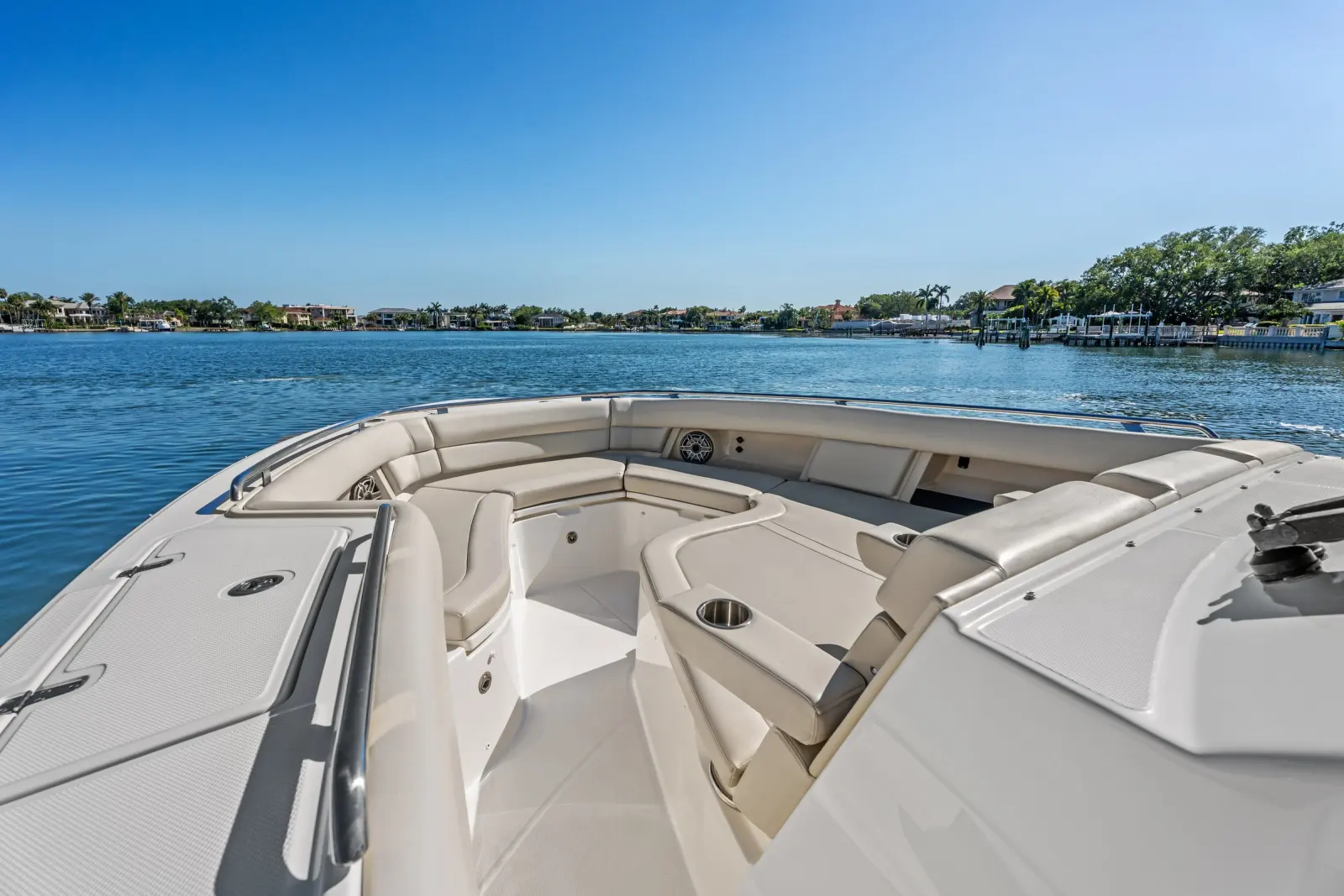
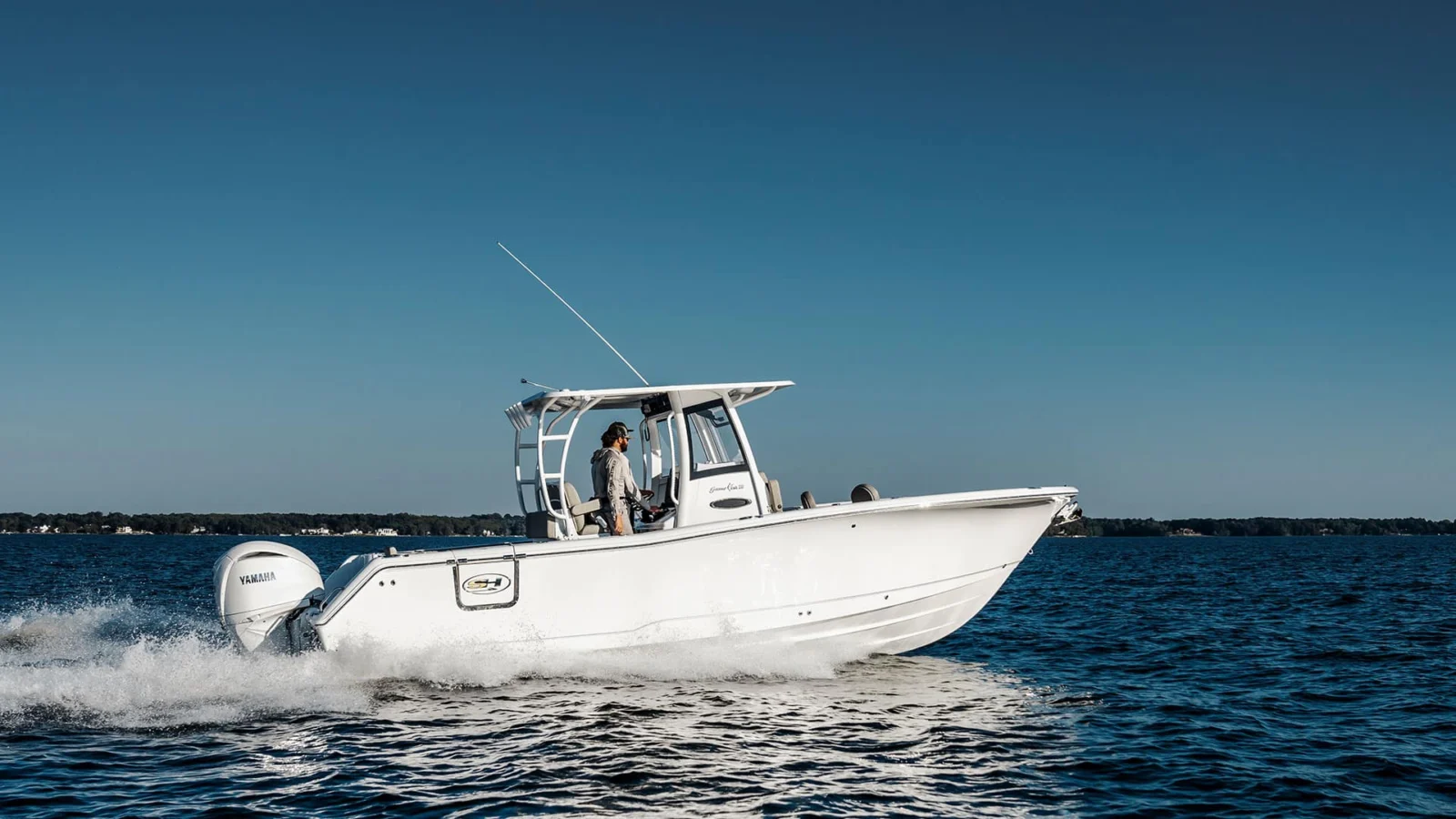
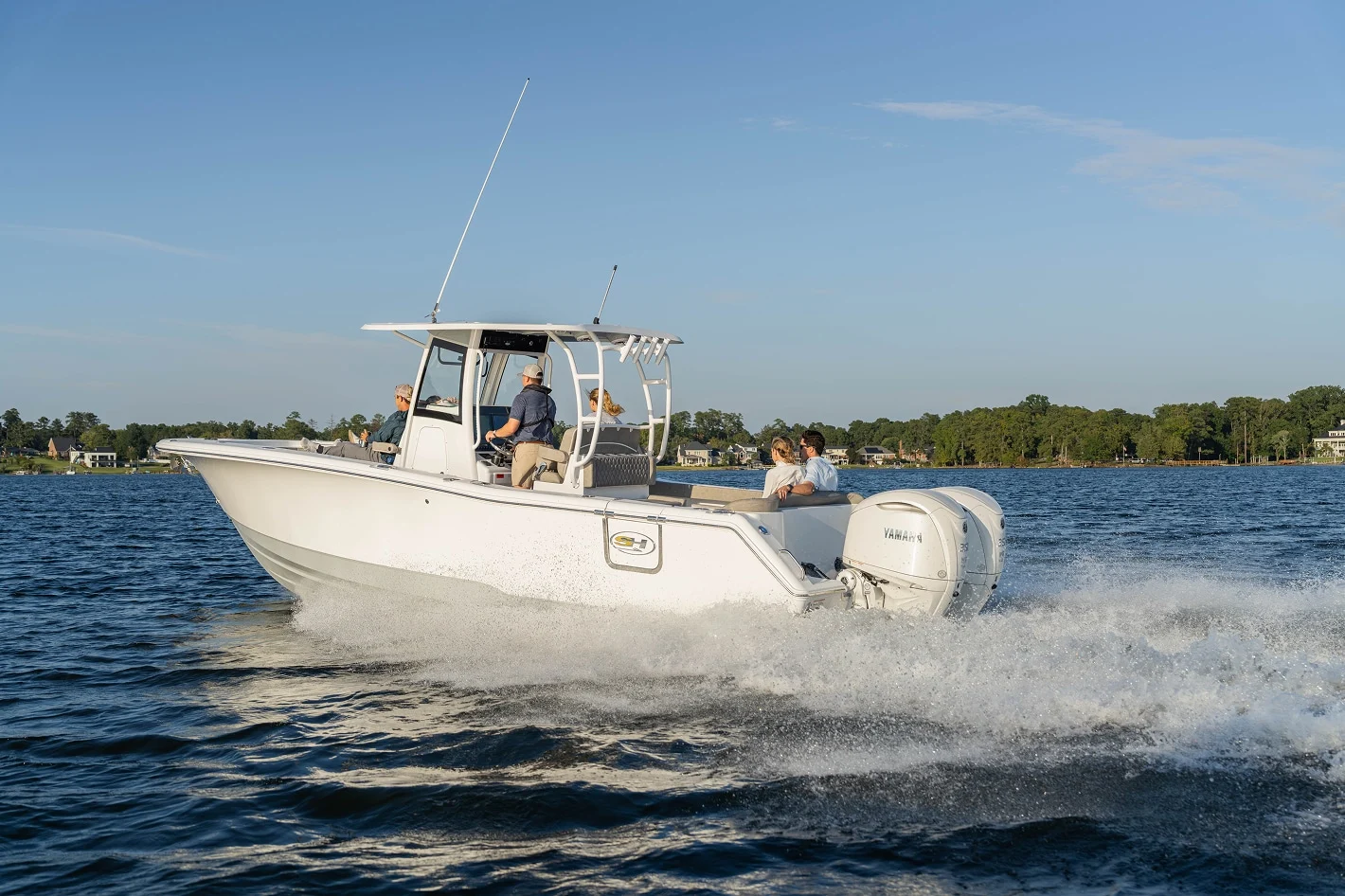
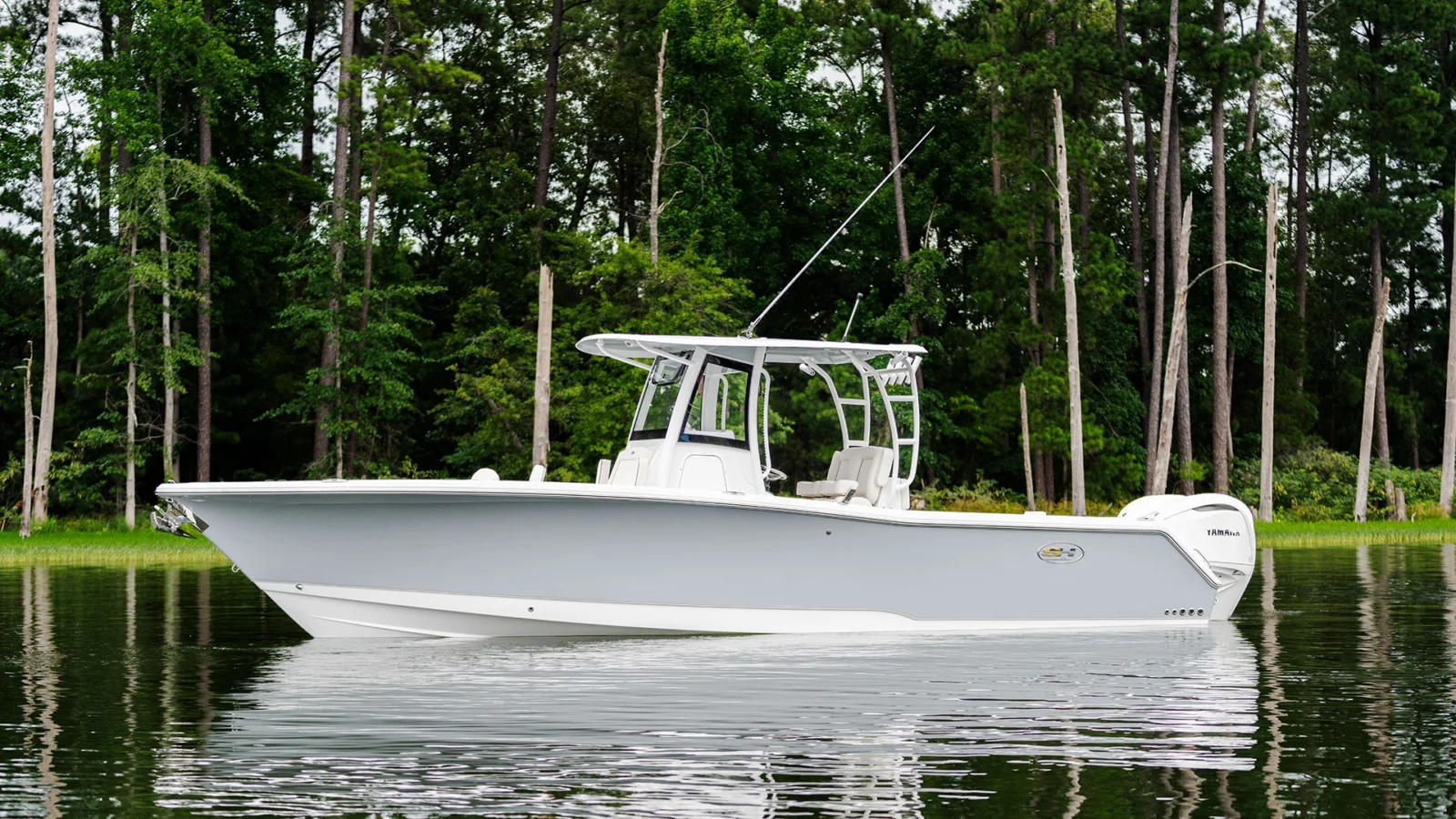
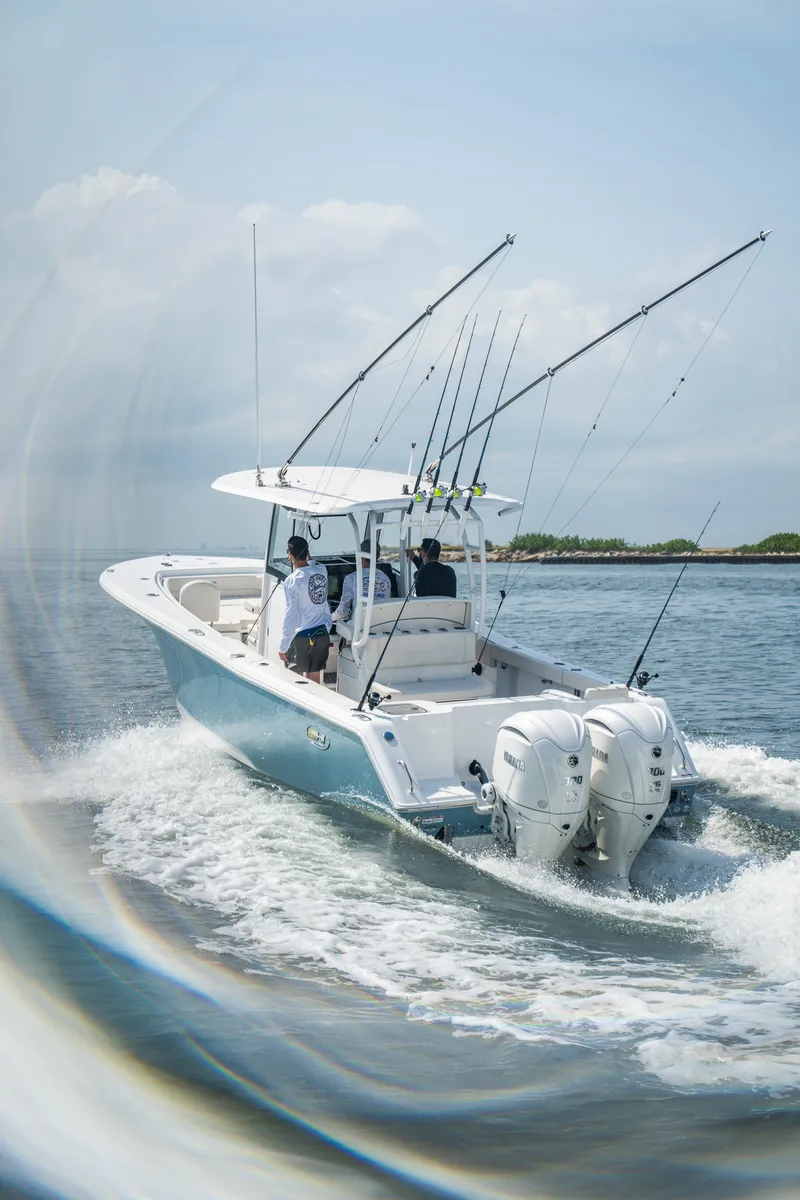
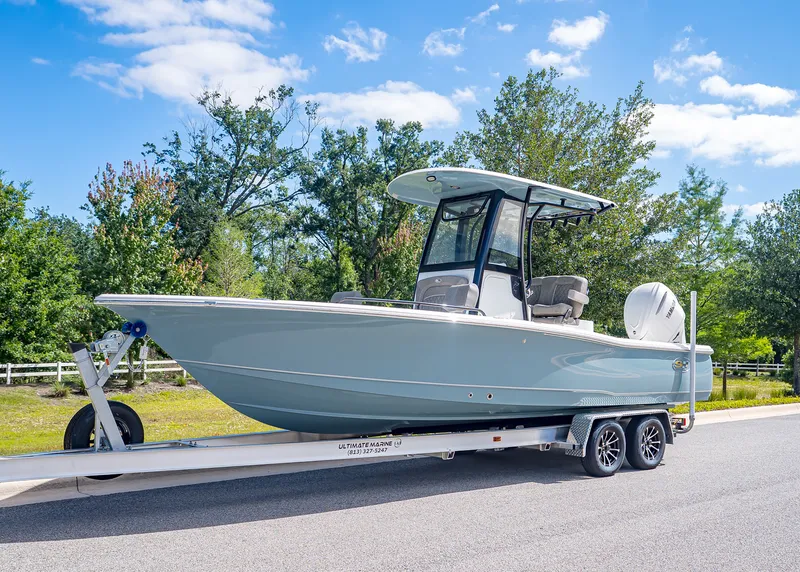
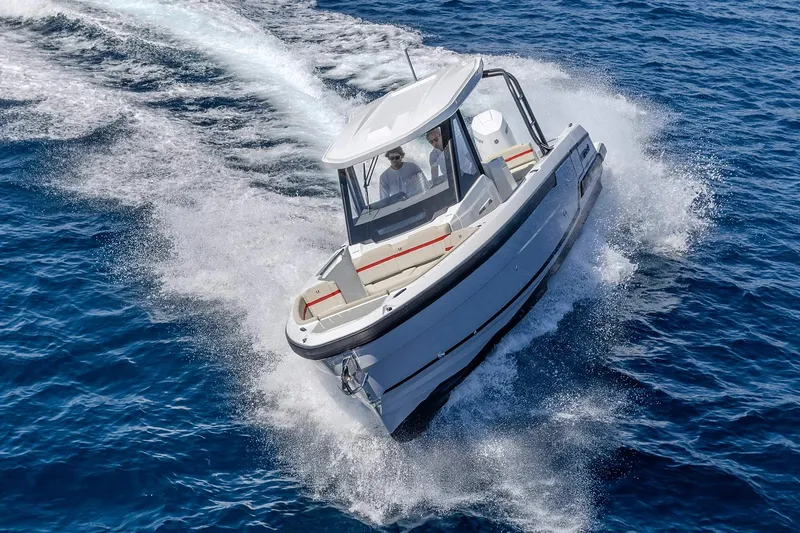
A Carolina flare is the outward sweep of the bow sides, the shape you see on the sportfishing boats built along the North Carolina coast. Look at a Sea Hunt from the front and the hull sides curve out as they rise from the waterline toward the rail. When the bow pushes into a wave, the water climbing the hull side meets that curve and gets turned outward and down instead of riding up and over the gunwale. The extra volume up high also adds buoyancy at the bow as it digs into a wave, which helps it rise.
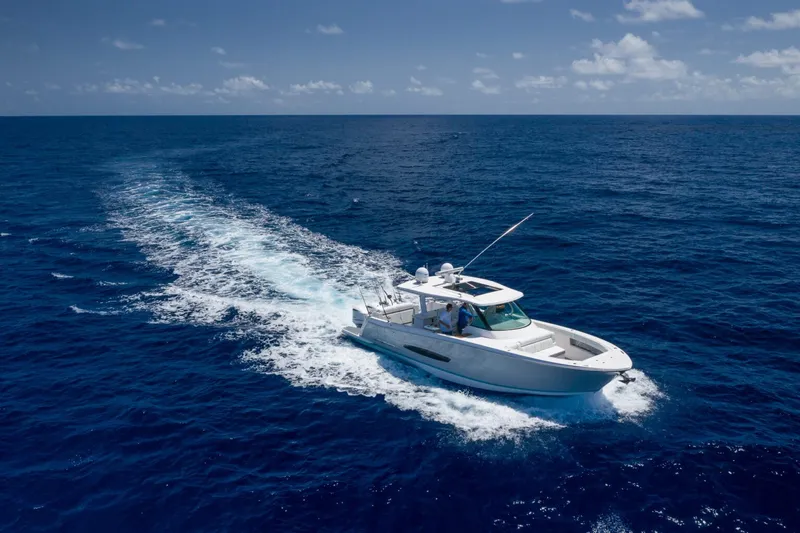
Sea Hunt credits the flare, working with the sharp entry, for its dry ride.
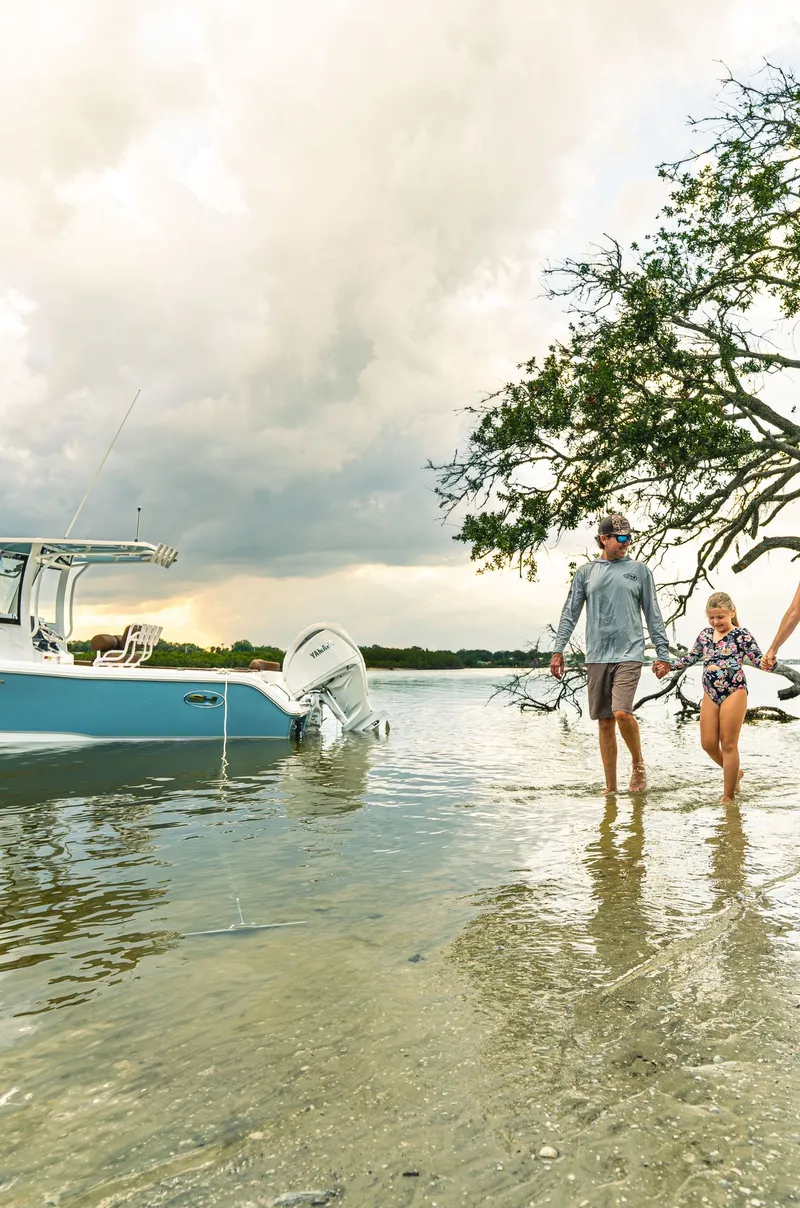
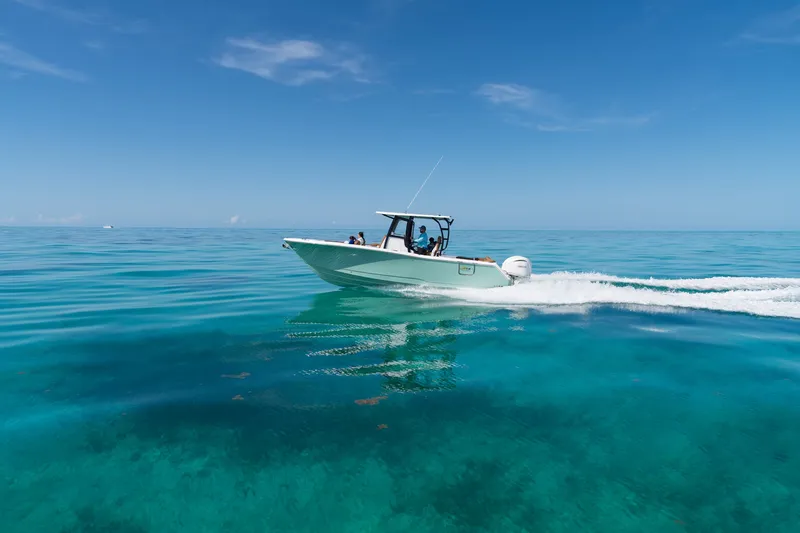
Here is where you notice it, as an example. It's a July afternoon off Ponce Inlet, the sea breeze has built a 2-foot east chop against an outgoing tide, and you're running home into it. On a hull with straight, plumb bow sides, a sheet of spray lifts off each wave and the wind carries it into the console. With a pronounced flare, more of that water peels off to the sides. You still feel the waves. You just stay drier.
The flare does less in a following sea, and no hull feature makes up for running too fast for the conditions. Throttle and trim still matter more on a rough run home.
What do Sea Hunt's deadrise numbers mean?
Deadrise is the angle between the bottom of the hull and a flat line drawn across it. A low angle makes a flatter bottom. A high angle makes a sharper V. Each Sea Hunt spec page lists deadrise as three numbers. The pages don't say where each one is measured, so read them as a set: the higher the numbers, the sharper the hull overall.
| Model | Type | Deadrise | Draft | Dry weight |
|---|---|---|---|---|
| BX 22 BR | Bay boat | 15/20/50 | 13 in | 2,700 lb |
| Ultra 219 | Family center console | 16/20/55 | 13 in | 2,350 lb |
| Ultra 234 | Family center console | 18/22/55 | 13 in | 2,800 lb |
| Ultra 255 SE | Family center console | 18/24/55 | 14 in | 4,600 lb |
| Ultra 265 SE | Family center console | 21/24/60 | 21 in | 5,800 lb |
| Gamefish 25 | Offshore fishing | 21/24/60 | 19 in | 6,100 lb |
| Gamefish 30 CB | Offshore fishing | 21/23/60 | 22 in | 7,000 lb |
Specs from Sea Hunt's model pages, checked October 2026. Dry weight leaves out fuel, gear and people. Specs can change by model year.
Three patterns stand out. First, the V gets sharper as the boats get bigger and more offshore-minded. The BX bay boat lists the lowest numbers, and the Gamefish and larger Ultras list the highest. Second, draft and weight climb with the deadrise. A sharper V sits deeper in the water and needs more horsepower to plane, which is why the Ultra 265 SE comes with twin Yamaha F150s as standard. Third, Sea Hunt reuses its ideas across lines: the Ultra 265 SE and the Gamefish 25 list the same 21/24/60 deadrise and the same 9′ 2″ beam.
What you feel follows from that. A sharper V meets a wave on a narrow edge and lands softer, so you hold speed across Tampa Bay in a west wind with less pounding. A flatter bottom sits steadier at rest and floats in less water, so it suits the Indian River flats. Neither is better in general: the BX bay boats sit at the flat end, the Ultras in the middle and the Gamefish at the sharp end. The right hull is the one built for the water you run most.
How is a Sea Hunt hull built?
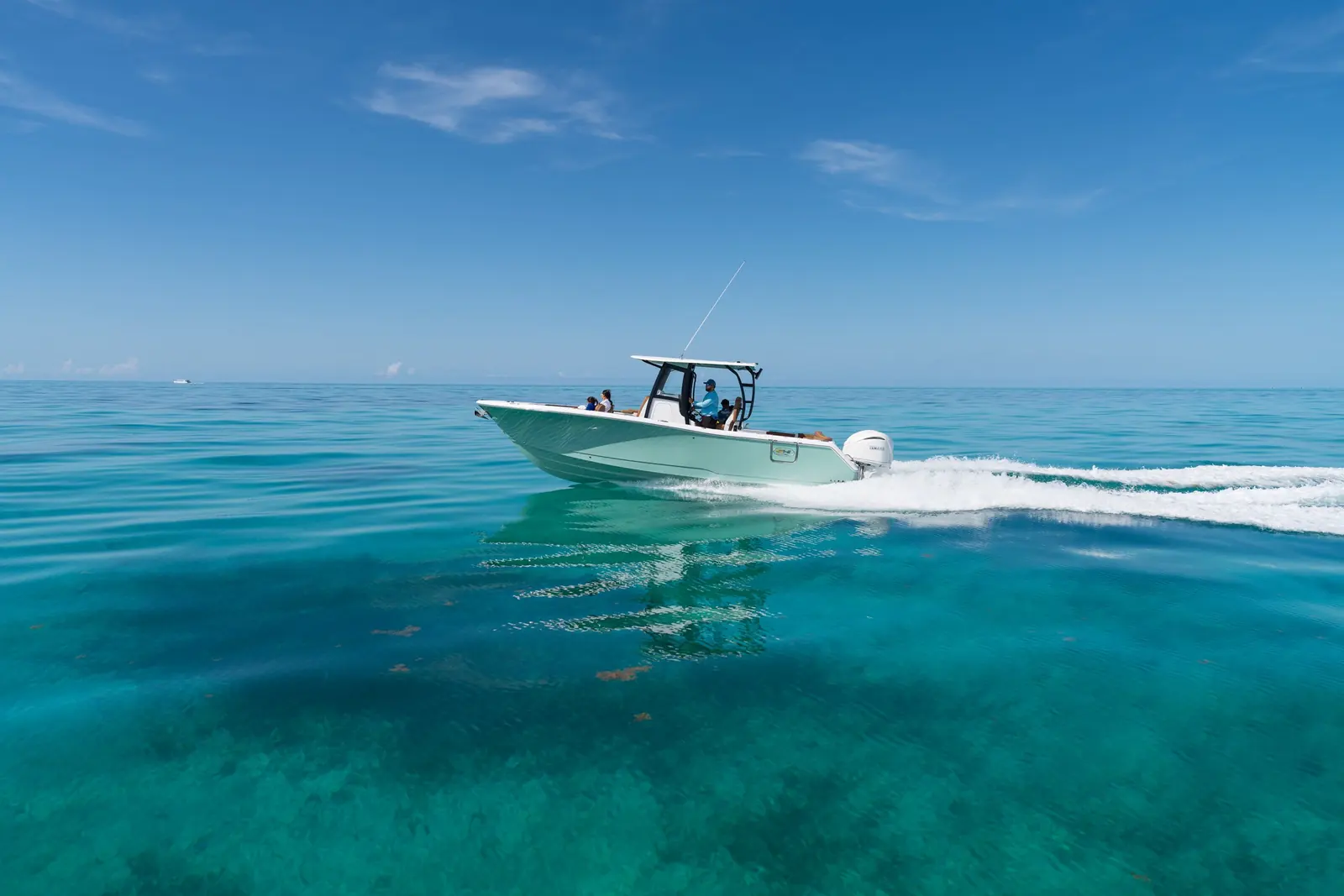
The hull and deck are built by the hand lay-up method, using fiberglass mat and knitted and woven fabrics. In hand lay-up, workers place layers of glass fabric into the mold by hand and wet each layer with resin. The method is meant to ensure a proper fiberglass-to-resin ratio and uniform thickness. In plain terms, the goal is a laminate with no dry, resin-starved spots and no heavy, resin-rich ones, because either can make a weak area.
The outside skin is gelcoat, a thin layer of pigmented resin. Its job is to protect the laminate underneath from moisture and chemicals and to give the boat its glossy color. Every Sea Hunt gelcoat color contains UV inhibitors, and color is available on the hull sides, the hull bottom and the underside of the T-top.
Stringers are the long structural members that run fore and aft inside the hull, much like the frame under a house floor. The manual defines them as longitudinal members that provide structural strength. Sea Hunt doesn't publish what its stringers are made of or how they're attached, so we don't describe them further here.
Gelcoat is elastic enough to flex with the hull, but over time it can show scratches, blisters and fine web-like cracks called crazing. Sea Hunt's manual says those are cosmetic and don't affect structural integrity, and that small nicks can be fixed with a color-matched patch kit from your dealer. On a used boat, crazing is a reason to look closer, not automatically a reason to walk away. For washing, waxing and the rest of the care routine, see our Sea Hunt maintenance schedule.
Do Sea Hunt boats have wood in them?
Sea Hunt's features page, owner's manual and warranty don't say whether any wood is used in the structure, so we won't answer for the factory here. What Sea Hunt does say: the manual describes hand-laid glass mat and woven cloth, and the ten-year hull warranty is written around the fiberglass itself: its material and its workmanship. If wood content matters to your purchase, ask us and we'll confirm with Sea Hunt for that model and year.
It helps to know why people ask. On many older boats, from many builders, the stringers and transom were built around wood sealed inside fiberglass. Water gets in through screw holes, badly bedded fittings or cracks, and the wood rots slowly where nobody can see it. BoatUS puts the stakes plainly: when stringers, decks, bulkheads or transoms go soft, the cost to repair almost always exceeds the finished value of the boat.
So the useful question isn't only what a hull was built with. It's whether this particular hull is sound today. On a used boat, check these things or have a surveyor check them:
- Transom flex. With the boat on its trailer, push and lift on the outboard's lower unit. The transom shouldn't visibly flex.
- Soft deck. Walk the whole deck and bounce gently around the helm, hatches and leaning post. Spongy spots can mean water in the core.
- Bilge and stringers. Open every hatch with a flashlight and look for cracked or separated fiberglass and water that won't drain.
- Moisture readings. A surveyor sounds cored areas and uses a moisture meter, which finds wet core before you can feel it.
Shopping a pre-owned Sea Hunt? Browse used boats and ask for the hull identification number so you can match the year to the warranty records.
Will a Sea Hunt sink if it's swamped? Flotation, scuppers and bilge pumps
Any boat can sink, and we don't describe Sea Hunts any other way. Searchers also ask whether Sea Hunts are foam filled: Sea Hunt's website, owner's manual and warranty don't mention foam fill, so we don't claim it. Here is what the rules and the manual actually say.
Federal rules set a level flotation standard for monohull outboard boats under 20 feet long, rated for engines over 2 horsepower (33 CFR 183, Subpart G). Sea Hunt's manual says its boats under 20 feet are designed to meet or exceed level flotation requirements, so that if swamped the crew may be able to bail out the cockpit and restart the engine. Every current Sea Hunt is longer than 20 feet; the smallest, the Ultra 219, measures 21′ 4″. For larger models, the manual says the boat should keep a portion of itself above water, depending on load and how badly the hull is damaged. That is a far more modest promise than "won't sink", and it's honest.
Two built-in features do the everyday work of keeping water out. Sea Hunt cockpits are self-bailing: water on the cockpit floor drains by gravity through large aft scuppers, not into the bilge. Each scupper has an external flap that limits water flowing back in. Below deck, an automatic bilge pump has a manual override switch at the helm.
There's one wiring detail every owner should know. The manual notes that the automatic bilge pump float switch is wired directly to battery 1. If that battery goes flat, the float switch can't protect the boat while it sits unattended, and a dead battery plus clogged scuppers after a summer downpour is how boats end up low at the dock.
If you're swamped, the manual's advice is simple: everyone puts on a life jacket, stay with the boat, climb onto the hull if you need to and signal for help. Don't try to swim to shore. It's usually farther than it looks.
Two more safety features come from the factory. The navigation lights are built to meet both inland and international rules. And most Gamefish and Ultra SE models have a side entry door for boarding at the dock; the BX boats and the Ultra 219, 229 and 234 don't.
Beyond the horn and navigation lights, the required safety gear doesn't come with the boat. Life jackets and the rest are yours to add before the first trip; see what Florida requires on board.
Safety tip Before every trip, check the bilge pumps, lights and life jackets. Once a year, get a free Coast Guard safety check, and if you haven't taken a boating safety course, it's worth the few hours. Florida boating laws covers the rest.
What does the Sea Hunt hull warranty cover?
Sea Hunt's warranty has two parts. The One-Year Limited Warranty covers the boat against defects in material and workmanship for the original purchaser for one year from delivery. It doesn't cover carpet, upholstery or gelcoat finishes, or equipment Sea Hunt didn't make, including the engine. That year can't be transferred.
The Ten-Year Hull Limited Warranty is the long one. It protects the hull against structural flaws in the glass and how it was laid up, for ten years from delivery to the original purchaser. Sea Hunt will repair or replace a hull found to have a structural defect, at its plant in Columbia, South Carolina, or at its option through an authorized Sea Hunt dealer. Transportation to and from the repair is the owner's cost.
| Covered by the hull warranty | Not covered by the hull warranty |
|---|---|
| Structural defects in fiberglass material | Fading, checking, crazing, blisters and gelcoat cracks |
| Structural defects in fiberglass workmanship | Damage from accidents, neglect or unauthorized repairs |
| Ten years from delivery to the first owner | Damage caused by items Sea Hunt didn't install, or by the trailer |
| The rest of the term for a second owner, if transferred | Boats used for racing, government, commercial or business use |
Summarized from Sea Hunt's limited warranty document. Read the full warranty for exact terms.
The transfer rule matters most if you're buying used. The hull warranty can move to the second owner for whatever time is left, but only if that owner completes a Warranty Transfer form and files it with Sea Hunt within 15 days of the transfer. A third owner isn't covered. If you buy a three-year-old Sea Hunt from its first owner, file the form right away, and keep a copy with the title.
How can you feel the hull on a sea trial?
Specs only tell you so much. Ask to run the boat on a day with some breeze, and bring the people who will ride with you most.
- Run into the chopWatch how much spray reaches the console and how the bow lands. This tests the flare and the entry.
- Quarter the wavesTake them on the bow at an angle, the way you'll often run home.
- Stop and driftStand at the rail with someone beside you. Notice how far the boat leans and how fast it settles.
- Listen at speedBangs, creaks and rattles can point to loose fittings or flex.
Compare like with like: a 21-foot Ultra and a 30-foot Gamefish will never feel the same in a 2-foot chop.
Ride one before you decide
Tell us where you boat and who comes along, and we'll match you with a hull worth trying in real water.
Questions we hear
Will a Sea Hunt boat sink?
Any boat can sink if it takes on enough water or the hull is badly damaged. Sea Hunt's owner's manual says its boats under 20 feet are designed to meet level flotation requirements, and that larger models should keep a portion of the boat above water depending on load and damage. Every current Sea Hunt is over 20 feet. Cockpits are self-bailing and an automatic bilge pump comes standard. Keep a life jacket for everyone aboard and a charged battery for the pump.
Do Sea Hunt boats have wood in them?
Sea Hunt doesn't publish whether its structure contains any wood. Its owner's manual says the hull and deck are built by hand lay-up with fiberglass mat and woven fabrics, and its Ten-Year Hull Limited Warranty covers structural defects in fiberglass material and workmanship. If wood content matters to you, ask a dealer to confirm with Sea Hunt for the exact model and year. On a used boat, a survey with a moisture meter is the best way to judge the structure.
Are Sea Hunt boats foam filled?
Sea Hunt doesn't say. Its website, owner's manual and warranty don't mention foam fill. What the manual does say is that its boats under 20 feet are designed to meet level flotation requirements, and that larger models should keep a portion of the boat above water depending on load and damage. Every current Sea Hunt is over 20 feet. If flotation matters to your purchase, ask a dealer to confirm with Sea Hunt for the exact model and year.
Is the Sea Hunt hull warranty transferable?
Yes, once. Sea Hunt's Ten-Year Hull Limited Warranty can transfer to the second owner for the remaining term if that owner completes a Warranty Transfer form and files it with Sea Hunt within 15 days of the transfer. The One-Year Limited Warranty can't be transferred. The hull warranty doesn't cover cosmetic gelcoat issues such as fading, crazing or blisters, or damage from accidents, neglect or the trailer.
Where are Sea Hunt boats built?
Sea Hunt builds its boats in Columbia, South Carolina. The warranty names the Columbia plant as the place where hull warranty repairs are made, or an authorized Sea Hunt dealer at Sea Hunt's option. Sea Hunt also runs an in-house tooling shop there, where it designs, builds and tests its molds and product updates.
What is the deadrise on a Sea Hunt?
It depends on the model. Each Sea Hunt spec page lists deadrise as three numbers. The BX 22 BR bay boat lists 15/20/50, the Ultra 234 18/22/55, the Ultra 255 SE 18/24/55, and the Ultra 265 SE and Gamefish 25 both list 21/24/60. Higher numbers mean a sharper V, which rides softer in chop but draws more water and needs more power to plane.
Sources
- Sea Hunt, Features page.
- Sea Hunt, Limited Warranty.
- Sea Hunt, Owner's Manual 2025-26.
- Sea Hunt model pages (BX 22 BR, Ultra 219, Ultra 234, Ultra 255SE, Ultra 265SE, Gamefish 25, Gamefish 30CB).
- 33 CFR 183.201.
- BoatUS, The Value Proposition.