


Boat troubleshooting: electrical, bilge pump and GPS problems
In this article
Most electrical, bilge pump and electronics problems on a boat trace back to three things: a weak or dead battery, a blown fuse or tripped breaker, or a loose or corroded connection. Check them in that order. With the engine off, a healthy battery reads 12 to 13 volts. If the battery is charged, the fuse is good and the connections are clean and tight, the part itself (pump, switch, light or display) has probably failed. A fuse or breaker that keeps tripping, or a bilge that fills faster than the pump clears it, is the point to stop and call service.
Sea Hunt builds its boats on a 12-volt DC system with waterproof connectors and tinned wire, per its 2025-26 owner's manual. That's a good start, but Florida is hard on any wiring. Salt spray, heat, afternoon downpours and long weeks on a trailer find every loose crimp and bare terminal. When something stops working, the cause is usually simple, and you can find it with a multimeter, a wire brush and twenty minutes.
Find your symptom in the table, then go to the section for that system. Where a number or rule comes from Sea Hunt, Yamaha or the Coast Guard, it says so.
What's wrong? Find your symptom
| Symptom | Likely cause | What to check first |
|---|---|---|
| Engine won't crank | Weak battery, battery switch off, loose or corroded cable | Voltage at the battery, switch position, terminals |
| Engine cranks but won't start | Fuel problem rather than electrical | Fuel level, primer bulb, fuel filter; see your engine manual |
| Battery dead after a few days | Something left on, or a weak battery | Switches at the helm, then a load test |
| Bilge pump won't turn on | Blown fuse, stuck float switch, wiring or a dead battery 1 | Fuse, then float switch, then wiring at the pump |
| Bilge pump runs and won't stop | Float switch stuck up, helm switch on manual, or water coming in | Float switch, helm switch, then look for the leak |
| Navigation lights out or dim | Corroded socket, failed bulb or LED, bad switch | Socket and bulb, then the fuse or breaker |
| Electronics won't power on | Blown fuse, loose power lead or low voltage | Fuse or breaker, power plug, battery voltage |
| Electronics flicker or reboot | Loose or corroded connection, voltage dip at start-up | Every connection between battery and unit |
| Poor GPS fix or wrong position | Blocked antenna, loose antenna lead, old software | Antenna's view of the sky, plug, software version |
| Breaker trips again after reset | A short or a failing device | Stop and book service |
Work left to right. The simple checks fix most problems; when they don't, the part has likely failed.
Safety first. Turn the battery switches off before you touch wiring, as Yamaha and Sea Hunt both advise. If the bilge is filling faster than the pump can clear it, or you smell fuel, stop troubleshooting: put on life jackets, head for the dock and call for help if you need it.
Two rows trip up new owners more than the rest. The first is "cranks but won't start." If the starter spins the engine at normal speed, the battery is doing its job, and the problem is usually fuel, not electrical. Sea Hunt's manual offers a simple test for that: run the engine off a portable six-gallon tank. If the problem goes away, it lives in the boat's fuel system; if it stays, it's in the engine.
The second is the bilge pump that runs on its own. It's tempting to treat that as a switch problem and silence it. Before you do, make sure the bilge really is dry, because a pump that keeps cycling may be the only thing telling you water is getting in.
How is a Sea Hunt's 12-volt system laid out?

Sea Hunt's 2025-26 owner's manual describes two layouts. Knowing which one you have tells you where to look when something goes dark.
Ultra 219 through 245 and the BX bay boats. Two dealer-installed batteries sit under the starboard rear seat with the battery switch; there is no separate house battery. Protection for the accessory harness, automatic bilge pump, windlass (Ultra 245) and isolator circuit sits at that switch, and every other accessory breaker sits beside its own switch on the dash. With a 150 or 200 hp motor, alternate batteries roughly every 10 to 15 hours so both stay charged; with 250 hp or more, an isolator lead keeps the second one charged. Don't run on "BOTH" or "ALL", which can drain both at once, and never turn the switch off with the engine running.
Ultra 255 through 305 and every Gamefish. A panel just inside the console door holds an engine and a house battery switch, plus breakers for the automatic bilge pumps, trim tabs and main power to the helm and T-top. Accessory breakers sit on a panel above it. Leave both switches on in normal running; "combine" is for a hard start only.
One detail matters most: the automatic bilge pump float switch is wired directly to battery 1. If battery 1 runs flat, the pump can't run while the boat sits unattended.
Boat won't start or the battery keeps dying: how to test it
A multimeter is the one tool that turns guessing into knowing. Set it to DC volts, red lead on the positive post, black on the negative. The whole test takes about ten minutes.
- Read it with the engine off.Battery switch on, engines off. The reading should be 12 to 13 volts DC. A reading below 11 volts means a weak battery that may not start the engine.
- Charge and read again.If the voltage is low, charge the battery fully and test again. If it still reads under 12.6 volts after charging, have the battery load-tested and replace it if it fails. Lithium batteries read differently; follow their maker's numbers.
- Read it with the engine running.Start the engine and hold it at no more than 2,500 rpm. Look for 13 to 15 volts at the battery; on the helm voltmeter, 13 to 14 volts is normal, and readings over 14 may point to a regulator problem. Low or jumpy readings mean loose connections or a charging fault, which is a job for a technician.
- Clean the terminals.Switches off. Remove the cables, scrub posts and clamps with a small wire brush and a little baking soda and water, keeping the mix out of the battery. Reattach the heaviest cable (the starter cable) closest to the battery and finish with a light coat of grease.
- Check the hardware.Skip wing nuts on battery terminals; use stainless hex nuts with lock washers. Make sure the hold-down strap is tight so the battery can't move in a chop.
A battery that dies after a few days on the trailer usually has help: a switch left on at the helm, a stereo memory circuit, or an electronics unit wired straight to the battery. If the boat sits for weeks between trips, a charger or maintainer keeps both batteries topped up. Sea Hunt's storage advice is the same: charge fully before layup, because a weak battery loses charge faster than a strong one.
If the engine clicks but won't turn over with a good reading at the battery, the loss is somewhere between the battery and the starter: a corroded cable end, the battery switch itself or a ground. That chain is worth one careful look with the switch off. Beyond that, call service.
Fuses and breakers: why they blow and what to do
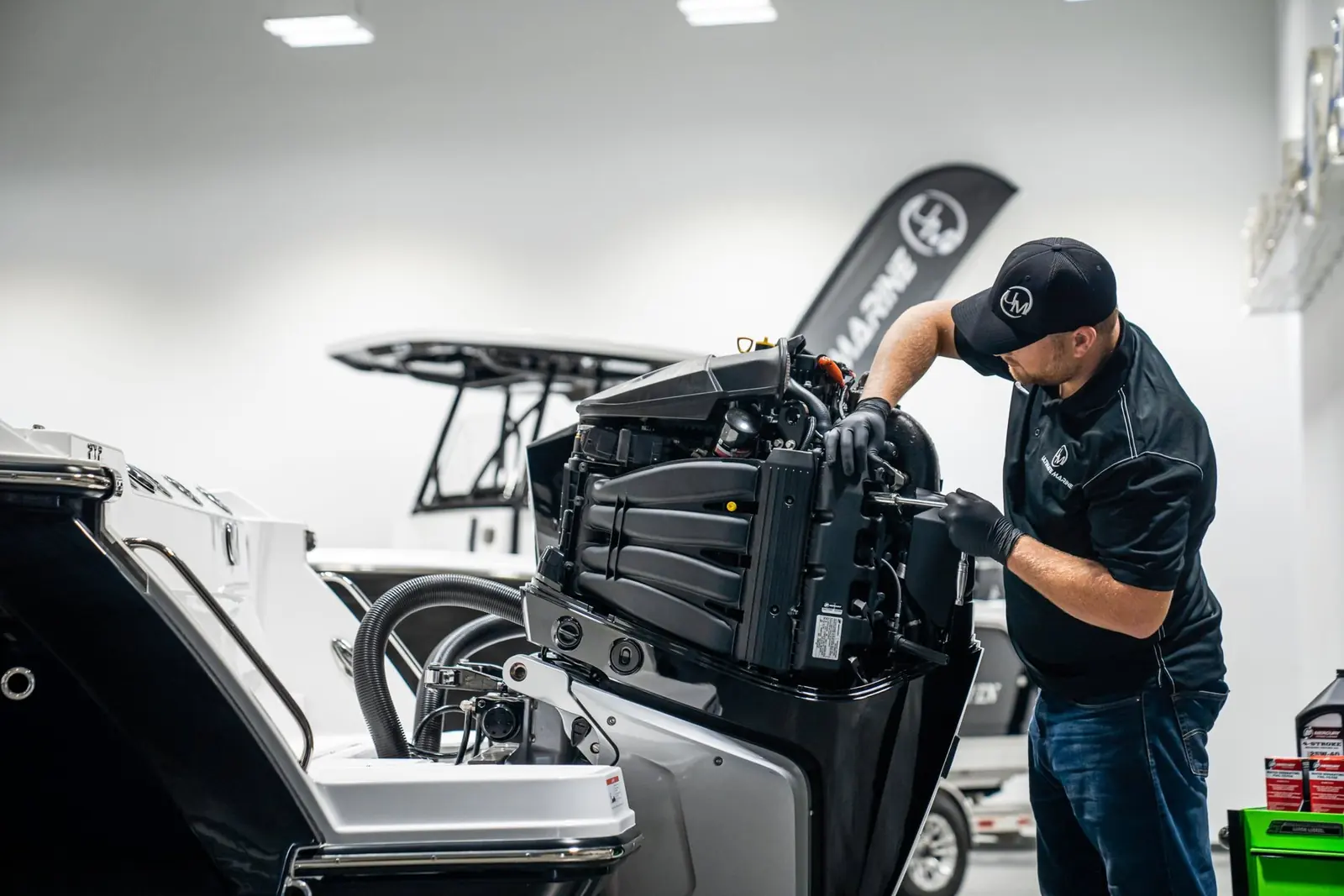
Every circuit on a properly rigged boat has a fuse or a circuit breaker, Yamaha explains. When a device fails or a wire shorts, too much current flows. The thin wire inside a fuse burns through, or the breaker pops, and that gap protects the rest of the circuit from heat, sparks and fire. A blown fuse is a symptom, not the problem.
- Find the right one.Use the locations in the layout section above, or the wiring diagram in your owner's manual.
- Check fuses with the power off.Yamaha's checklist: battery switch off or the negative cable removed, then look at each fuse. If the wire inside is broken, replace it with a fuse of the same amp rating. Never fit a bigger one.
- Clean the holder.Chalky or rusty contacts cause the same symptoms as a blown fuse. Clean them with emery cloth, a small wire brush, contact cleaner or even a pencil eraser.
- Test breakers one at a time.Power on, turn on the devices on that breaker one by one. If it trips, turn them off and look for an overloaded circuit or a faulty device.
- Stop after the second trip.If a breaker trips repeatedly, troubleshoot and repair the circuit before using the boat.
The most common cause of a fuse that won't stay put is something added after the boat left the factory. A bigger stereo, an extra light bar or a second display on a circuit that was sized for less will pull more current than the fuse allows. Sea Hunt provides switches labeled "ACC" for add-on equipment and reminds owners to make sure the fuse or breaker is sized for whatever they install. If a problem began right after an install, start there.
Carry a few spares of each rating your boat uses, kept dry in a small bag in the console. A blown nav light fuse at dusk on the Indian River is a two-minute fix with a spare and a long, dark idle home without one.
Bilge pump not working: what to check
The bilge pump removes water from the lowest part of the hull. On a Sea Hunt, the helm bilge switch is a manual override for when the automatic float switch fails. It's a safety item, and checking the pumps in both manual and automatic modes is one of the recommissioning steps in the owner's manual.
If the pump won't turn on
- Try the helm switch.If the pump runs on manual, the pump, its fuse and its wiring are fine, and the float switch is the likely problem.
- Check the fuse or breaker.On the smaller Ultras and the BX, the bilge circuit protection sits at the battery switch; on larger Ultras and the Gamefish, on the panel inside the console. Replace or reset it.
- Check battery 1.Because the automatic float switch runs from battery 1, a flat battery 1 means no automatic pumping, even if battery 2 is full.
- Free the float switch.Lift it gently by hand. It should move freely and turn the pump on. Clear hair, fishing line, scales and sludge from around it and from the pump's strainer.
- Look at the connections.Corroded butt connectors near the pump sit in the wettest place on the boat. Green crust or a loose wire is a common culprit.
If the pump runs and won't stop
Check that the float switch isn't stuck up and that the helm switch isn't left on manual. Then look for real water. Some sources are easy: a drain plug not fully tightened, a washdown or livewell hose that has slipped, or rain finding its way under a hatch. Sea Hunt's cockpits are self-bailing, so water on the deck drains overboard through the aft scuppers, not into the bilge. Each scupper has an external flap that keeps water from flowing back in; if debris holds a flap open or the rubber has worn, water can come aboard at rest. Inspect the flaps periodically and replace them when they no longer seal.
Florida adds its own test: a summer storm can drop inches of rain on a boat sitting on a lift or trailer. Keep it covered, the drain plug out on the trailer and battery 1 charged. If the pump cycles every few minutes with no rain and a dry deck, have us find the leak.
Navigation lights not working: how to fix them
Navigation lights aren't optional after dark. The Coast Guard's Navigation Rules require them from sunset to sunrise and during restricted visibility such as fog or heavy rain. A power-driven boat under 12 meters (39.4 feet), which covers every Sea Hunt, may show red and green sidelights plus an all-round white light instead of separate masthead and stern lights, and the sidelights must be visible for at least 1 mile and the white light for 2.
On a Sea Hunt the helm switch has three positions, per the owner's manual: NAV, OFF and ANC. NAV lights the red and green bow light and the white all-round light aft for running at night. ANC lights only the white all-round light for when you're anchored. The switch also runs the gauge lights, so dark gauges and dark nav lights together point to the switch or its breaker.
- Test each light separately.Yamaha's checklist starts with the power on and each light switched on by itself.
- Incandescent bulb.Switch off, pull the bulb and look at the filament. If it's broken, replace the bulb. If it's intact, clean corrosion from the socket and bulb base, reinstall and test.
- LED light.LEDs have no bulb to swap. If an LED light doesn't work and its fuse or breaker is good, replace the LED fixture.
- Then the circuit.Check the fuse or breaker, then the connections behind the light and the switch.
Two Florida habits cause most light failures: salt spray sitting in the bow light socket for months, and pressure-washing that drives water into fittings. A dab of dielectric grease on the bulb base or plug after cleaning helps keep both out. Sea Hunt also reminds owners to stow folding tops and canvas at night if they block other boats' view of the all-round light.
GPS, fish finder or chartplotter not working
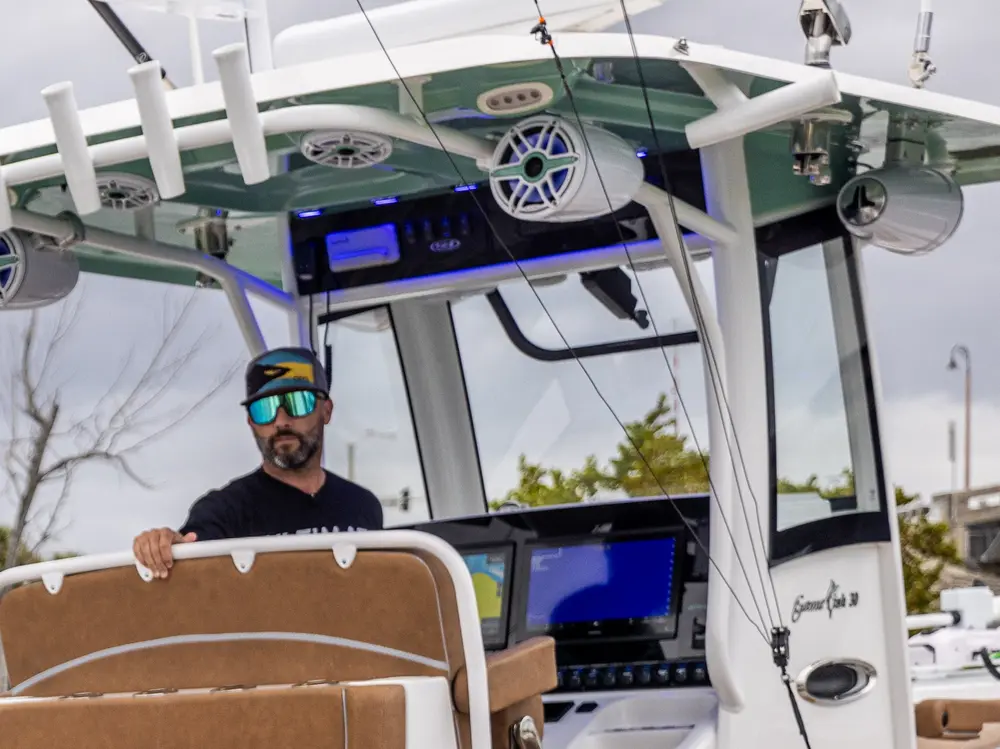
Modern displays are computers, and most of their problems are power or software, not broken hardware. Sea Hunt's manual notes that many electronics makers now provide online or built-in manuals instead of printed ones, so download your unit's manual while you're at the dock with a signal.
- No power at all.Check the unit's fuse, often an in-line fuse on the power lead, then the plug at the back of the display and the breaker on the dash. Make sure the power button isn't stuck.
- Reboots at start-up.A display that restarts when you turn the key is usually seeing a voltage dip. Check battery voltage and look for a loose or corroded connection on its power and ground leads.
- Freezes or acts strangely.Power it down fully, wait, and restart it to clear a software fault.
- Poor GPS fix.The antenna needs a clear view of the sky. A new T-top, a radar dome or a bimini can shade an antenna that worked fine before. Then check the antenna lead and plug.
- Update the software.Install the latest version from the maker (Garmin, Simrad, Raymarine and others) using their instructions.
- Touchscreen won't respond.Clean it with a soft cloth and a screen-safe cleaner; salt film and sunscreen make screens unresponsive. Then restart.
Keep a backup that doesn't depend on any of this. Every Sea Hunt has a Ritchie magnetic compass, which needs calibrating to your boat and location before you rely on it, per the leaflet in the owner's packet. In fog, Sea Hunt's advice is to set a course by GPS or compass and chart, slow down and post lookouts. If lightning builds, get to the dock and shelter ashore; after a nearby strike, have the electronics and compass checked.
How to prevent electrical problems in Florida salt and sun
Corrosion causes most of the problems in this guide. Its favorite hiding places are buss bars, fuse blocks, the backs of switches and bulb sockets. With the battery off, clean anything chalky with contact cleaner and a small brush, then protect it with a corrosion-inhibiting spray. Sea Hunt also recommends covering the compass in storage, because UV clouds it.
Before every trip
Every few months, and before layup
When should you stop and call a marine technician?
Owners can read voltage, clean terminals, swap fuses and bulbs and free a float switch. Book a technician for these:
- A fuse or breaker that trips again after one reset. Repair the circuit before using the boat.
- Charging voltage out of range with the engine running: under 13 or over 14 to 15 volts.
- A battery that won't hold a charge after a full charge and clean terminals.
- A bilge pump that cycles with a dry deck and no rain.
- Anything near the fuel system, or a smell of fuel or hot insulation.
- New accessories that need their own circuit.
Before you call, note the symptom, what you've checked and your readings, and have your hull identification number (HIN) ready; Sea Hunt asks for it on warranty correspondence. If the boat is under Sea Hunt's one-year limited warranty, talk to your dealer before you modify any wiring.
Some fixes need a technician
Tell us the symptom, what you've already checked and your hull number, and we'll take it from there.
Questions we hear
Why won't my boat's bilge pump turn on?
Work through the causes in order. First try the manual switch at the helm: if the pump runs, the float switch is the likely problem. If it doesn't, check the bilge pump fuse or breaker, then battery voltage, then the wiring at the pump. On Sea Hunts, the automatic float switch is wired directly to battery 1, per the owner's manual, so a flat battery 1 stops automatic pumping even if battery 2 is charged. A pump that won't run with good power has likely failed.
Why does my bilge pump keep running?
Usually the float switch is stuck in the up position, held there by debris, or the helm switch has been left on manual. If neither is true, the pump may be doing its job: look for water coming in. Common sources are a loose drain plug, a slipped washdown or livewell hose, or a scupper flap that no longer seals. If the pump keeps cycling with a dry deck and no rain, have a technician find the leak before the boat goes out again.
What should a boat battery read on a multimeter?
With the engines off, 12 to 13 volts DC. Below 11 volts, the battery may not start the engine. If it reads low, charge it and test again; get a load test if it's still under 12.6 volts after charging. With the engine running at no more than 2,500 rpm, look for 13 to 15 volts at the battery. Lithium batteries use different numbers, so follow their maker's guide.
Where can I find a Sea Hunt parts catalog or wiring diagram?
Sea Hunt doesn't publish a public parts catalog. Its owner's manual, posted as a PDF on seahuntboats.com, includes accessory-harness wiring diagrams for several current models, plus the location of fuses, breakers and battery switches. If your diagram isn't included, contact Sea Hunt's factory. For parts, call a Sea Hunt dealer's service department with your hull identification number (HIN), which identifies your exact boat.
Why do my boat's navigation lights not work?
Start with the helm switch: on a Sea Hunt, NAV lights the red and green bow light and the white light aft, and ANC lights only the white light. Then check each light. Replace a failed incandescent bulb or clean a corroded socket; an LED fixture that fails with a good fuse needs replacing. Then check the fuse or breaker. The Coast Guard requires lights from sunset to sunrise and in restricted visibility.
Sources
- Sea Hunt, 2025-26 Owner's Manual (PDF)..
- Yamaha Outboards, Troubleshooting Trifecta..
- U.S. Coast Guard, 33 CFR Part 83 Subpart C, Lights and Shapes..
- U.S. Coast Guard, A Boater's Guide to the Federal Requirements for Recreational Boats..