





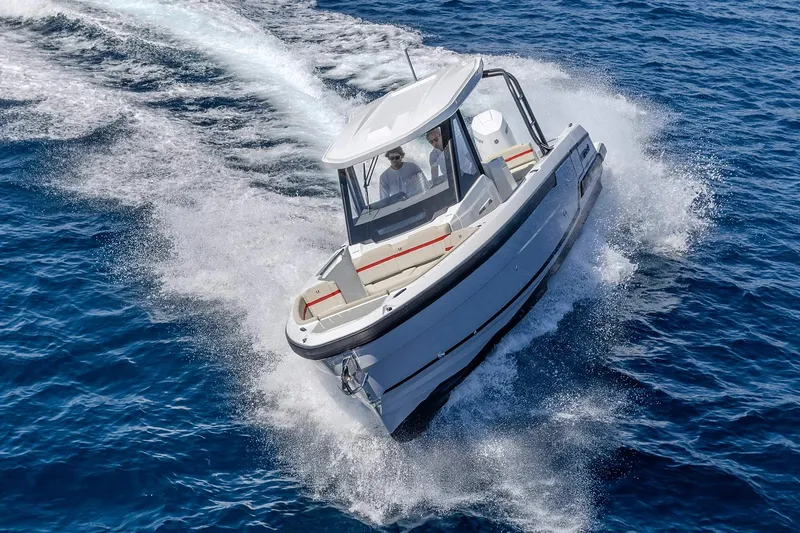

Gamefish 25, 27, 28, 30: which one fits you?
Seven boats on four hulls, from 25′ 8″ to 30′ 2″. Here's what changes as you step up, what the CB and FS layouts trade, and how far offshore each one is built to take you.
In this article
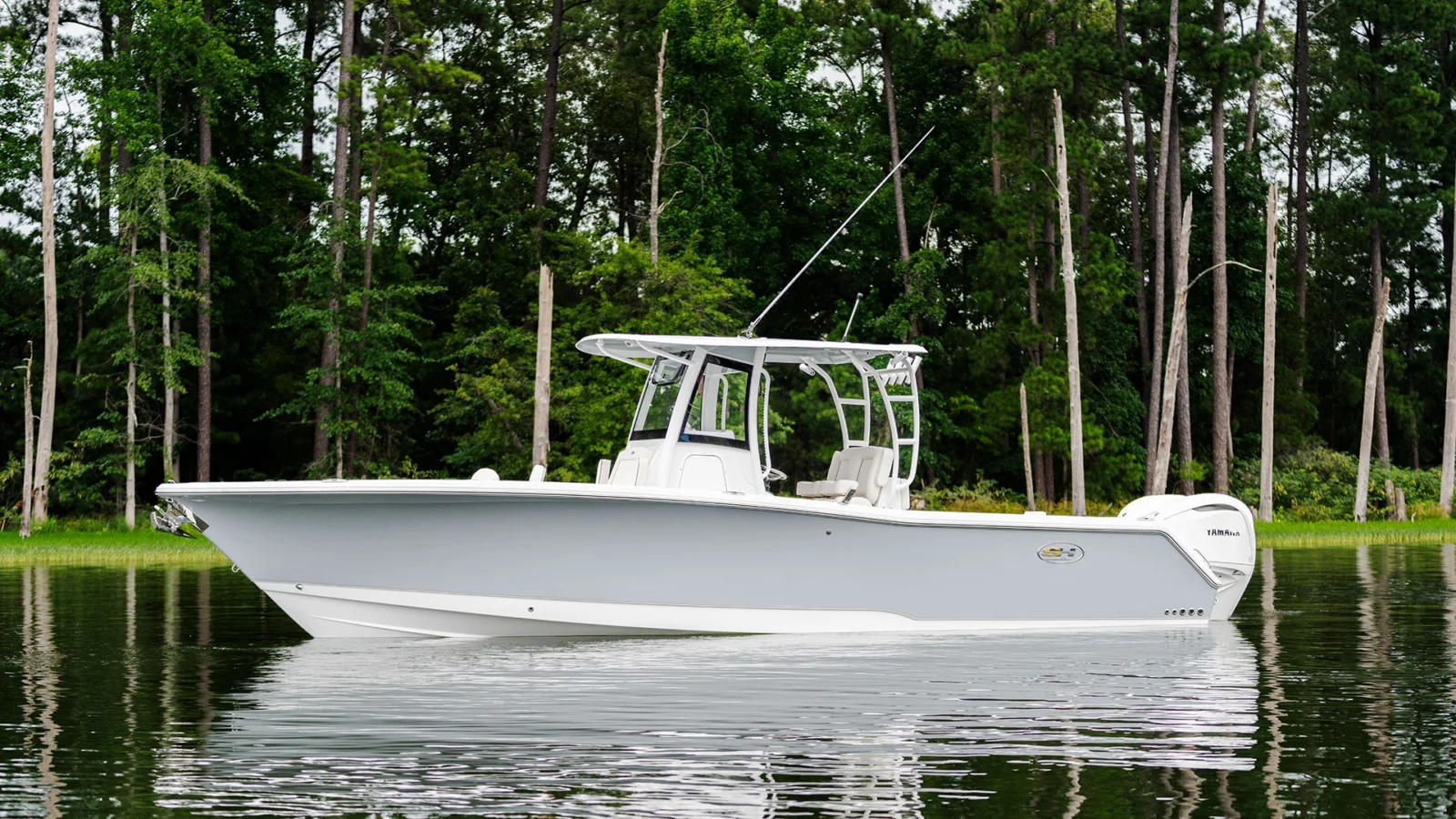
Pick by how far you run and who comes along. The Gamefish 25 is the smallest twin-engine Gamefish, with family seating up front. The 27 adds fuel and a full fishing layout. The 28 comes with twin F300s, dual 17-inch screens and autopilot as standard. The 30 carries the most fuel. On the 27, 28 and 30, choose CB for a bow coffin box and pitch-bait well, or FS for bow seating and a table.
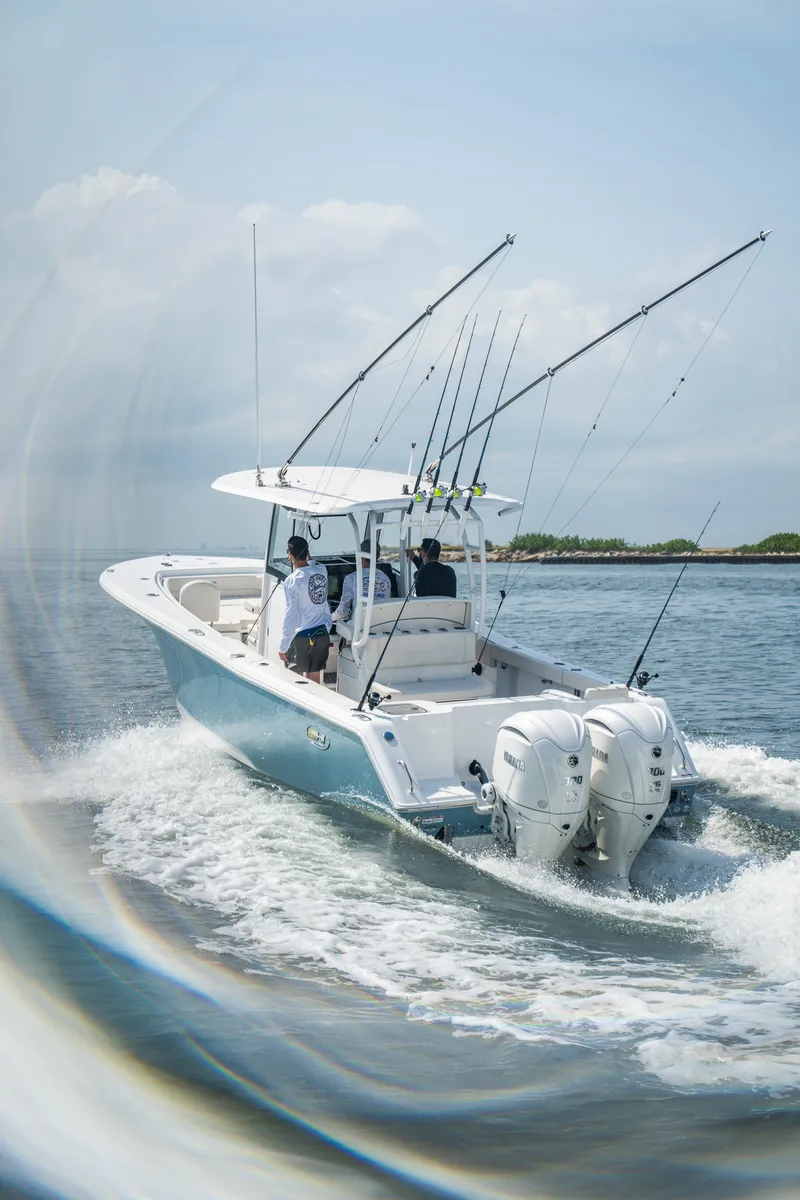
Gamefish is Sea Hunt's offshore fishing series. Every model runs twin Yamaha outboards as standard, and every one is built around livewells and fish boxes before seating. The series covers four hull sizes. The 25 comes in one layout. The 27, 28 and 30 each come as a CB (with a bow coffin box) or an FS (forward seating), so there are seven boats in all. See the Gamefish series.
Every number here comes from Sea Hunt's current model pages. Sea Hunt updates standard equipment each model year, so confirm anything you're counting on with the model page before you buy.
Sea Hunt Gamefish 25, 27, 28 and 30 specs side by side
| Model | Length | Beam | Draft | Dry weight | Standard power | Max hp | Fuel |
|---|---|---|---|---|---|---|---|
| Gamefish 25 | 25′ 8″ | 9′ 2″ | 19″ | 6,100 lb | Twin Yamaha F150 | 400 | 145 gal |
| Gamefish 27 CB / 27 FS | 27′ 6″ | 9′ 6″ | 21″ | 6,600 lb | Twin Yamaha F200 | 500 | 180 gal |
| Gamefish 28 CB / 28 FS | 28′ 6″ | 9′ 9″ | 21″ | 6,800 lb | Twin Yamaha F300 | 600 | 180 gal |
| Gamefish 30 CB / 30 FS | 30′ 2″ | 9′ 9″ | 22″ | 7,000 lb | Twin Yamaha F300 | 700 | 230 gal |
Specs from our model pages, current model year. CB and FS versions of the same size share every number in this table.
Three things stand out once the numbers sit in one place. First, the CB and FS versions of each size are the same hull: same length, beam, draft, weight, power and fuel. Choosing between them is a deck decision, covered in the next section.
Second, look at standard power against the rating. The 25 comes with 300 hp on a 400 hp transom, and Sea Hunt offers twin F200s as an upgrade. The 27 comes with 400 hp on a 500 hp transom, with twin F250s as the option. The 28 is the exception: its standard twin F300s already use its full 600 hp rating. The 30 has 100 hp of headroom, and twin F350s are its power option. If you want more speed or a heavier load at cruise, that option list matters more than the max-hp column.
Third, fuel doesn't climb in a straight line. The 27 and 28 both carry 180 gallons, and the 28 burns it through bigger engines. The real range step is the 30, with 230 gallons. Draft barely moves (19 to 22 inches), so none of these is a flats boat. They're inlet-and-offshore boats from the 25 up.
Gamefish CB vs FS: what the two layouts change
| CB (coffin box) | FS (forward seating) | |
|---|---|---|
| Bow | Coffin box: 256 qt on the 27, 320 qt on the 28 and 30 | Port and starboard bow storage (172 qt each on the 27, 198 qt on the 28 and 30) |
| Bow comfort | Bow bolsters | Bow cushion, backrests and a telescoping table |
| Livewells | 40-gal mezzanine, pitch-bait well (10 gal on the 27, 15 on the 28 and 30), 16-gal transom | 40-gal mezzanine and 16-gal transom; no pitch-bait well |
| Fish boxes | Two 200-qt boxes | Two 200-qt boxes |
Specs from our model pages for each CB and FS model.
The table shows how narrow the gap really is. Both layouts keep the 40-gallon mezzanine livewell behind the helm, the 16-gallon transom well and the two 200-quart fish boxes. What changes is the front third of the boat.
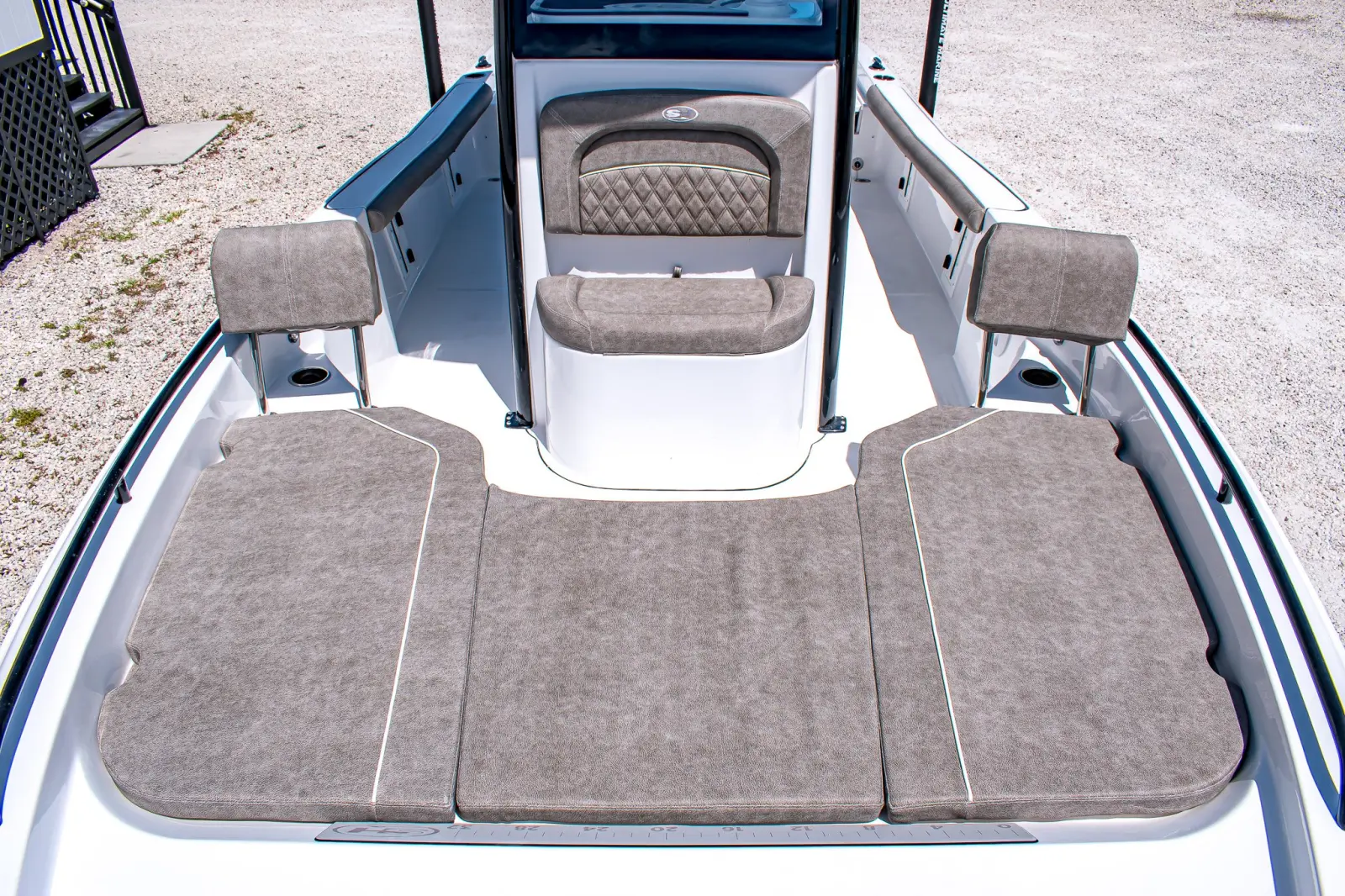
On a CB, the bow is a work area. The coffin box is a long insulated box that runs down the center of the foredeck, big enough for a day's catch of dolphin or a pile of ice and bait. The pitch-bait well keeps a few lively baits apart from the main well, so you can grab one fast when a cobia swims up to the boat without netting through the whole supply. On an FS, that space becomes seating: a cushioned bow with backrests, a table and two big dry-storage lockers.
A simple test settles it. Picture your last ten trips. If guests rode in the bow on most of them, buy the FS; nobody wants to sit on a coffin box lid for an hour. If the bow was mostly a place to stand and cast or stack gear, the CB gives you more fishing for the same hull. Sea Hunt prices and builds them as separate models, so you'll pick at order time rather than convert later.
Gamefish 25: the smallest Gamefish, with family seating
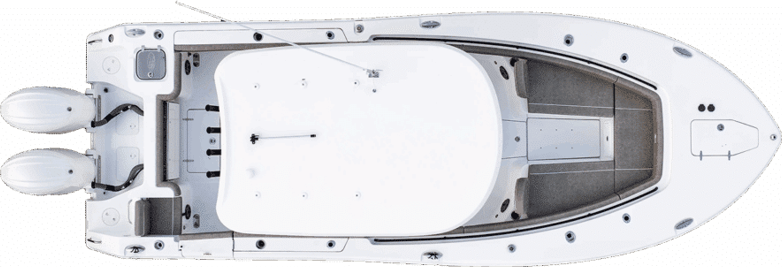
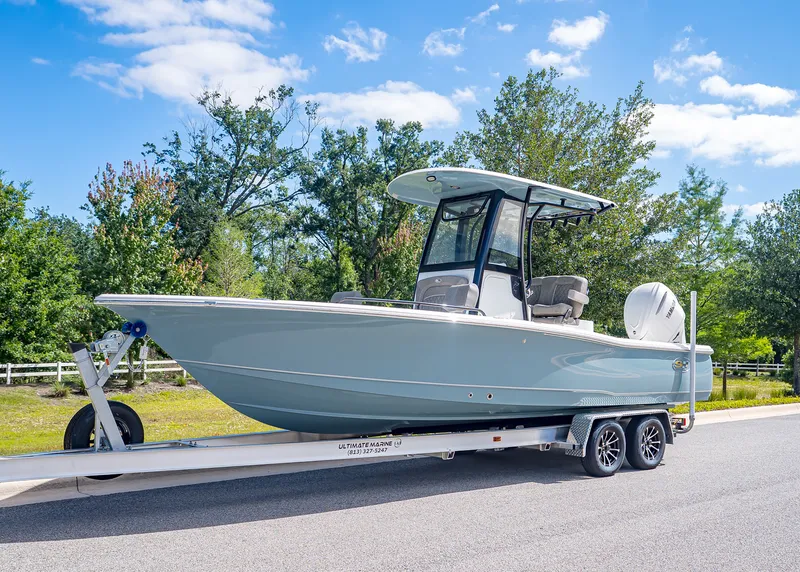
Layout. The 25 is 25′ 8″ long with a 9′ 2″ beam, and it's the only Gamefish with one layout. It mixes the two styles. Behind the helm is a bait-tank leaning post holding a 35-gallon livewell, backed by a 16-gallon transom well and two 200-quart fish boxes. Up front it has what the FS boats have: bow backrests, a bow cushion, a telescoping table and two 148-quart bow lockers, plus 140 quarts of in-floor storage.
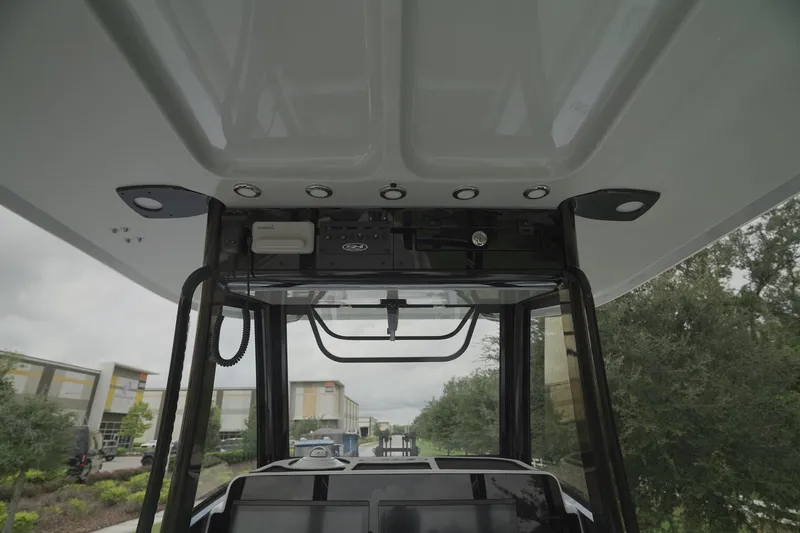
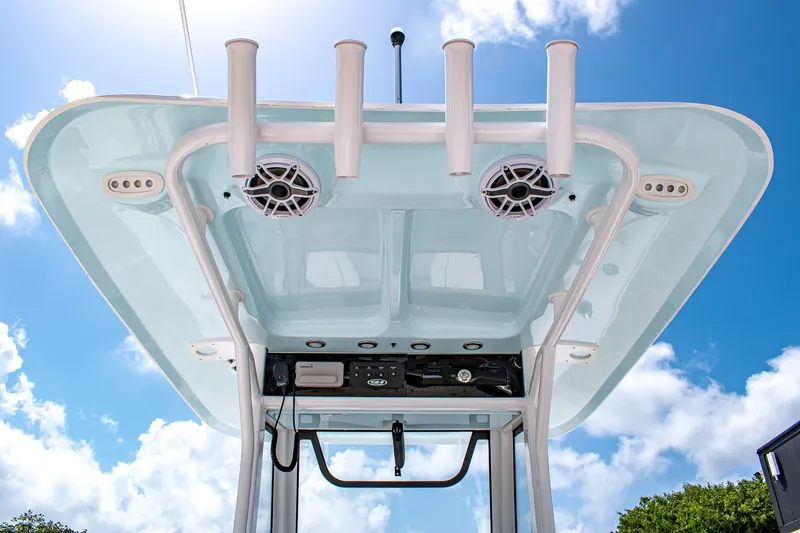
What comes standard. Twin Yamaha F150s with electric steering, a 12-inch Garmin with VHF, Yamaha's CL5 touchscreen, a fiberglass T-top with a mister system, a side entry door, a windlass, a toilet and Bennett trim tabs. Options include twin F200s, a second 12-inch screen, Yamaha autopilot and an outrigger kit.
On Florida water. Twins on a 25-footer change how you can plan a day. With two engines you can idle home on one, so a run to the reefs off Clearwater or the wrecks outside Port Canaveral carries less risk than it would in a single-engine boat. The 145-gallon tank covers most nearshore and mid-range offshore days. It's still the boat in this lineup that wants the most respect for the forecast: at 6,100 pounds dry it has less weight and length to carry through a steep inlet chop than the 28 or 30.
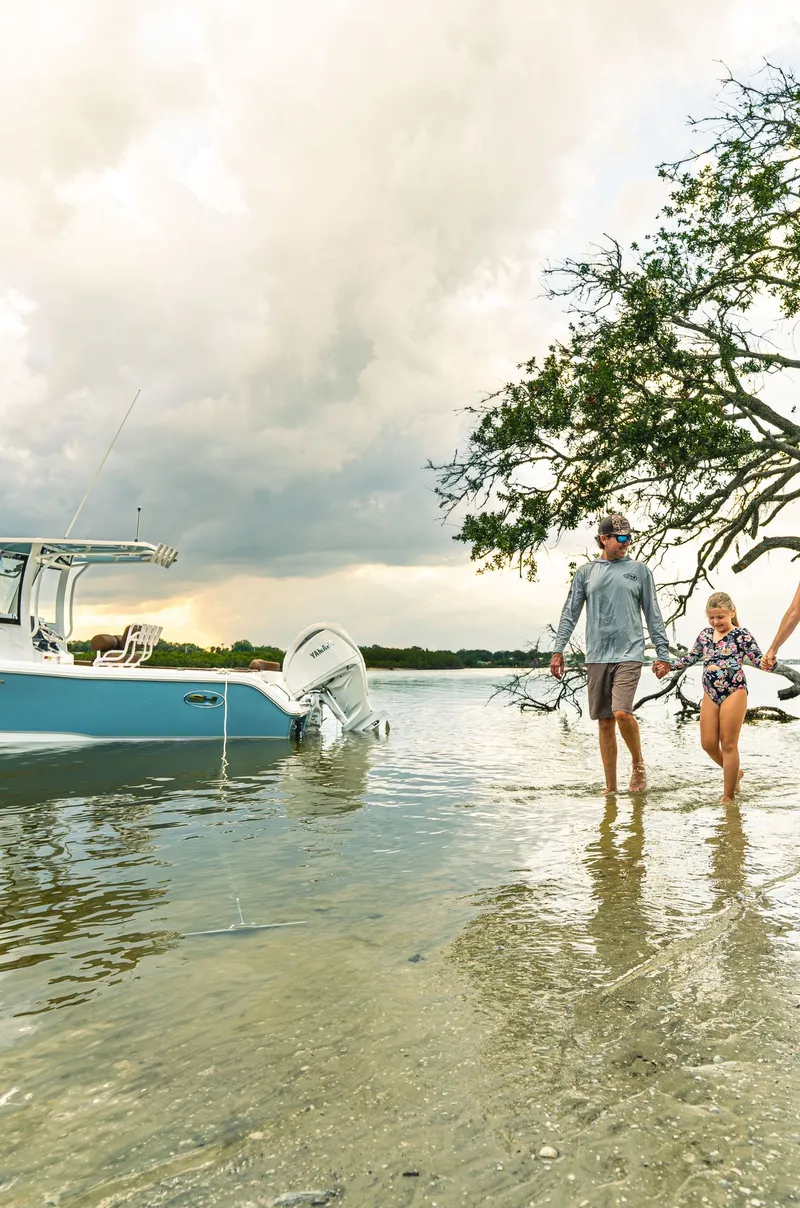
Who it suits. Anglers moving up from a 21- to 23-foot bay boat, and families who fish hard but still want a table at the sandbar. It is not a driveway boat; its beam is over Florida's road-width limit (see the ownership section).
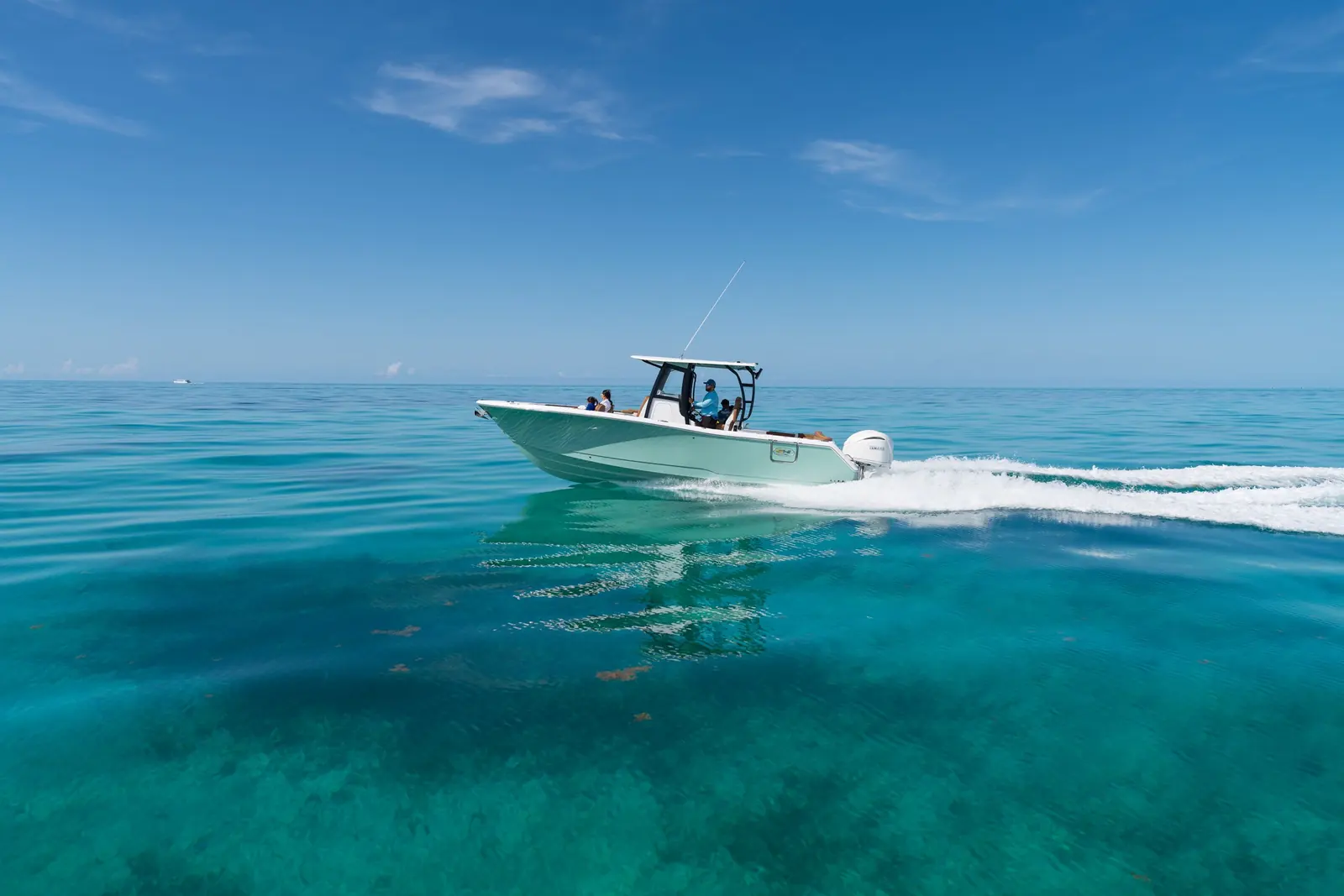
Twin F150s, a 35-gallon bait tank and a family bow in 25′ 8″.
The 27 and up carry 180 gallons or more.
Gamefish 27 CB and 27 FS: the full fishing layout
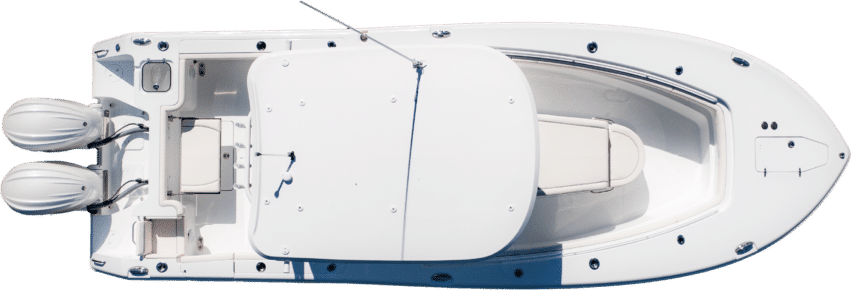
Layout. At 27′ 6″ by 9′ 6″, the 27 is the size most shoppers search for, and the first Gamefish with a mezzanine leaning post. On the 27 CB, that post holds a split 40-gallon livewell, with a 10-gallon pitch-bait well, a 16-gallon transom well, two 200-quart fish boxes and a 256-quart coffin box. The 27 FS keeps the mezzanine and transom wells and the fish boxes, and swaps the coffin box and pitch-bait well for 172-quart bow lockers on each side, a bow cushion with backrests and a telescoping table.
What comes standard. Twin Yamaha F200s on a 500 hp transom, the same 12-inch Garmin, CL5 display, T-top, side door, toilet and windlass as the 25, plus a rear bench seat. The power option is twin F250s, which uses the full rating. Sea Hunt also offers a bait-tank leaning post, dual 12-inch screens and Helm Master with autopilot.
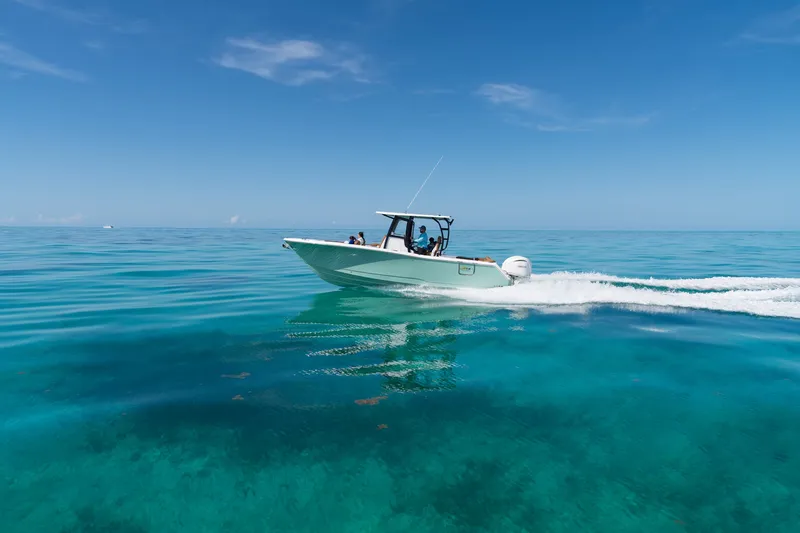
On Florida water. This is where range starts to open up. With 180 gallons, the 27 handles a full day trolling for kingfish and mahi off Ponce Inlet or a run to the ledges out of Port Canaveral with a healthy reserve. The extra 1′ 10″ over the 25 and 500 more pounds of dry weight give it a steadier ride when the sea breeze kicks up a chop on the way back in. Its 21-inch draft means you'll pick your channels in the Indian River on the way to the inlet.
Next to its neighbors. It shares the Ultra 275 SE's hull dimensions and engines, so the 27 FS and the 275 SE are the two to compare if family comfort matters. Step to the 28 for more beam, more power and standard autopilot.
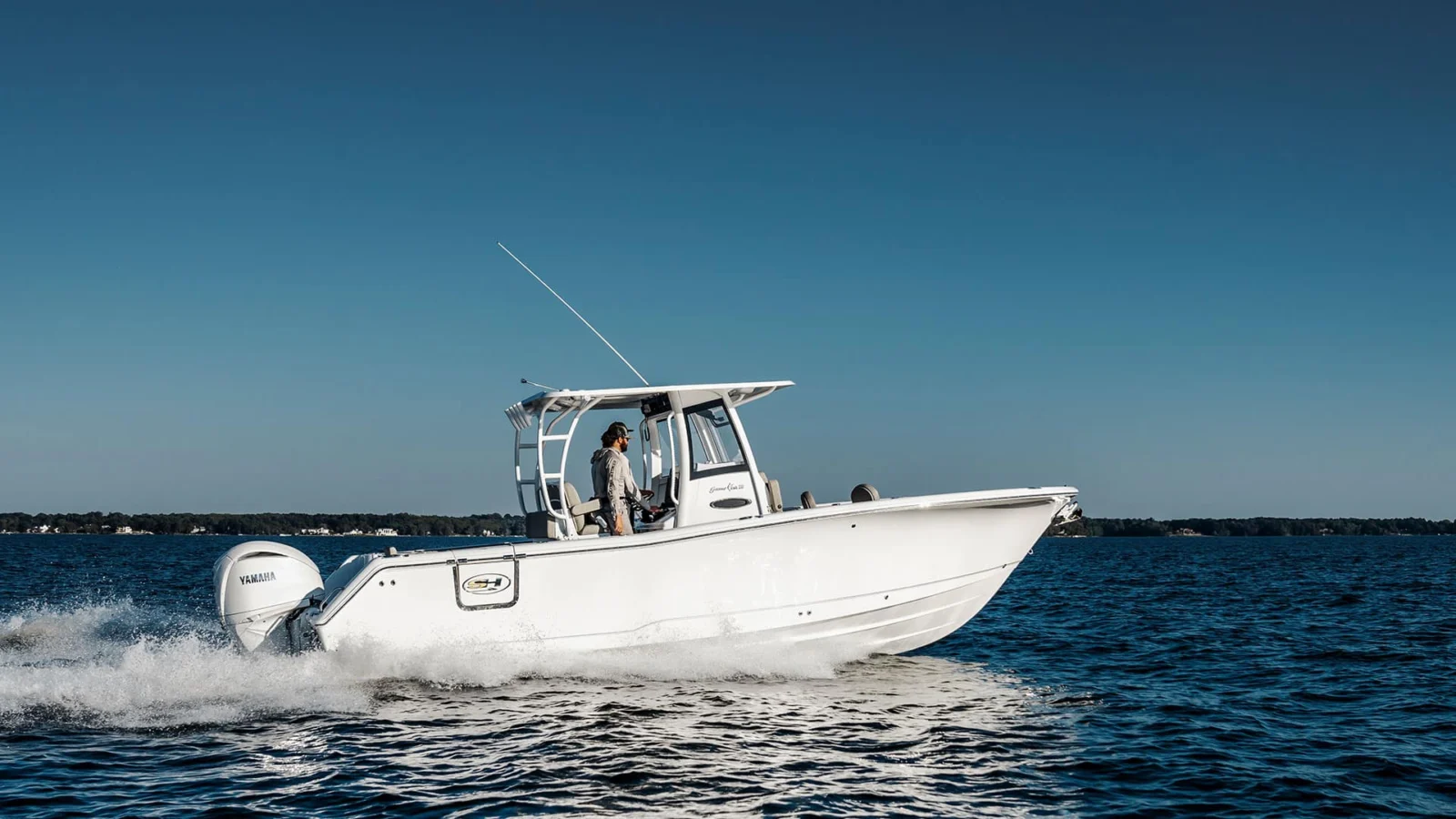
180 gallons, a 40-gallon mezzanine well and twin F200s.
The 30 carries 50 more gallons.
Gamefish 28 CB and 28 FS: more beam and power, with autopilot
Layout. The 28 measures 28′ 6″ with a 9′ 9″ beam. That's three more inches of width than the 27, which you feel as room to move around the leaning post with four anglers aboard. The CB grows its coffin box to 320 quarts and its pitch-bait well to 15 gallons. The FS gets 198-quart bow lockers on each side, 130 quarts of bow floor storage, bow cushions, a backrest and a table.
What comes standard. This is the biggest jump in standard equipment in the lineup. Twin Yamaha F300s, dual 17-inch Garmin displays with VHF and Yamaha autopilot are standard on the 28, where the 27 offers a single 12-inch screen and lists autopilot as an option. The leaning post becomes fiberglass, and a battle-station leaning post is an option.
On Florida water. Autopilot sounds like a luxury until the ride home. After eight hours offshore, letting the boat hold a heading frees the captain to watch the water ahead, the weather and the crew. Two 17-inch screens let you run the chart on one and the sonar on the other while you mark bottom. The catch is fuel. The 28 carries the same 180 gallons as the 27 but feeds 600 hp instead of 400, so at the same speed it won't stretch further, and running it harder shortens your range.
Next to its neighbors. If you'd add autopilot and a second screen to a 27 anyway, price the 28 next to it. If range is the goal, skip to the 30.
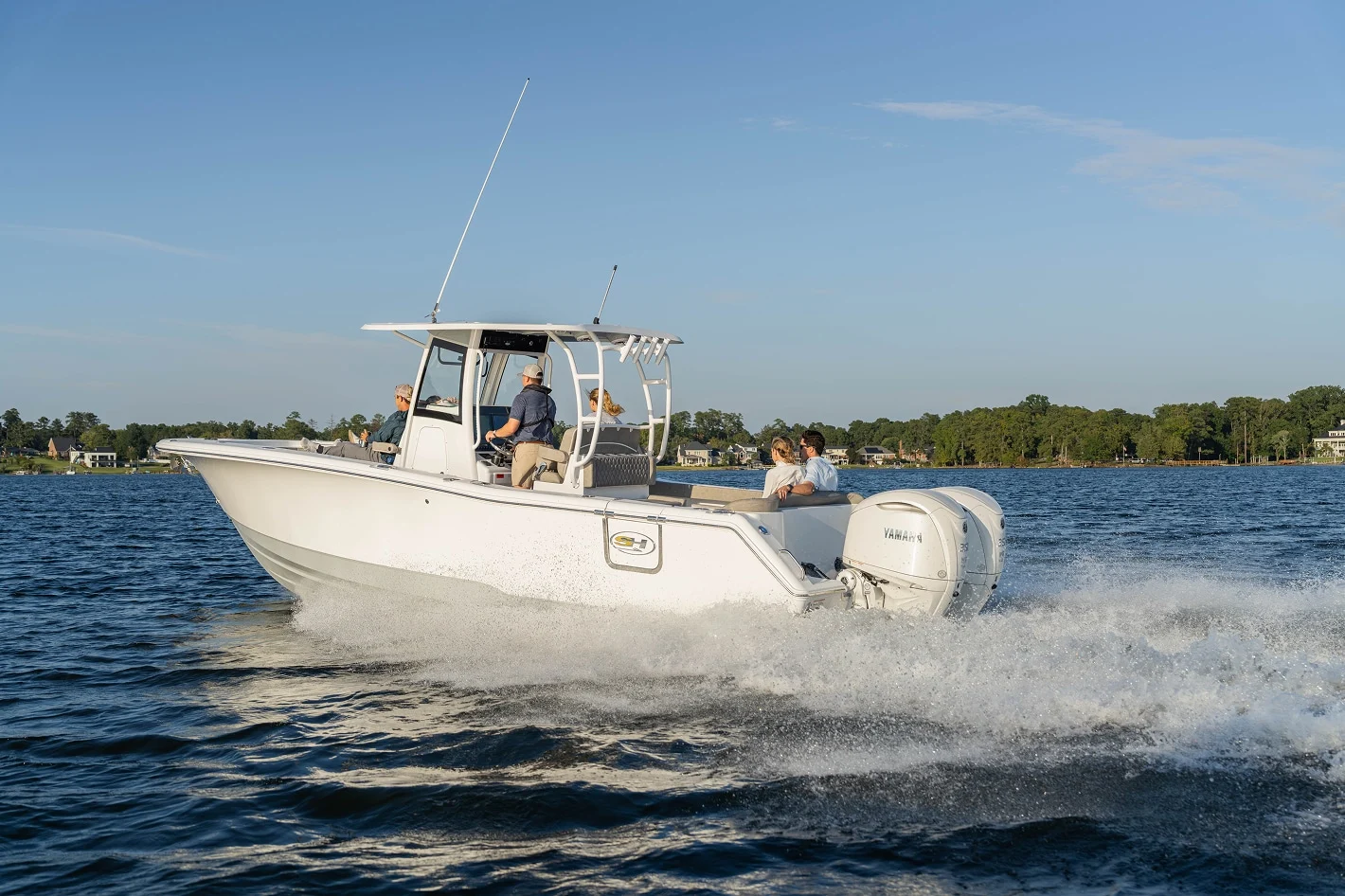
9′ 9″ of beam, twin F300s, dual 17-inch screens and autopilot.
Same 180-gallon tank as the 27.
Gamefish 30 CB and 30 FS: the most fuel in the series
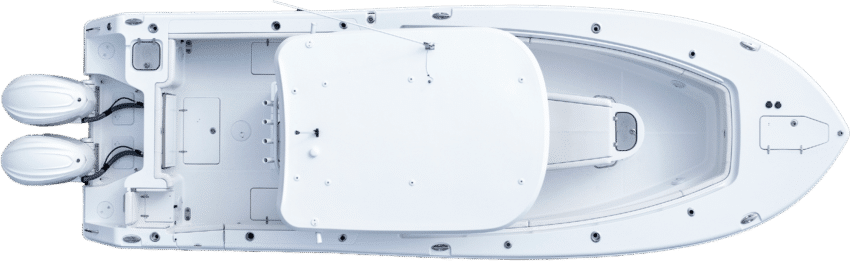
Layout. The 30 is 30′ 2″ long on the same 9′ 9″ beam as the 28. The CB keeps the 28's fishing layout: 40-gallon mezzanine well, 15-gallon pitch-bait well, 16-gallon transom well, 320-quart coffin box and two 200-quart floor fish boxes. The 30 FS has 198-quart bow lockers on each side, 140 quarts of in-floor storage, bow backrests and a table. The extra length goes mostly into cockpit.
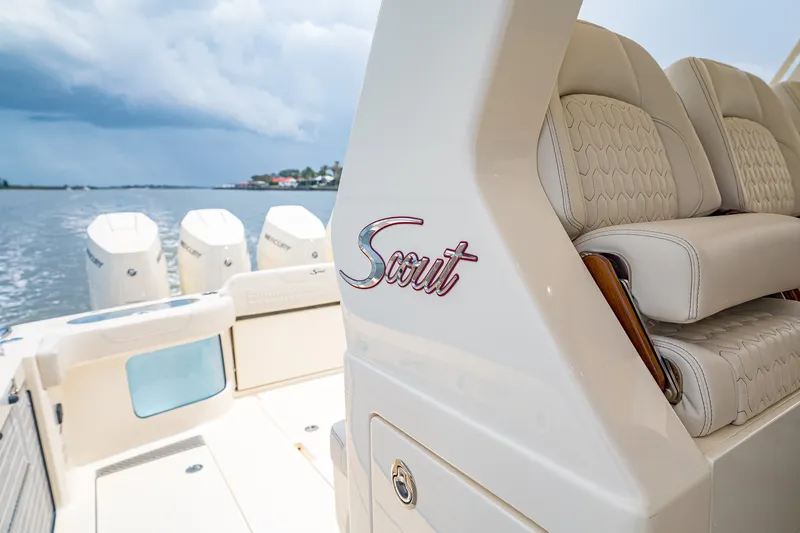
What comes standard. Twin F300s, dual 17-inch Garmins and Yamaha autopilot, matching the 28. The options list is where the 30 pulls away: twin F350s, a Seakeeper package with a matching mezzanine leaning post, and Helm Master with SetPoint. Seakeeper's gyro stabilizers are built to cut a boat's roll, which matters when you're drifting or bottom fishing in a beam swell rather than running.
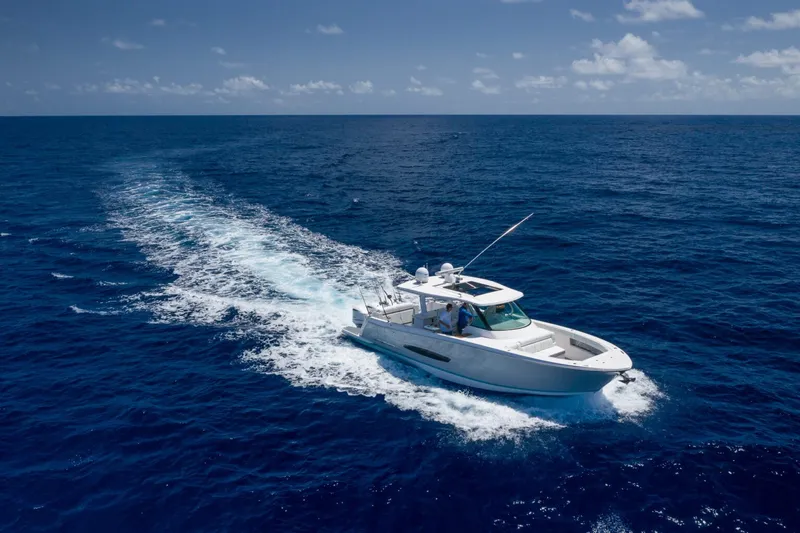
On Florida water. The 230-gallon tank is the reason to buy it. Plan fuel by thirds: one third out, one third back, one third in reserve. Fifty more gallons stretches every third, which counts on Gulf trips out of Tampa Bay, where the shelf is wide and deep water is a long ride, and on Keys days when you run to the humps and still want margin for a detour around a storm. Size brings homework: at 7,000 pounds dry with a 22-inch draft, confirm that your lift or rack is rated for it before you buy.
Gamefish 28 vs 30
Same beam and standard equipment, easier to store and dock.
230 gallons, 100 hp of headroom and the Seakeeper option.
If you're between the two, the deciding questions are practical: how far is your usual spot, and what will your marina accept? The equipment is the same; the tank and the footprint are not.
What comes standard on every Sea Hunt Gamefish
Standard on all seven Gamefish models
Read that list as the baseline you don't have to add. The T-top mister helps on a July afternoon when shade alone isn't enough. The side entry door lets a swimmer or diver climb in at the side instead of over the gunwale. Trim tabs level the boat when the crew stands on one side. The dual battery switch keeps a starting battery in reserve while the electronics run on the house battery.
The options are where builds differ. Yamaha autopilot is an option on the 25 and 27 and standard on the 28 and 30. Helm Master with SetPoint is an option on every size; its SetPoint modes include FishPoint and DriftPoint, and StayPoint on twin-engine rigs, which hold the boat on a spot or a drift line from the joystick. Outrigger kits, kingfish rod holders, a recirculating livewell and a trolling-motor harness round out the fishing options. Two boats with the same name can be equipped very differently, so compare the option sheet, not just the model.
Gamefish vs Ultra: how to tell which series you need
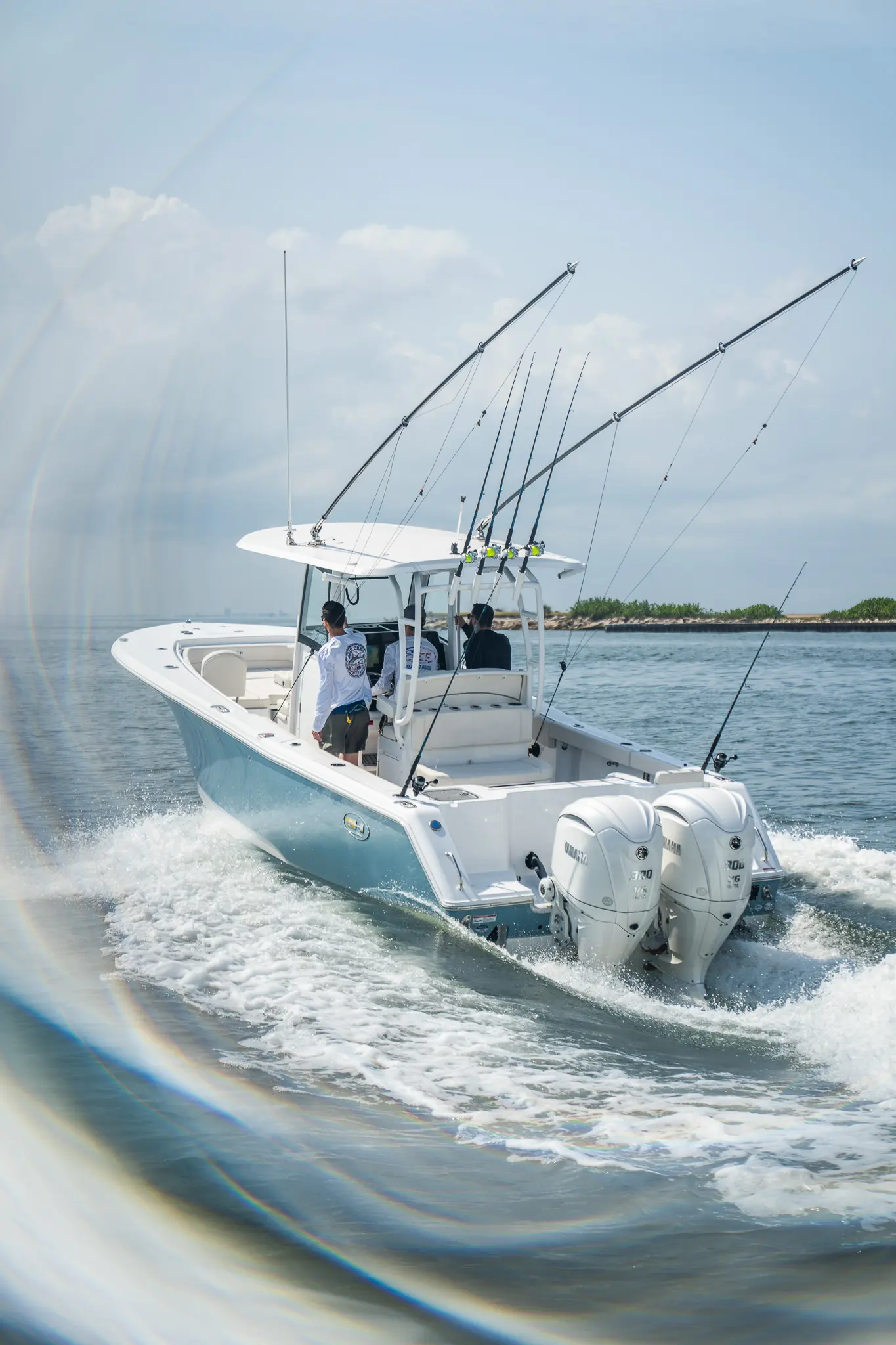
The Gamefish 25 shares the Ultra 265 SE's beam, fuel, power rating and engines, and the Gamefish 27 matches the Ultra 275 SE on length, beam, fuel and engines. On those pairs you're choosing a deck, not a hull. The Gamefish carries the bait: 51 gallons of livewell on the 25 against the 265 SE's 10, and a 40-gallon mezzanine well on the 27 against 30 gallons across two on the 275 SE. The Ultra answers with seating, side doors on both sides and lounge space. Buy for the trip you take most.
Which Gamefish fits where you fish in Florida?
| Where you fish most | What matters | Start with |
|---|---|---|
| Tampa Bay and the Gulf | Long runs across a wide, shallow shelf to deep water | 27 for reefs and wrecks; 30 for regular deep-water trips |
| Atlantic out of Ponce, Port Canaveral or Sebastian | Inlet chop, wind against tide, offshore ledges | 27 or 28 |
| Southeast Florida and the Gulf Stream | The Stream runs closer to shore, but the water gets big | 25 or 27 on good days; 28 for rougher ones |
| Florida Keys reef, humps and deep water | Short reef runs, long runs to the humps, building afternoon seas | 25 or 27 for the reef; 28 or 30 for the humps |
A starting point for a sea trial, not a rule. Specs from our model pages.
Florida offshore fishing splits into a few very different jobs, and the right size follows the job. On the Gulf side, the continental shelf is wide and shallow, so the bottom off Tampa Bay drops slowly. Nearshore reefs and wrecks are within easy reach of a 25 or 27, but true deep water is a long run, and that's where the 30's 230 gallons pays for itself.
On the Atlantic side, the inlet is often the hardest part of the day. When an outgoing tide meets an onshore wind at Ponce or Sebastian, the waves stand up short and steep. More length and weight carry through that more calmly, which is the case for a 27 or 28 if you cross an inlet every trip.
In the Keys, the reef is close and the humps are not, so size the boat for the farthest trip you make regularly, not the closest.
Owning a Gamefish in Florida: storage and service
Where it lives. Every Gamefish is 9′ 2″ to 9′ 9″ wide, which is over the 102-inch limit Florida law sets for towing without a permit. Most owners keep a boat this size on a lift, in a wet slip or at a dry-stack marina. Check that the lift or rack is rated for dry weight plus fuel, at roughly 6 pounds a gallon. Do Sea Hunt boats come with a trailer?
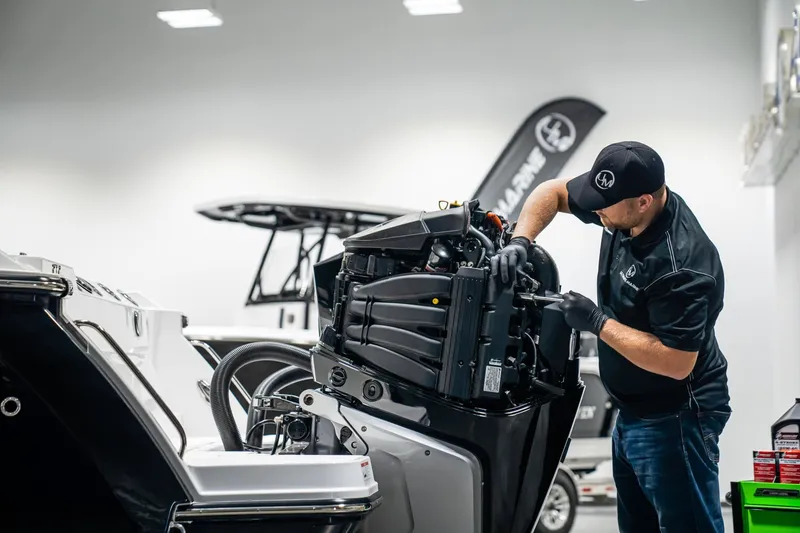
Service and warranty. Two outboards mean two sets of service each season; see the Yamaha maintenance schedule. Sea Hunt backs the hull with a 10-year limited structural warranty, and Yamaha covers the outboards separately. For storm season, keep a hurricane plan.
Tell us where you launch
Tell us your inlet, your usual crew and how far you run. We'll narrow it to one or two Gamefish and the layout that fits.
Questions we hear
How big is the Sea Hunt Gamefish 27?
The Gamefish 27 is 27′ 6″ long with a 9′ 6″ beam and a 21-inch draft. It weighs 6,600 pounds dry, carries 180 gallons of fuel and is rated for 500 hp, with twin Yamaha F200s as standard power. Sea Hunt builds it in two layouts, the 27 CB with a bow coffin box and the 27 FS with forward seating, and both share those numbers.
What is the difference between the Gamefish 27 CB and 27 FS?
They are the same hull with different bows. The 27 CB has a 256-quart coffin box and a 10-gallon pitch-bait well. The 27 FS replaces those with two 172-quart bow lockers, a bow cushion with backrests and a telescoping table. Both keep the 40-gallon mezzanine livewell, the 16-gallon transom well, two 200-quart fish boxes, 180 gallons of fuel and twin F200s. Pick the CB if the bow is for fishing, the FS if guests ride there.
What's the difference between the Sea Hunt Gamefish 27 and 28?
The 28 is a foot longer and three inches wider (9′ 9″ vs 9′ 6″). It comes standard with twin Yamaha F300s, dual 17-inch Garmin displays and Yamaha autopilot, where the 27 has twin F200s, a single 12-inch screen and autopilot as an option. The CB's coffin box grows from 256 to 320 quarts. Both carry 180 gallons, so the 28 doesn't add range.
Does the Sea Hunt Gamefish 25 have twin engines?
Yes. Twin Yamaha F150s are standard on the Gamefish 25, with twin F200s as an option, on a transom rated for 400 hp. Every Gamefish model comes with twin Yamaha outboards. The 25 also carries 145 gallons of fuel, a 35-gallon bait-tank leaning post and family seating with a table in the bow.
What warranty comes with a new Sea Hunt Gamefish?
A new Sea Hunt has a one-year limited warranty on materials and workmanship and a 10-year limited warranty on the hull against structural defects. The hull warranty can transfer to a second owner for the remaining term if a transfer form is filed with Sea Hunt within 15 days. Engines are covered by Yamaha's own warranty. Ask us for the current terms on the boat you're considering.