
Florida boating laws: what every boat owner needs to know
In this article
Florida doesn't issue a boating license. Anyone born in 1988 or later needs an FWC Boating Safety Education ID card and a photo ID to run a boat with 10 hp or more. Most boats must be registered within 30 days of purchase, with numbers on both sides of the bow and the registration certificate aboard. Carry a Coast Guard-approved life jacket for each person plus the gear your boat's length requires, keep kids under 6 in a life jacket while underway on boats under 26 feet, obey posted speed zones, and never run impaired: 0.08 is the limit, 0.02 if you're under 21.
This is a plain-English summary of the rules a new Florida boat owner meets most often. It isn't legal advice. Florida's boating rules change from year to year, so check the agency sources at the end of this article before you rely on a rule. When this page and the agency disagree, the agency wins.
The rules come from chapters 327 (vessel safety) and 328 (titles and registration) of the Florida Statutes, enforced by FWC, plus the Coast Guard's federal equipment and navigation rules. Breaking the federal Navigation Rules is also a violation of Florida law. Counties and cities add local speed zones.
Florida boating laws at a glance
| Rule | What it requires |
|---|---|
| Boater education | Born on or after Jan. 1, 1988: education ID card plus photo ID to run 10 hp or more |
| Registration | Within 30 days of purchase; certificate aboard; numbers on each side of the bow |
| Life jackets | One wearable per person; throwable on boats 16 ft and up; kids under 6 wear one underway on boats under 26 ft |
| Fire extinguisher, signals, sound | Set by boat length and where you run |
| Speed zones | Idle speed and slow speed zones are posted and enforced |
| Alcohol | 0.08 presumed impaired; 0.02 for operators under 21 |
| Engine cut-off switch | Federal: wear the link on plane on most boats under 26 ft |
| Accidents | Report injury, death, a missing person or major damage at once |
Summary only. Check the sources at the end of this article before you rely on a rule.
If you read nothing else, read the first three rows; they're where new owners get caught out. The education card follows the operator, not the boat, so it's about whoever is driving today. Registration is about the boat, and the 30-day clock starts on the purchase date. Life-jacket rules cover everyone aboard. Equipment depends on length, so the gear section below has the table by size.
Do you need a boating license in Florida?
No. Florida doesn't issue a boating license. What it requires is a Boating Safety Education ID card, issued by FWC. Florida law requires anyone born on or after January 1, 1988 who runs a vessel powered by 10 horsepower or more to pass an approved boating safety course and carry the card plus a photo ID. The card doesn't expire, and it isn't a license. There's no minimum age to run a boat in Florida, but age-specific rules such as the personal watercraft limits still apply.
- Pick an approved course.Approved courses that meet Florida's requirement are offered online and in classrooms. Florida also accepts a course equivalency exam.
- Pass and keep your completion certificate.Print it or save the electronic copy. For 90 days after the course, the certificate plus a photo ID counts in place of the card, if it shows your name, date of birth and completion date.
- Get the card.Many course providers send your details to FWC automatically, and the card arrives in about two to three weeks. If yours doesn't, send FWC the certificate with your name, date of birth, address and phone number.
- Carry it with a photo ID.Every time you operate a boat of 10 hp or more.
Florida law exempts: a person licensed by the Coast Guard as a master of a vessel; someone operating on a private lake or pond; an operator accompanied by a person 18 or older who holds the card and is responsible for the boat's safe operation; an operator accompanied by someone who is exempt, on the same terms; a non-resident with proof of a NASBLA-approved course or equivalency exam from another state; and someone running a boat within 90 days of buying it, with a bill of sale meeting s. 328.46(1) aboard. FWC's temporary course completion certificate is valid for up to 90 days from the day you complete the course and pass the exam, and it isn't a permanent replacement for the ID card.
The accompanied-operator exemption is the one families use most: a teenager can learn to drive with a card-holding parent aboard who is responsible for safe operation. For anyone who'll drive regularly, the course takes a few hours and the card lasts a lifetime.
How do you register and title a boat in Florida?
Every vessel must be registered through your county tax collector's office except non-motorized boats under 16 feet and non-motorized canoes, kayaks, racing shells and rowing sculls of any length. FLHSMV sets the titling rules, and both happen at the same counter. You have 30 days from purchase to register and number a new or used boat. FLHSMV lets you register for one year or two.
Registration checklist
Florida added one more piece at registration. Under state law, owners sign an attestation form at the tax collector confirming the boat carries the required safety equipment, and receive a Florida Freedom Boater decal, placed within 6 inches of the registration decal. You don't bring the boat or the gear to the office; the signature is the attestation. An officer also may not stop or board a boat for the sole purpose of inspecting safety or sanitation equipment, because those are secondary offenses. An officer can still stop a boat for any other lawful reason with probable cause.
Tip: photograph the certificate and keep the original in a sealed bag in the console. Salt air ruins paper fast.
What safety equipment does Florida require on a boat?
The owner and operator are both responsible for carrying, storing, maintaining and using the safety equipment the Coast Guard requires. Most of it scales with length, so start by knowing which class your boat falls in.
| Equipment | Under 16 ft | 16 to under 26 ft | 26 to under 40 ft |
|---|---|---|---|
| Wearable life jacket | One per person | One per person | One per person |
| Throwable (Type IV) | Not required | One | One |
| Fire extinguisher | Needed with a built-in tank or enclosed spaces | One 5-B (B-I) if built-in tank or enclosed spaces | Two 5-B (B-I) or one 20-B (B-II) |
| Visual distress signals | Night signals on coastal waters, sunset to sunrise | Day and night signals on coastal waters, at all times | Same as 16 to 26 ft |
| Sound device | Whistle, horn or bell | Required | Required |
From FWC's equipment pages and boating regulations. Coastal waters include the Atlantic, the Gulf and bays and inlets more than 2 miles wide at the entrance.
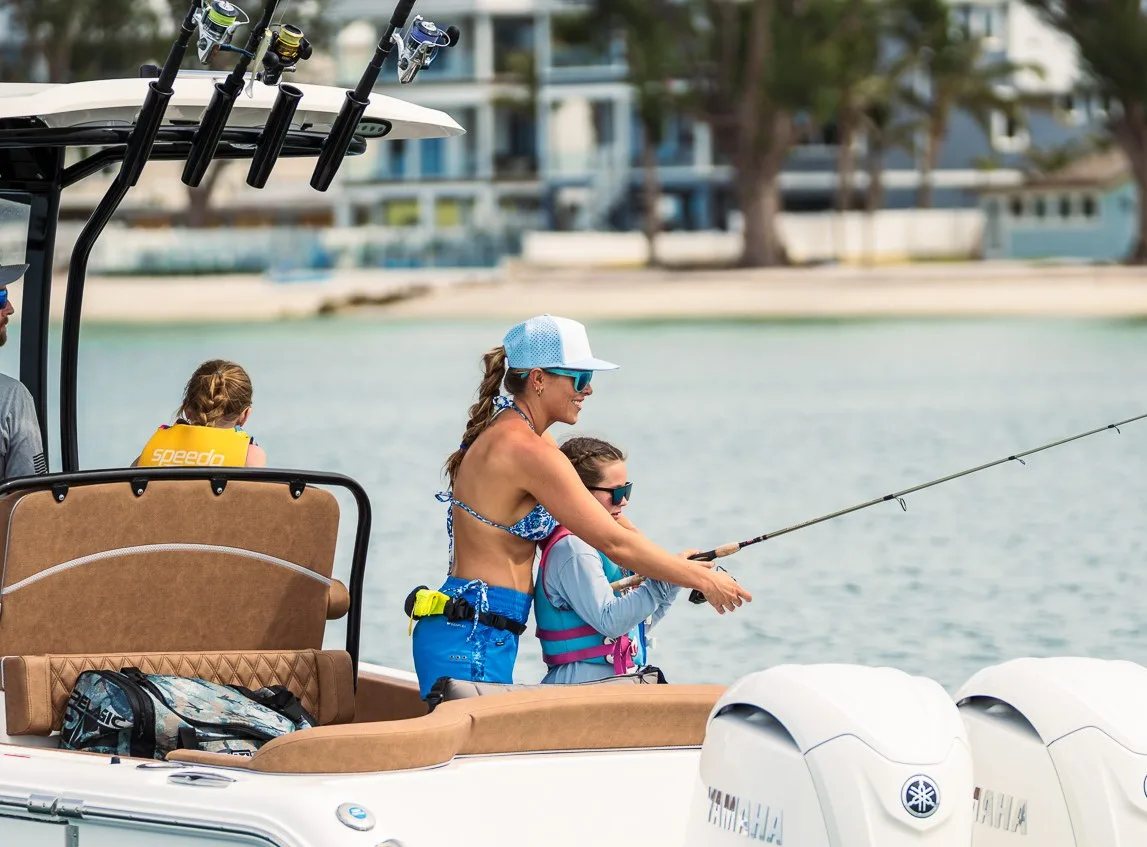
Three rows trip people up. Life jackets must be Coast Guard-approved, the right size for the wearer, in serviceable condition and easy to reach. A pile of adult jackets still in shrink-wrap under the bow hatch doesn't meet the rule for a 40-pound child. Children under 6 must wear a Coast Guard-approved life jacket while the boat is underway on any vessel under 26 feet, under Florida Statutes s. 327.50. "Underway" means any time the boat isn't anchored, moored, tied to shore or aground, so drifting a grass flat counts. Fire extinguishers apply to almost every center console and bay boat, because FWC requires one on outboard boats under 26 feet whenever there's a built-in fuel tank or a space where fumes can collect. Check the gauge and the label, since some extinguishers are only approved in their mounting bracket.
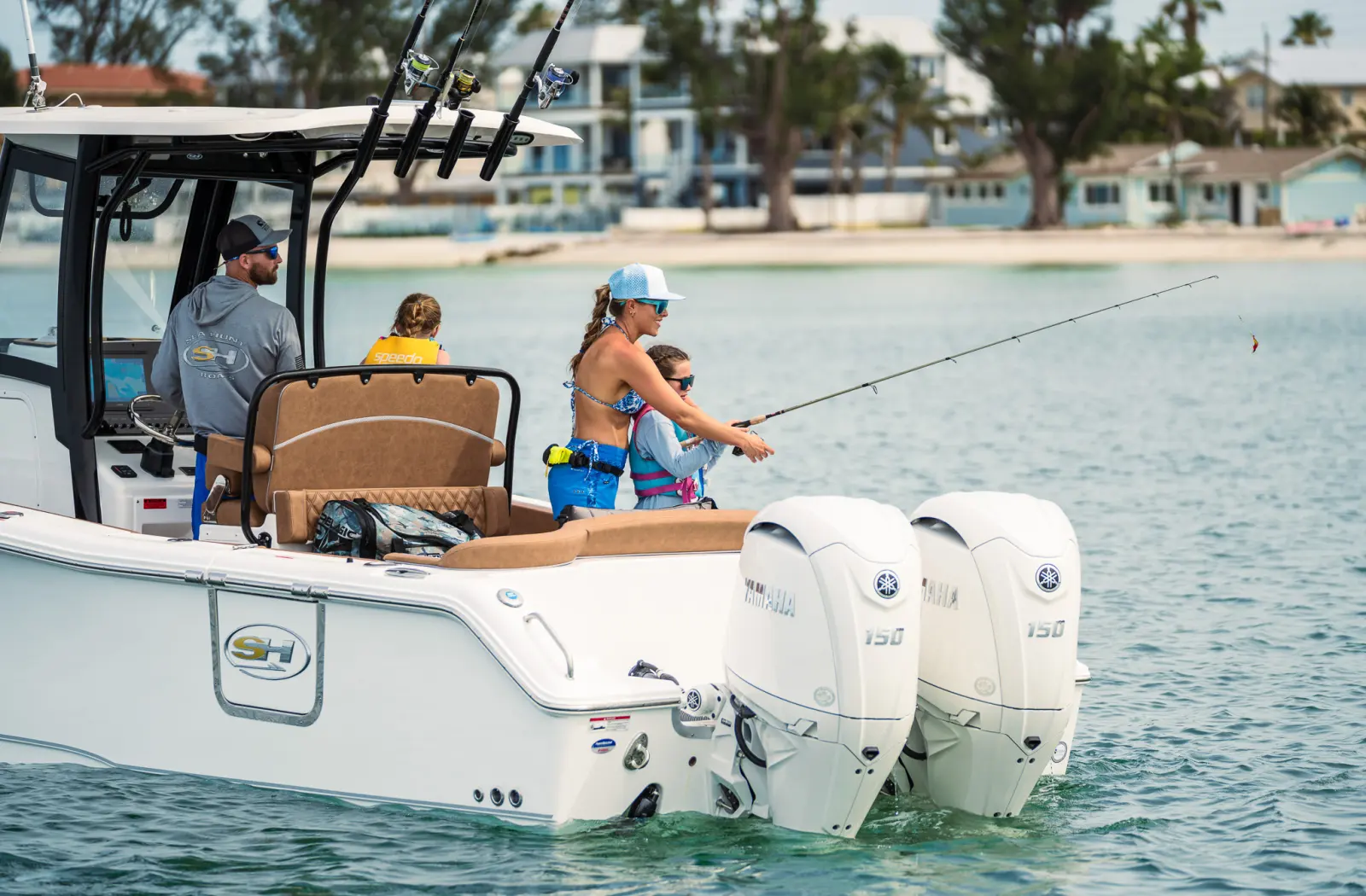
Distress signals depend on where you run. The coastal-waters rule covers the ocean, the Gulf and the wide bays, so a boat that fishes Tampa Bay or runs out of Ponce Inlet needs day and night signals at all times. FWC also recommends an anchor with enough line, a bilge pump or other way to remove water, and a paddle or other backup propulsion, even though they aren't required. Gasoline inboards add ventilation and backfire-flame rules.
Do you have to wear the engine cut-off lanyard?
On most open boats under 26 feet, yes, under federal law. The Coast Guard requires operators of boats under 26 feet with about 3 horsepower or more to use the engine cut-off link when running on plane or above displacement speed, unless the main helm is in an enclosed cabin. Florida has no matching state law, but the federal rule applies on navigable waters. Florida law does require a worn link on a personal watercraft fitted with one and on a boat used to teach a water sport.
Exemptions, wireless links and the boats it covers: the engine cut-off switch law →
What are Florida's speed zone, manatee and seagrass rules?
Florida's speed zones are signed, and Florida law defines the two you'll see most. In an Idle Speed - No Wake zone, you run at the minimum speed that still lets you hold headway and steer. In a Slow Speed, Minimum Wake zone, the boat must be fully off plane and settled in the water, and the wake can't be excessive or create a hazard. Either way, your wake is your responsibility: Florida's careless-operation rule covers running in a way that endangers people or property outside your boat.
Many zones exist for manatees, and some apply only part of the year; the sign gives the months. Manatees are protected by state and federal law, and anything that disrupts a manatee's normal behavior is a violation, punishable under federal law by up to $100,000 in fines, a year in prison or both. FWC urges boaters who accidentally strike a manatee to report it, and says they may not be prosecuted if they were following the posted speed restrictions at the time.
Seagrass is where the lagoon's fish live. Avoid running through seagrass beds, stay in marked channels on unfamiliar water, and skip shortcuts across the flats that leave prop scars. Charts show seagrass as light green or mark it "grs", and damaging seagrass is a violation of Florida law in some areas of state waters. In Mosquito Lagoon or on the Banana River flats, a falling tide turns a familiar shortcut into a scar in minutes.
Two more rules catch boaters around the inlets and reefs. Except in an emergency, you may not tie up to a navigation aid or regulatory marker, which rules out the channel marker at the end of a long drift. And when you see a divers-down flag or buoy, a red field with a white diagonal stripe, Florida law requires a reasonable effort to stay 300 feet away in open water and 100 feet away in rivers, inlets and channels; closer than that, slow to idle speed. In the Keys and off Palm Beach, that comes up every weekend.
What are the BUI laws and penalties in Florida?
It's illegal to operate a boat while impaired by alcohol or drugs. An operator is presumed under the influence at a blood- or breath-alcohol level of 0.08 or more, and anyone under 21 is in violation at 0.02 or more. An operator suspected of BUI must submit to sobriety tests and a physical or chemical test. The law covers whoever is operating or in actual physical control of the boat, which is why the designated driver at the sandbar has to be a real one.
| BUI conviction (s. 327.35) | Fine | Jail |
|---|---|---|
| First | $500 to $1,000 | Up to 6 months |
| Second | $1,000 to $2,000 | Up to 9 months |
| First, with 0.15 or higher or a minor aboard | Same as a second conviction | Same as a second conviction |
Florida Statutes s. 327.35. Additional penalties apply; read the statute for the full schedule.
The fines are only the start. For a first conviction, s. 327.35 also requires up to a year of probation with at least 50 hours of community service, and impoundment or immobilization of the boat or a vehicle registered to you for 10 days. A second conviction within five years brings at least 10 days in jail and 30 days of impoundment. The statute also sets harsher penalties for third convictions and for BUI that causes injury or death, including a mandatory minimum of four years for BUI manslaughter.
What counts as reckless or careless boating, and when must you report an accident?
Florida draws a line between two offenses. Reckless operation is running a boat with willful disregard for the safety of people or property, a first-degree misdemeanor. Careless operation is failing to operate in a reasonable and prudent way given other traffic, posted restrictions, divers-down flags and other conditions, so that people or property outside the boat are put at risk; it's a non-criminal infraction. Weaving through congested traffic on a personal watercraft, jumping another boat's wake too close and swerving at the last moment all count as reckless. It's also unlawful, except in an emergency, to anchor or run a boat so that it unreasonably blocks other boats.
If you're involved in an accident, the duties are specific. The operator must report, by the quickest means possible, any accident involving injury beyond immediate first aid, a death, a person who disappears in circumstances that suggest death or injury, or combined damage to boats and property of at least $2,000. Report to FWC, the county sheriff or the city police chief where it happened. Leaving the scene without giving all possible aid and reporting is unlawful.
Some violations trigger school. FWC requires boater education for anyone convicted of a criminal boating violation, an infraction that caused a reportable accident, or a specified non-criminal infraction within a 12-month period.
The everyday version is the Rules of the Road, which are part of Florida law: know who gives way in a crossing, pass port to port in a narrow channel and slow down early, especially at busy inlets and ramps.
What rules apply to water skiing, tubing and personal watercraft?
Towing a skier or tuber needs an observer besides the driver, or a wide-angle rear-view mirror, and no towing between half an hour after sunset and half an hour before sunrise. Anyone towed wears a non-inflatable Coast Guard-approved life jacket. On a personal watercraft, everyone aboard wears one, the operator attaches the cut-off lanyard, and there's no riding after dark. Riders must be 14 to operate and 18 to rent.
What navigation lights does a Florida boat need?
| Situation | Lights required |
|---|---|
| When | Sunset to sunrise and in reduced visibility (fog, rain, haze) |
| Underway, power boat | Masthead light, red and green sidelights, white sternlight |
| Underway, under 12 m (about 39 ft) | May show one all-round white light plus sidelights instead |
| At anchor | All-round white light visible from every direction |
| Not allowed | Sirens and flashing, occulting or revolving lights, except where the law allows |
Coast Guard Navigation Rules and FWC. Required visibility range depends on boat length.
Switch your lights on and walk around the boat at the dock before any run that could end after sunset. Salt kills bulbs and sockets fast.
What should you check before you leave the dock?
Check the marine forecast for the time you'll be coming home, not just the morning. Before you untie, check the fuel, start the engine, test the bilge pumps and switch on the navigation lights. Then leave a float plan with someone on shore: where you're going, who's aboard and when you'll be back, so they know when to call for help.
Meeting the life jacket rule is the minimum. A life jacket only helps if it fits and someone can get to it fast, so adjust each one until it's snug on its wearer and keep them where everyone can reach them, not locked in a hatch under the gear. How to read a life jacket label explains the sizes and types.
On coastal and offshore trips, carry a VHF radio; it reaches other boats and the Coast Guard where a phone often can't. Keep a phone in a waterproof case as a backup, and for offshore runs add an EPIRB or a satellite messenger that can send your position if everything else fails.
Before you leave, show every passenger where the safety gear is and how to call for help on the radio, and practice a man-overboard pickup on a calm day. If you were born before 1988 and the law doesn't require a boating safety course for you, take one anyway; FWC lists approved courses, online and in classrooms.
What fishing rules apply when you fish from your boat?
Boating laws and fishing laws are separate. Residents and visitors need a Florida saltwater or freshwater fishing license to fish, including catch and release, unless an exemption applies, and the rule is per person: everyone aboard who casts a line. To fish for or harvest certain reef fish such as snapper, grouper and hogfish from a private vessel, you also need the no-cost State Reef Fish Angler designation. Seasons, sizes and bag limits change through the year, so check FWC before each trip.
Current limits: FWC saltwater fishing regulations →
Have our service team check it
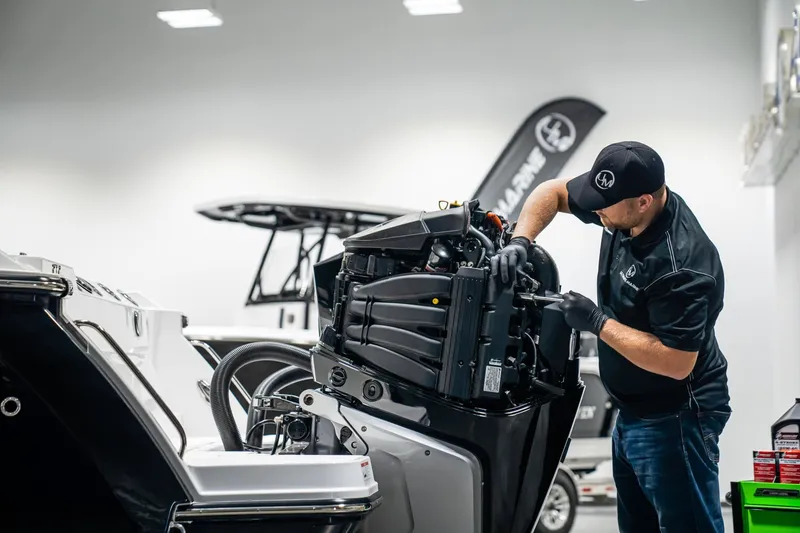
Before the season starts, we can look over the gear, lights and engine so the boat is ready when you are.
Questions we hear
Do you need a license to drive a boat in Florida?
No. Florida doesn't issue a boating license. Anyone born on or after January 1, 1988 who runs a boat of 10 horsepower or more needs an FWC Boating Safety Education ID card and a photo ID. You get the card by passing an approved boating safety course or the equivalency exam, and it never expires. There are exemptions, including operators accompanied by a cardholder 18 or older and new owners within 90 days of purchase with a bill of sale aboard.
What are the boating requirements in Florida?
The basics: an education ID card and photo ID if you were born in 1988 or later, a registered boat with numbers on both sides of the bow and the certificate aboard, a Coast Guard-approved wearable life jacket for each person, and the extinguisher, distress signals and sound device your boat's length requires. Kids under 6 wear a life jacket while underway on boats under 26 feet. Follow posted speed zones and stay under the 0.08 alcohol limit, or 0.02 under 21.
Do kids have to wear life jackets on a boat in Florida?
Children under 6 must wear a Coast Guard-approved life jacket while the boat is underway if it's under 26 feet long, under Florida Statutes s. 327.50. Underway means any time the boat isn't anchored, moored, tied to shore or aground, so drifting counts. Everyone being towed and everyone riding a personal watercraft must wear a non-inflatable life jacket regardless of age. FWC urges everyone aboard to wear one.
How long do you have to register a boat in Florida?
Thirty days from purchase. Register through your county tax collector or license plate agent, put the numbers on both sides of the forward hull in 3-inch block letters, and place the decal within 6 inches of the numbers on the port side. Keep the registration certificate aboard whenever you run the boat. A boat registered in another state can be used in Florida for up to 90 days before it needs a Florida registration.
What is the BUI limit in Florida?
A boat operator is presumed under the influence at a blood- or breath-alcohol level of 0.08 or higher, the same as driving, and anyone under 21 violates the law at 0.02. Under Florida Statutes s. 327.35, a first conviction carries a fine of $500 to $1,000 and up to six months in jail, plus probation, community service and impoundment of the boat or a vehicle for 10 days.
Do I have to wear the kill switch lanyard in Florida?
Under federal law, yes on most open boats under 26 feet. The Coast Guard requires operators of boats under 26 feet with about 3 horsepower or more to use the engine cut-off link when running on plane or above displacement speed, unless the helm is in an enclosed cabin. Florida has no matching state law yet, but the federal rule applies on federally navigable waters. Florida law does require it on personal watercraft fitted with one.
Sources
- FWC, Boating Safety Education ID Cards..
- FLHSMV, Vessel Titling and Registrations..
- FWC, Boating Regulations (current as of July 2025)..
- FWC, Boating Safety Equipment by vessel class..
- FWC, Florida Freedom Boater Decal FAQs..
- U.S. Coast Guard, Engine Cut-Off Switch FAQ. and news release.
- U.S. Coast Guard Navigation Center, Navigation Rules..
- Florida Statutes: s. 327.35, BUI penalties; s. 327.50, life jackets and cut-off switch for water-sport instruction; chapter 328, registration, including the 90-day rule for out-of-state boats in s. 328.58.
- FWC, Do I need a license?.
- FWC, State Reef Fish Survey..