






Get a free vessel safety check
A volunteer examiner checks your boat's safety gear in about half an hour, at your dock or in your driveway. No ticket if something's missing, just a written list of fixes.
In this article
Request a free Vessel Safety Check (VSC) through the Coast Guard Auxiliary's online form. A certified volunteer examiner from the Auxiliary or America's Boating Club (the Power Squadrons) comes to your boat, checks the required safety gear against a 15-item list and explains anything that needs fixing. Pass and you get a decal good through December 31. Don't pass and you get a written report, not a citation. Ultimate Marine does not perform these checks.
- It's free, voluntary and not a law-enforcement boarding. The Auxiliary says no citation is issued if you don't pass.
- The two items that fail most often are easy to check at home: the date on your flares and the date stamped on a disposable fire extinguisher.
- Florida's Freedom Boater decal, issued at registration, is a separate thing from the VSC decal. Getting one doesn't replace the value of the other.
The Vessel Safety Check is one of the few genuinely free things in boating. A trained volunteer walks your boat with a checklist, tells you what's missing or out of date, and answers questions while they're at it. The U.S. Coast Guard recommends every recreational boater, including personal watercraft and paddle craft users, get one every year.
What is a vessel safety check, and who does it?
A Vessel Safety Check is a courtesy inspection of your boat's required safety equipment. Volunteer vessel examiners from the U.S. Coast Guard Auxiliary and from America's Boating Club, the organization formerly known as the United States Power Squadrons, perform it at no cost. The Auxiliary covers personal pleasure craft up to 65 feet, and a check usually takes 15 to 30 minutes depending on the size of the boat.
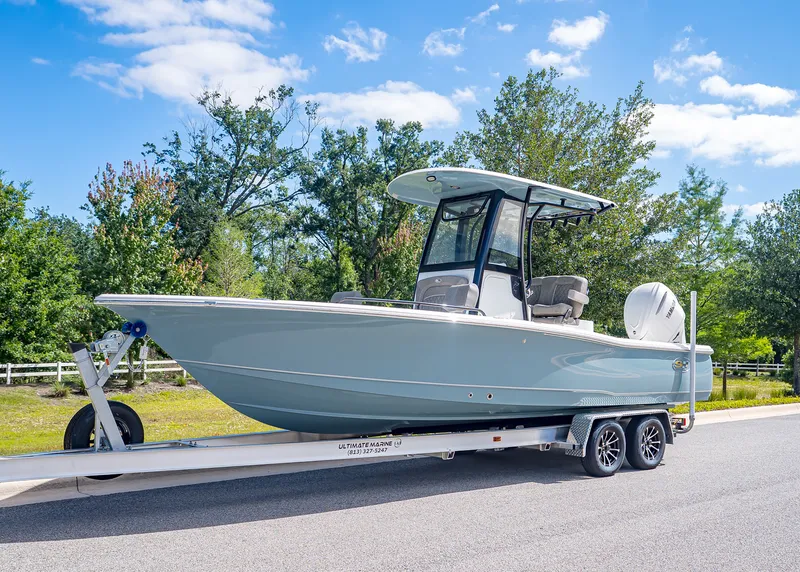
The examiner comes to you: a marina slip, the ramp or your driveway with the boat on its trailer. You may be asked to show your current registration. The examiner works down a standard form, the same one you can download beforehand, and marks each item yes, no or not applicable.
It is not a boarding. The Auxiliary's own checklist says the exam is not an official boarding for law-enforcement purposes, and America's Boating Club says no citations will be or can be given as a result. If something is missing, you get a written report showing how to correct it. The flip side: a VSC decal doesn't exempt you from a law-enforcement stop, and the Auxiliary says the decal is void if you stop maintaining the boat and its gear to the standard you showed that day.
Ultimate Marine doesn't perform vessel safety checks; the decal comes only from the volunteer examiners. A shop can fix what the examiner finds, covered below.
How do you schedule a free vessel safety check?
Booking takes a few minutes online. The Auxiliary's form passes your request to volunteer examiners within 30 miles of your location, and one of them contacts you to set a time.
- Request it.Start at the Auxiliary's VSC page, which links to the short request form. America's Boating Club takes requests too, through its scheduling page.
- Pick a place and time.Agree on a driveway, ramp or marina. Daylight is best, but leave time to switch on the navigation lights.
- Run the checklist first.Download the examiner's checklist and go through it yourself a week ahead.
- Be there for the check.Bring the registration, open every hatch and locker, and plan on 15 to 30 minutes.
- Get the decal or the report.Pass and the decal goes on the boat. Don't pass and you keep a written list of fixes.
Book early in Florida. Volunteers' calendars fill in spring and around National Safe Boating Week in May. A late-winter check leaves time to order a replacement extinguisher or flare kit. In summer, ask for a morning slot, before the afternoon thunderstorms build.
Examiners also set up at ramps and marinas during safe-boating events, a handy way to get checked without booking.
What does the examiner check during a vessel safety check?
The Auxiliary's form lists 15 required items. Not all apply to every boat. Here's what each one means.
| Item | What the examiner looks for |
|---|---|
| Display of numbers | Registration number on both sides of the forward half, block characters at least 3 inches high, contrasting color, with a space or hyphen between letters and numbers. |
| Registration | Registration or documentation papers aboard and available. |
| Life jackets | An approved wearable of suitable size for each person, readily accessible and not in sealed plastic; a throwable on boats 16 feet and up. |
| Visual distress signals | On coastal waters, boats 16 feet and up carry day and night signals that are in date. |
| Fire extinguishers | The right number and rating for the boat, readily accessible and serviceable. |
| Ventilation | Powered ventilation where gasoline engines sit in closed compartments, on boats built after August 1, 1980. |
| Backfire flame control | An approved flame arrester on gasoline inboard and sterndrive engines. |
| Sound-producing device | A whistle or horn capable of a 4-second blast audible for half a mile; a bell too on boats over 39.4 feet. |
| Navigation lights | Working running lights and an all-around anchor light that can be lit on its own, on boats 16 feet and up. |
| Placards | Oily-waste pollution and MARPOL trash placards on boats 26 feet and over, where they apply. |
| Marine sanitation device | Any installed toilet must be an approved device, with overboard discharge able to be sealed. |
| Navigation rules | A current copy aboard on boats 39.4 feet and over. |
| State requirements | The boat must also meet the rules of the state where it's examined. |
| Overall condition | Clean bilge, no fire hazards, sound visible structure, fused wiring, secured and covered batteries, leak-free fuel system, and horsepower within the capacity plate. |
Summarized from the Coast Guard Auxiliary's VSC checklist (form ANSC 7012). Items that don't apply to your boat are marked N/A.
On an outboard center console, ventilation and the flame arrester usually don't apply. Under overall condition, older boats most often lose points on unfused wiring and uncovered battery terminals. If the engine has a cut-off switch, it must work, and the Coast Guard requires operators of boats under 26 feet to use it on plane.
Why do fire extinguishers and flares fail most often?
Both expire on a date printed on the device, and both sit unseen in a locker for years. Check them first.
Fire extinguishers
Since April 20, 2022, the Coast Guard requires a disposable extinguisher to come out of service 12 years after its date of manufacture. Look for the year on the bottom of the bottle or beside the UL label. Boats of model year 2018 and newer need date-stamped 5-B or 20-B units; older boats may still carry B-I or B-II units in good condition. A gauge in the red means replace a disposable or recharge a rechargeable.
| Boat length | 5-B extinguishers required (no fixed system) |
|---|---|
| Under 16 ft | 1 |
| 16 to under 26 ft | 1 |
| 26 to under 40 ft | 2 |
| 40 to 65 ft | 3 |
Coast Guard extinguisher rules. One 20-B may replace two 5-B; one 10-B counts only as one 5-B.
A boat under 26 feet with an outboard, a portable fuel tank and no space where vapor can collect doesn't need one. Most center consoles and bay boats have a permanent tank, so they do. Mount it within the skipper's reach.
Flares and distress signals
On coastal waters (the open sea plus connected bays and inlets with an entrance over 2 nautical miles wide), Florida law requires boats 16 feet or longer to carry three day and three night signals, or three combination signals. A signal past its marked service life doesn't count. The checklist also accepts a non-pyrotechnic option: an orange distress flag for day and an automatic SOS light for night. Check its batteries before the exam.
How do you prepare your boat for the examiner?
Most failed checks are things the owner could have caught in half an hour. Do this the weekend before, with the boat on the trailer or at the dock and the battery switch on.
Driveway prep, the weekend before
The light check is the one people skip, and salt makes it the most likely failure on a Florida boat. Flip each switch at dusk and walk around the boat. If a light stays dark after you clean the contacts, it's usually a wiring or connector job. Test the horn too; salt spray can seize one over a summer.
Life jackets must be approved, serviceable, the right sizes and out of their plastic. If a child moved up a weight class, fix it now. Our guide to reading life jacket labels explains what to look for.
What happens if your boat doesn't pass?
Nothing happens to you. The examiner explains each problem and leaves a written report. There's no fine, no citation and no record sent to law enforcement. Then it's on you to fix the items before you run the boat again, since the gear the examiner checks is required by law.
| What they find | How to fix it |
|---|---|
| Expired flares | Replace with in-date Coast Guard–approved signals, or switch to a day flag and electronic SOS light. |
| Too few life jackets, or wrong sizes | Add approved wearables sized for everyone aboard; add the required throwable if the boat is 16 feet or longer. |
| Expired or discharged extinguisher | Replace a disposable; have a rechargeable serviced and tagged. |
| Navigation lights out | Clean or replace bulbs and contacts; trace corroded connectors or wiring. |
| Horn not working | Check the fuse and connections; replace a seized horn. |
| Uncovered battery terminals, loose wiring | Fit terminal covers, secure the battery, repair damaged wiring. |
Common examples. Follow any fixes your examiner recommends.
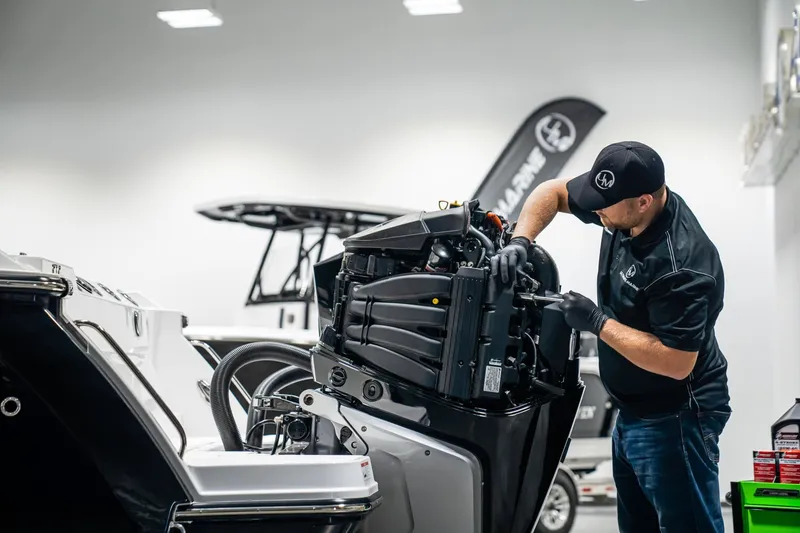
Sort the list into two piles. Gear problems (flares, jackets, extinguishers, a throwable) are a trip to a marine store. Systems problems (lights that stay dark with a new bulb, a dead horn, a bilge pump that won't cycle, cracked or corroded wiring) need someone who can trace a circuit. That's the point to call a technician; our service department can handle that repair.
Once everything's fixed, ask for a re-check to earn the decal, or book again next season, since the decal runs only through December 31. Keep the report with the boat's paperwork.
How is the VSC decal different from Florida's Freedom Boater decal?
- VSC decal. Earned by passing a hands-on check by a volunteer examiner. Void December 31 of the year issued.
- Florida Freedom Boater decal. Issued by the county tax collector when you register or renew, after you sign an attestation that your boat meets Florida's safety equipment requirements. Nobody inspects the boat, and there's no separate fee. It goes within 6 inches of the registration decal.
Florida law says an officer may not stop a boat solely to inspect safety equipment; equipment violations are secondary offenses. An officer who stops you for another reason can still cite missing gear. Signing the attestation is a promise, and a free check is the easiest way to keep it. Some insurers discount boats that pass a VSC, so ask yours.
Questions we hear
Is the Coast Guard vessel safety check really free?
Yes. The Vessel Safety Check is a free, voluntary service run by trained volunteers from the U.S. Coast Guard Auxiliary and America's Boating Club, the former U.S. Power Squadrons. The examiner comes to your boat at a marina, ramp or driveway, works through a standard checklist in about 15 to 30 minutes and answers your questions. There's no fee for the check, the report or the decal. Request one through the Auxiliary's online form, which finds examiners within 30 miles of you.
Can you get a ticket during a vessel safety check?
No. The check is not a law-enforcement boarding, and the Auxiliary and America's Boating Club both say no citation is issued if your boat doesn't pass. Instead, the examiner explains each problem and gives you a written report on how to fix it. The catch is that the equipment checked is required by law, so you should correct the items before you run the boat again. A law-enforcement officer who stops you for another reason can still cite missing gear.
What does the Coast Guard check during a boat safety inspection?
On the Auxiliary's form: registration numbers and papers, life jackets and a throwable, visual distress signals, fire extinguishers, ventilation, backfire flame control, a sound device, navigation lights, pollution and trash placards, a marine toilet if installed, navigation rules on larger boats, state requirements and overall condition. Overall condition covers a clean bilge, fused wiring, covered battery terminals and a leak-free fuel system. Items that don't apply to your boat are marked N/A.
How long is the vessel safety check decal good for?
Through December 31 of the year it's issued. The Auxiliary says all decals and checks are void on that date, and also void if the owner or operator stops maintaining the boat and its equipment to the standard shown during the check. That's why the Coast Guard recommends a check every year. If you sell the boat, the checklist asks you to remove the decal.
Do boat dealers do free safety inspections?
The official Vessel Safety Check and its decal come only from Coast Guard Auxiliary and America's Boating Club examiners, so a dealer can't issue one. Ultimate Marine doesn't perform vessel safety checks. A dealer's service department can help in a different way: by repairing what the examiner finds, such as navigation lights, a dead horn, corroded wiring or a bilge pump that won't run, so the boat passes the next check.
Is the Florida Freedom Boater decal the same as a safety check?
No. The Florida Freedom Boater decal is issued by the county tax collector or plate agent when you register or renew, after you sign an attestation that your boat meets Florida's safety equipment rules. No one inspects the boat. The VSC decal is earned by passing a hands-on check by a volunteer examiner. Having both is reasonable: the check confirms that what you signed for is actually aboard.
Sources
- U.S. Coast Guard Auxiliary, Vessel Safety Check..
- Coast Guard Auxiliary VSC request form..
- Coast Guard Auxiliary, VSC checklist (ANSC 7012)..
- America's Boating Club, Scheduling a Free Vessel Safety Check..
- U.S. Coast Guard, Fire Extinguisher FAQ..
- 33 CFR Part 175, Subpart C, Visual Distress Signals..
- U.S. Coast Guard, Engine Cut-Off Switch FAQ..
- FWC, Boating Regulations..
- FWC, Florida Freedom Boater Decal FAQs..