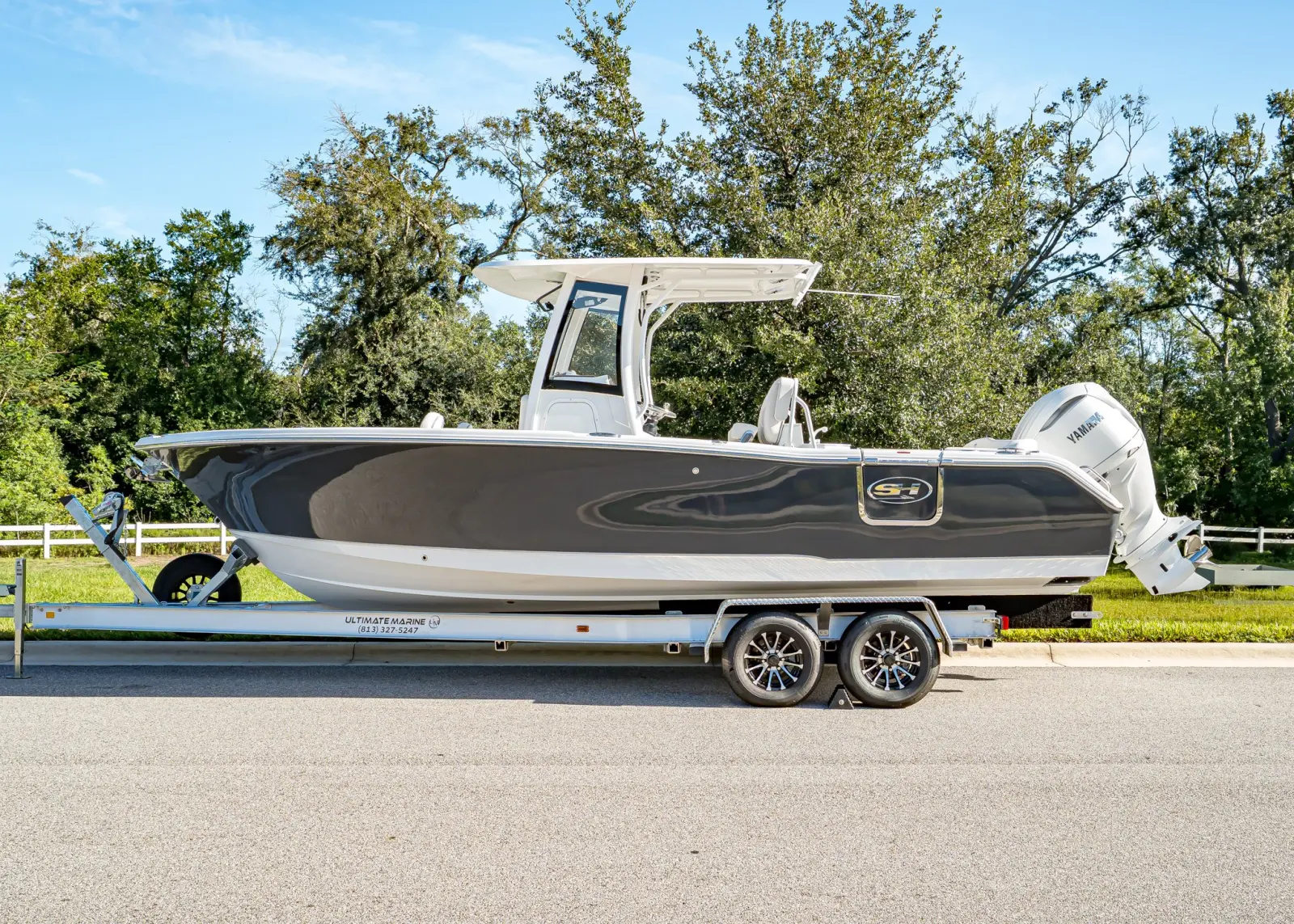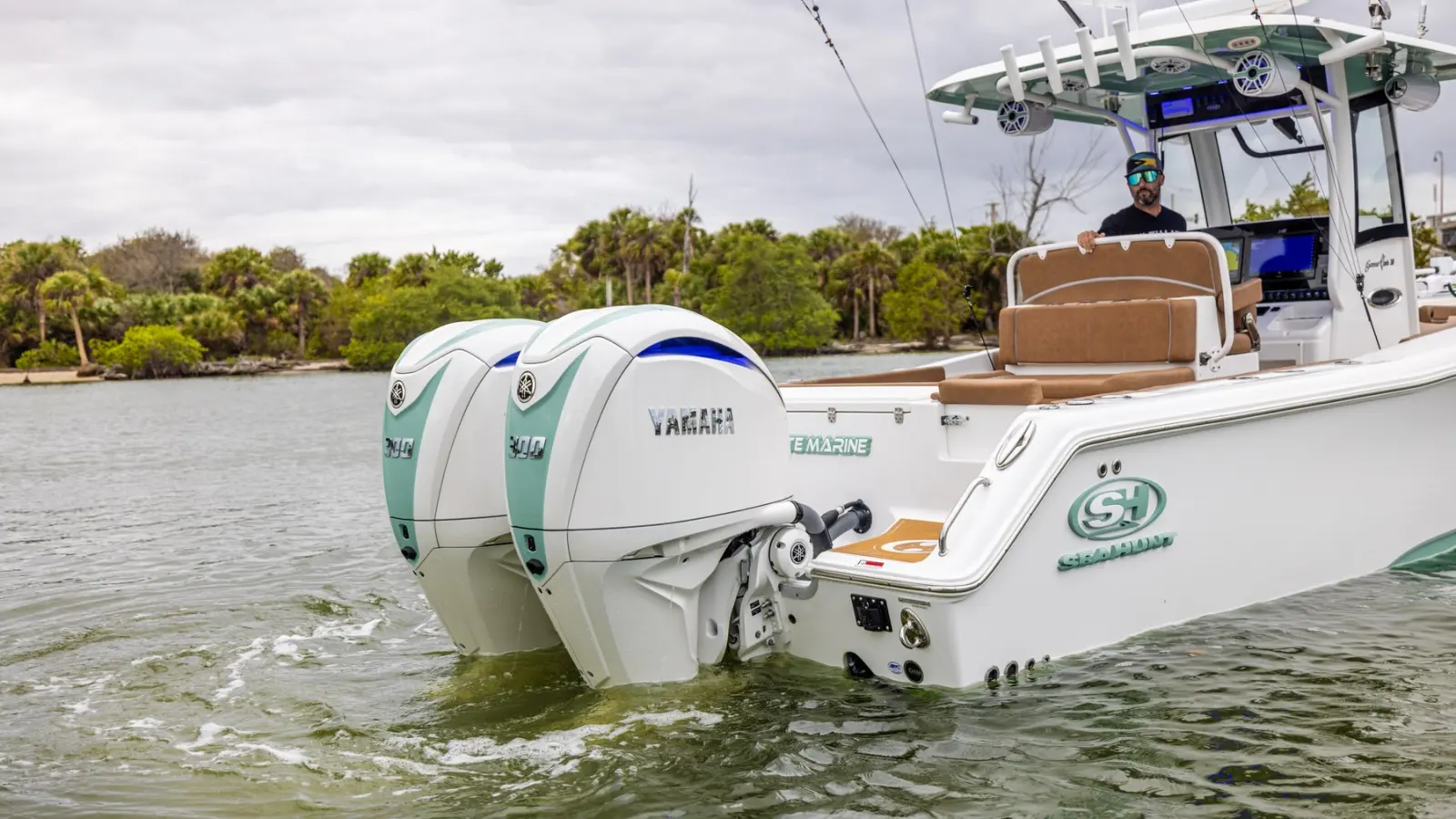



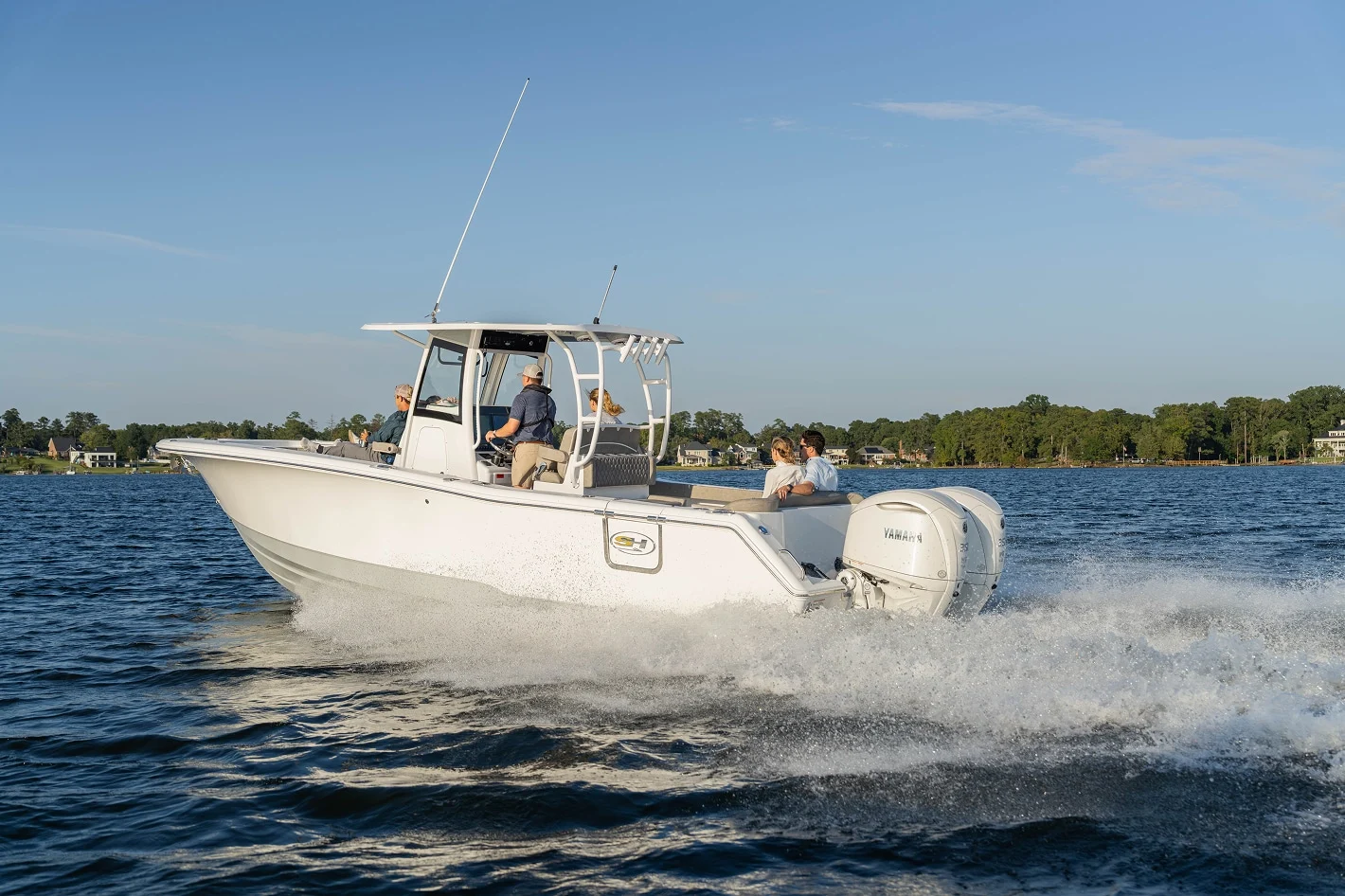
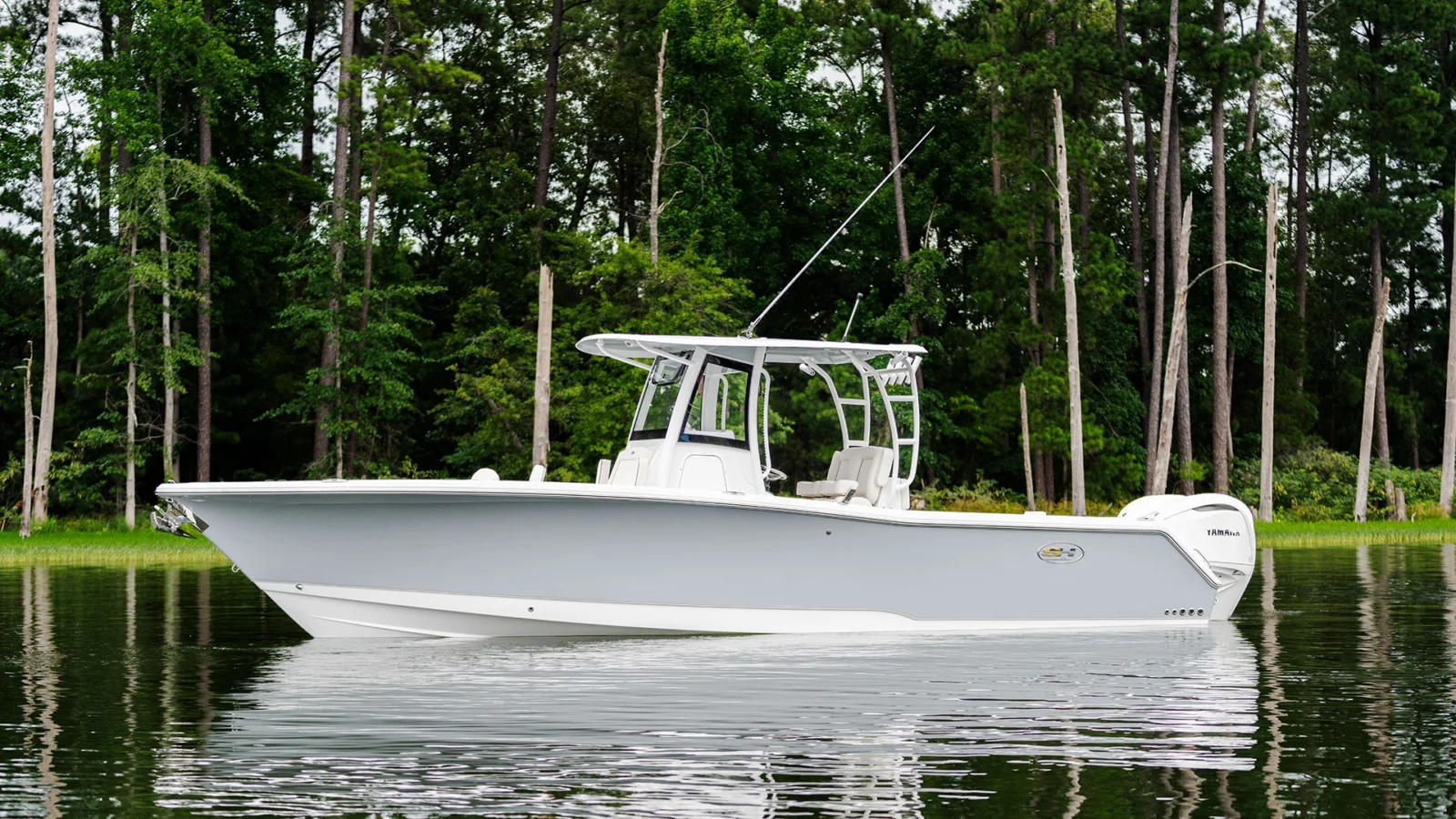




9 Sea Hunt fishing boats, compared
From the 21-foot Ultra 219 to the 30-foot Gamefish 30 CB: how each one is laid out, how it suits Florida water, and how to choose between them.
In this article
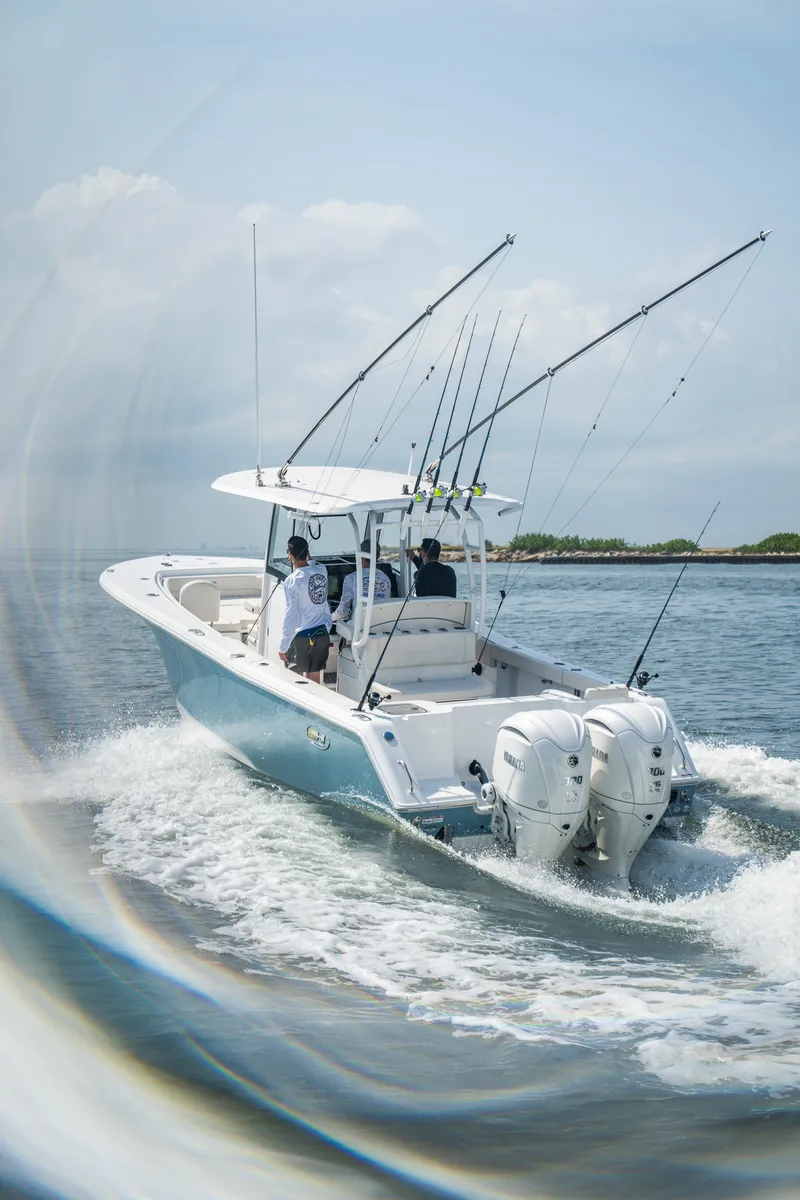
- Fish offshore most weekends? Start with the Gamefish line: 25 to 30 feet, with twin Yamahas standard on all four.
- Fish some days and sandbar on others? The Ultras here run from the 21-foot 219 to the 27-foot 275 SE, with more seating and shade.
- Only the Ultra 219 and 234 have a beam within Florida's 8′ 6″ road-width limit. The other seven need an oversize permit to tow on public roads, so many owners keep them on a lift, in a slip or at a dry stack.
Sea Hunt sells two center console lines that matter to anglers. Gamefish boats give most of the deck to fishing: big livewells, fish boxes and twin outboards on every model. Ultra boats trade some of that for seating, shade and family comfort, and they still carry a livewell and rod storage. This guide covers nine of them, four Gamefish and five Ultras, with the layout of each, how it suits Florida water, and how it differs from the boat next to it in the lineup.
Every spec and standard feature below comes from Sea Hunt's current model pages. Sea Hunt changes standard equipment from year to year, so confirm a feature on the Sea Hunt boats page or the model page before you count on it.
Sea Hunt fishing boats compared: size, power and fuel
| Model | Length | Beam | Draft | Standard power | Max hp | Fuel |
|---|---|---|---|---|---|---|
| Gamefish 25 | 25′ 8″ | 9′ 2″ | 19″ | Twin Yamaha F150 | 400 | 145 gal |
| Gamefish 27 CB | 27′ 6″ | 9′ 6″ | 21″ | Twin Yamaha F200 | 500 | 180 gal |
| Gamefish 28 CB | 28′ 6″ | 9′ 9″ | 21″ | Twin Yamaha F300 | 600 | 180 gal |
| Gamefish 30 CB | 30′ 2″ | 9′ 9″ | 22″ | Twin Yamaha F300 | 700 | 230 gal |
| Ultra 219 | 21′ 4″ | 8′ 3″ | 13″ | Yamaha F150 | 200 | 60 gal |
| Ultra 234 | 23′ 7″ | 8′ 6″ | 13″ | Yamaha F200 | 250 | 96 gal |
| Ultra 255 SE | 24′ 11″ | 8′ 9″ | 14″ | Yamaha F300 | 350 | 120 gal |
| Ultra 265 SE | 26′ 5″ | 9′ 2″ | 21″ | Twin Yamaha F150 | 400 | 145 gal |
| Ultra 275 SE | 27′ 6″ | 9′ 6″ | 21″ | Twin Yamaha F200 | 500 | 180 gal |
Specs from our model pages, current model year. Standard power is the standard engine package; max hp is the total rating for the transom.
Read the table in pairs, because Sea Hunt builds several of these boats to matching dimensions. The Gamefish 25 and Ultra 265 SE share a 9′ 2″ beam, a 400 hp rating, 145 gallons of fuel and twin F150s. The Gamefish 27 CB and Ultra 275 SE match on length, beam, fuel, dry weight and twin F200s. Within each pair, you're choosing a deck layout, not a hull size.
Three columns matter most in Florida. Beam tells you if you can tow the boat on the road without an oversize permit. Draft decides how close you can get to a grass flat or a shallow ramp: the three smallest Ultras draw 13 to 14 inches, while the twin-engine boats draw 19 to 22 inches. Fuel decides how far offshore you can run and still come home with a reserve. Max horsepower matters less than shoppers expect. Eight of the nine come standard below their maximum rating, and the standard package is the one you'll most likely test drive.
Gamefish or Ultra: which Sea Hunt line fits how you fish?
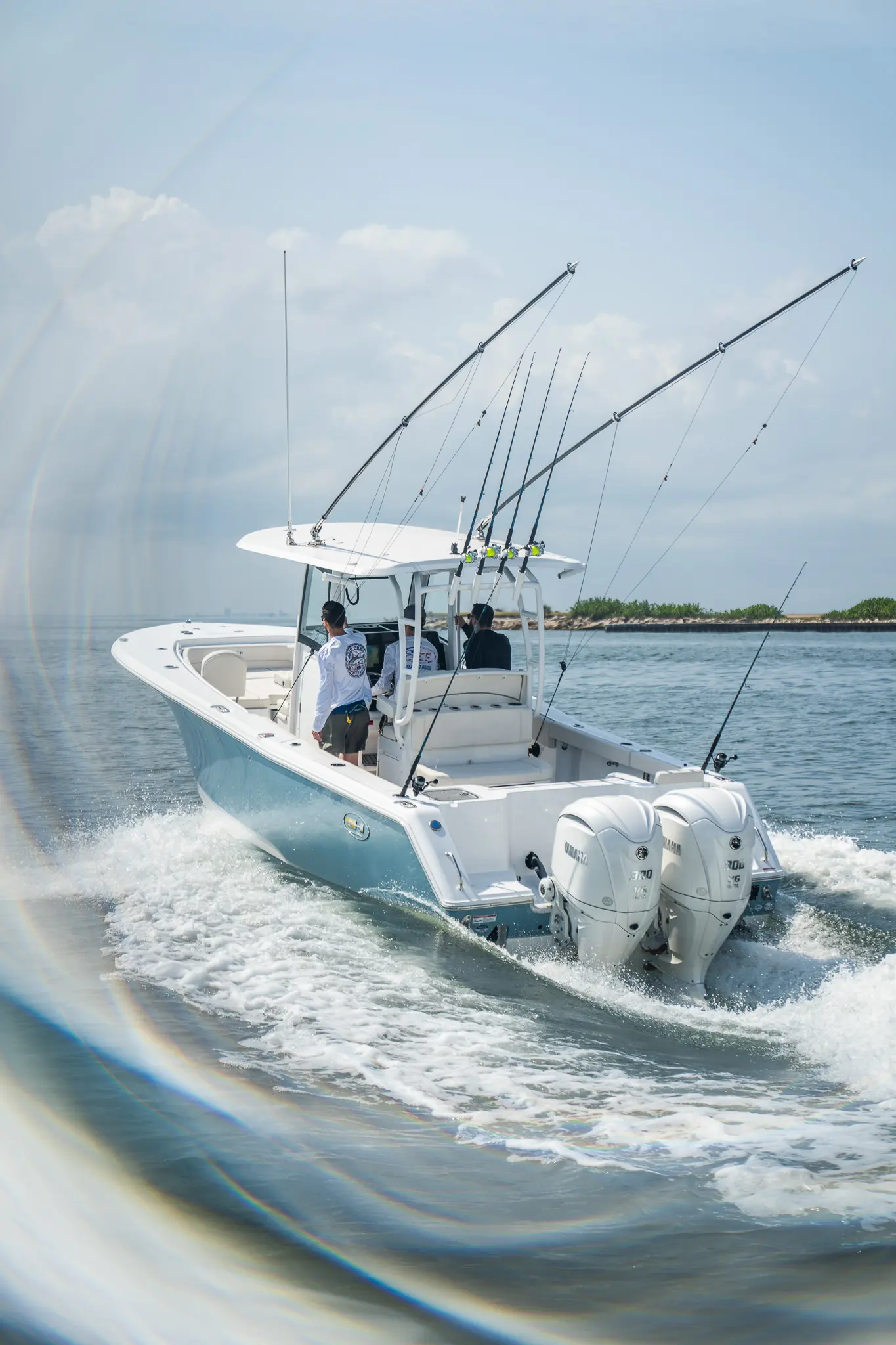
The two lines split on one question: who is the deck for? On the Gamefish 27, 28 and 30 CB, the space behind the helm is built around a mezzanine leaning post with a 40-gallon livewell, and the bow carries a coffin box (256 quarts on the 27, 320 on the 28 and 30) instead of lounge seating. That's a layout for four anglers working baits around the boat and icing fish all day. See the Gamefish line.
The Ultra SE models put more of the boat into people. Bow backrests, dual side entry doors, a 10-gallon livewell and a 40-quart insulated box are standard on the 255, 265 and 275 SE, and the 265 and 275 add a telescoping bow table. The 275 SE also gets a 20-gallon mezzanine livewell. That's enough for a morning of live-bait snook or a couple of hours on a nearshore reef, then lunch at the sandbar. See the Ultra line.
The Gamefish 25 sits between the two. It has a bait-tank leaning post and two 200-quart fish boxes like a fishing boat, plus bow backrests, a bow cushion and a telescoping table like a family boat.
Two examples make the choice clearer. A family of five who sandbar on Saturday and fish on Sunday will use an Ultra's seating on every trip and miss the extra livewell only on the best fishing days. Two friends who chase kingfish and mahi off Port Canaveral every weekend will feel the opposite: the seating sits empty while they wish for more bait capacity. Pick the line that matches the trip you take most often, not the one you take twice a year.
1. Gamefish 25: twin outboards in the smallest Gamefish
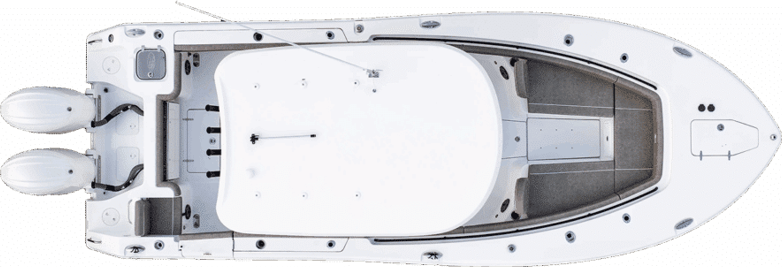
Layout. The Gamefish 25 is 25′ 8″ long with a 9′ 2″ beam. It's built around a bait-tank leaning post with a 35-gallon livewell, backed by a 16-gallon transom livewell and port and starboard fish boxes of 200 quarts. Up front it keeps family seating and a table, which the bigger CB models trade for a coffin box.
What comes standard. Twin Yamaha F150s with electric steering, a 12-inch Garmin with VHF, Yamaha's CL5 touchscreen, a fiberglass T-top with a mister system, a side entry door, a windlass anchor, a toilet, Bennett trim tabs and a 19-gallon freshwater system.
On Florida water. The twins are the point. If one engine quits 15 miles off Sebastian Inlet, you idle home on the other. The 145-gallon tank covers most nearshore and mid-range offshore days with fuel to spare. The hull is not a lagoon boat, though: it draws 19 inches and weighs 6,100 pounds dry, and its beam is over Florida's road-width limit, so towing it needs an oversize permit. Many owners keep a boat this size on a lift, in a slip or at a dry-stack marina instead.
Next to its neighbors. It shares the Ultra 265 SE's beam, power rating, fuel and engines. Choose the 25 for the 35-gallon bait tank and the fish boxes. Choose the 265 SE for side doors on both sides and nine more inches of length.
Twin F150s, a 35-gallon bait tank and family seating up front, in 25′ 8″.
Its 9′ 2″ beam needs an oversize permit on Florida roads.
2. Gamefish 27 CB: the dedicated offshore layout
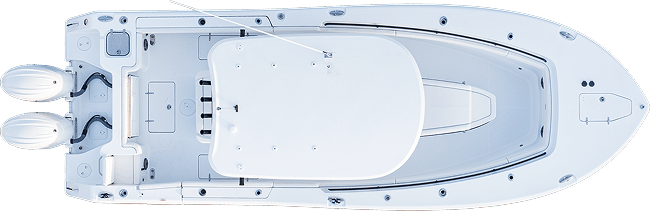
Layout. This is where the Gamefish turns into a dedicated fishing platform. The 27 CB measures 27′ 6″ with a 9′ 6″ beam. Behind the helm, a mezzanine leaning post holds a split 40-gallon livewell, and a 10-gallon pitch-bait well and a 16-gallon transom well add more bait room. Two 200-quart fish boxes sit in the deck, and the bow holds a 256-quart coffin box.
What comes standard. Twin Yamaha F200s sit on a transom rated to 500 hp. The helm electronics, T-top with misters, side door, windlass, toilet and rear bench seat carry over from the 25.
On Florida water. With 180 gallons of fuel, it's sized for long runs: out of Port Canaveral to the offshore ledges, or west from Tampa Bay, where the Gulf deepens slowly and good bottom can be a long ride out. The pitch-bait well is the detail sight-casters notice. A lively bait waits at the rail when a cobia or a mahi swims up to the boat, and nobody has to dig through the main well.
Next to its neighbors. The Ultra 275 SE uses the same length, beam, weight, fuel and engines. The difference is the deck: a coffin box and 66 gallons of combined livewell here, against bow seating, a table and 30 gallons of livewell on the Ultra. Sea Hunt also lists a 27 FS version on the same dimensions.
180 gallons, twin F200s and 66 gallons of livewell across three wells.
The Ultra 275 SE is the same size with a family bow.
3. Gamefish 28 CB: more beam, more power, bigger electronics
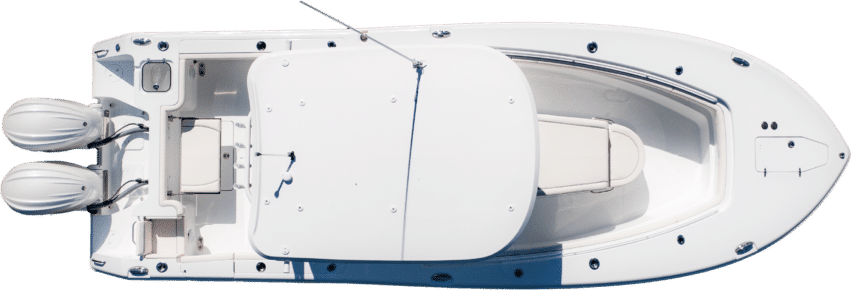
Layout. The 28 CB is 28′ 6″ long and gains three inches of beam over the 27, to 9′ 9″. The fishing layout follows the 27 CB with bigger numbers: a 320-quart coffin box, a 15-gallon pitch-bait well, the 40-gallon mezzanine well, a 16-gallon transom well, and 200-quart fish boxes on each side.
What comes standard. This is the first Gamefish here with twin Yamaha F300s as standard, which is also its 600 hp maximum. Sea Hunt adds dual 17-inch Garmin displays with VHF and a Yamaha autopilot, on top of the T-top, side door, windlass and toilet found on the smaller Gamefish.
On Florida water. Width and weight help most at an inlet. When the afternoon sea breeze blows against an outgoing tide at Ponce Inlet, you get a short, steep chop that slaps a lighter boat around. A wider hull at 6,800 pounds dry carries through it more steadily. The autopilot earns its keep on the run home with a tired crew, freeing the captain to watch the water ahead.
Next to its neighbors. It carries the same 180 gallons as the 27 CB but bigger engines. Running more horsepower harder burns fuel faster, so if range is your priority, the 30 CB's 230 gallons is the real step up. Choose the 28 for the bigger cockpit, the dual-screen electronics and the extra power.
More beam, twin F300s and autopilot standard for long, choppy runs.
Same 180-gallon tank as the 27 CB; the 30 CB carries 230.
4. Gamefish 30 CB: the most range in the lineup
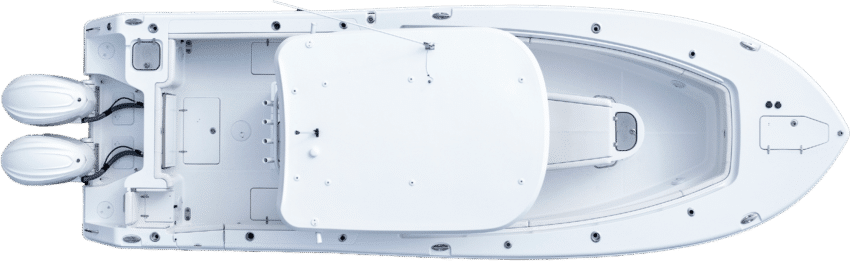
Layout. At 30′ 2″ with a 9′ 9″ beam, the 30 CB is the biggest Gamefish. It keeps the 28's fishing layout on a longer hull: the same three livewells, the 320-quart coffin box and two 200-quart floor fish boxes.
What comes standard. Twin Yamaha F300s again, but on a transom rated to 700 hp, so there's headroom for more power. The dual 17-inch Garmins, autopilot and deck equipment match the 28.
On Florida water. The 230-gallon tank is the headline. Boaters plan fuel by thirds: one third to get out, one third to get back, one third in reserve. A bigger tank stretches each third, which matters on a day trolling deep water off the Atlantic coast or making the long Gulf run. Size brings its own homework. At 7,000 pounds dry with a 22-inch draft, this is a lift, slip or dry-stack boat. Before you buy, confirm that your marina's rack or lift is rated for a 30-footer of that weight.
Next to its neighbors. Pick the 30 over the 28 for range and the extra length of cockpit. Pick the 28 if your slip or rack tops out under 30 feet. If your crew wants seating on the same hull size, Sea Hunt's Ultra 305 SE shares the 30′ 2″ length, 9′ 9″ beam and 230-gallon tank.
230 gallons, twin F300s and the full fishing layout.
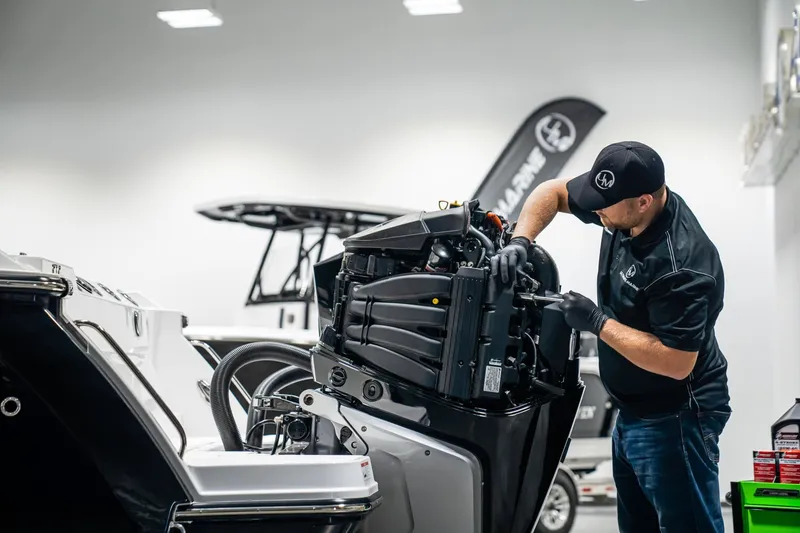
Two big outboards mean more fuel, more service and a bigger slip.
5. Ultra 219: the easy-to-tow bay boat
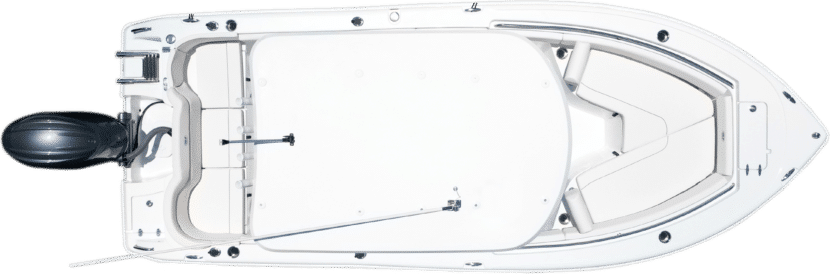
Layout. The Ultra 219 is the entry point to this list: 21′ 4″ long with an 8′ 3″ beam. It's a simple center console with an aluminum leaning post and captain's chairs, a 15-gallon livewell, bow cushions with backrests, and bow storage of 110 and 70 quarts.
What comes standard. A single Yamaha F150 (the boat is rated to 200 hp), hydraulic steering, a 9-inch Garmin with VHF, Yamaha digital gauges and a Bluetooth stereo. A T-top isn't on the standard list, so plan for shade before your first July afternoon on the water.
On Florida water. A 13-inch draft makes it a protected-water boat: the Indian River and Banana River, the edges of Mosquito Lagoon, Tampa Bay on a calm morning, or the Keys' backcountry channels. Its deadrise is 16/20/55, the flattest V in this group. On a glassy lagoon morning that shallow V feels stable when you stand to cast. In a 2-foot sea-breeze chop on open water, it pounds, so you'll slow down and quarter the waves. The 60-gallon tank suits bay days, not offshore runs.
Towing. At 2,350 pounds dry and inside Florida's 8′ 6″ limit, it's the easiest boat here to keep in a driveway. Before you hitch up, compare your vehicle's tow rating with the weight of the loaded rig (boat, engine, fuel, gear and trailer).
Next to its neighbors. The 234 adds two feet, 36 gallons of fuel and a sharper V, and it stays within the road-width limit.
Easy to tow and launch, with a livewell and a 13-inch draft.
Step up to a 255 SE or a Gamefish for open water.
6. Ultra 234: open deck room for three or four anglers
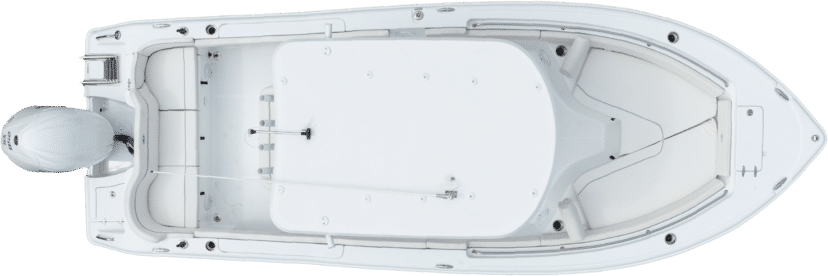
Layout. The 234 is 23′ 7″ long with an 8′ 6″ beam. Its equipment list mirrors the 219 (aluminum leaning post, 15-gallon livewell, bow cushions and backrests), but the extra length goes into open deck and storage, with 140 and 92 quarts in the bow.
What comes standard. A Yamaha F200 on a transom rated to 250 hp, with the 219's hydraulic steering, Garmin and stereo. Like the 219, it has no T-top on the standard list.
On Florida water. This is the plain, uncluttered fishing boat of the Ultra line, with room for three or four anglers to cast without crossing lines. With an 18/22/55 deadrise and 96 gallons of fuel, it handles Tampa Bay or the nearshore Atlantic on a fair day better than the 219, and it still draws 13 inches for the lagoon. At 2,800 pounds dry and exactly 8′ 6″ wide, it sits at the upper edge of what you can tow at home without a permit. Measure the whole rig, trailer fenders included, before you assume it's legal.
Next to its neighbors. Sea Hunt also builds the Ultra 229 at 22′ 8″ and the Ultra 235 SE on the 234's length and beam, at 3,800 pounds dry. Choose the 234 when deck space and simplicity matter more than lounge seating. Choose the 255 SE when you want a T-top, a toilet and more fuel as standard.
A simple, open 23-footer you can still tow on Florida roads.
The SE models add a T-top, more seating and a toilet.
7. Ultra 255 SE: family comfort on a single engine
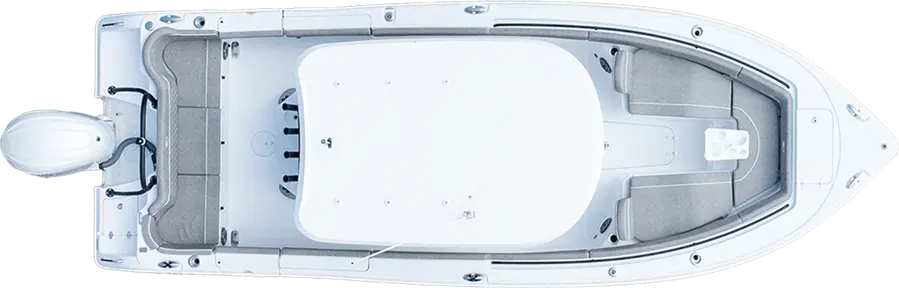
Layout. The 255 SE is 24′ 11″ long with an 8′ 9″ beam, and it's the first Ultra here set up as a full family boat. It has a mezzanine leaning post with a 60-quart cooler, a 40-quart aft insulated box, a bow beverage center, a contoured bow cushion and dual side entry doors. Fishing gear is lighter: a 10-gallon livewell and 188 quarts of in-floor storage.
What comes standard. A single Yamaha F300 (350 hp max), electric steering, a 12-inch Garmin, the CL5 display, a T-top with misters, a toilet, a windlass, trim tabs, underwater LEDs and a 19-gallon freshwater system.
On Florida water. One big outboard is simpler and cheaper to maintain than two. It has an 18/24/55 deadrise against the 234's 18/22/55, and 120 gallons of fuel, enough to reach nearshore reefs on a fair day. A 14-inch draft still gets you to the sandbar. The trade-off is redundancy. With one engine, keep offshore runs modest, keep the VHF on, and leave a float plan with someone ashore, as the Coast Guard recommends.
Ownership note. At 8′ 9″, it's over Florida's 102-inch road limit, so trailering it on public roads needs a permit. Plan on a lift or dry storage unless you're ready for that.
Next to its neighbors. The 265 SE adds a second engine, a deeper V and 25 more gallons. If most of your runs stay nearshore, the 255's single engine is the simpler boat to own.
Family seating, shade and a toilet on a single F300.
The 265 SE adds a second outboard.
8. Ultra 265 SE: twin engines for family offshore days
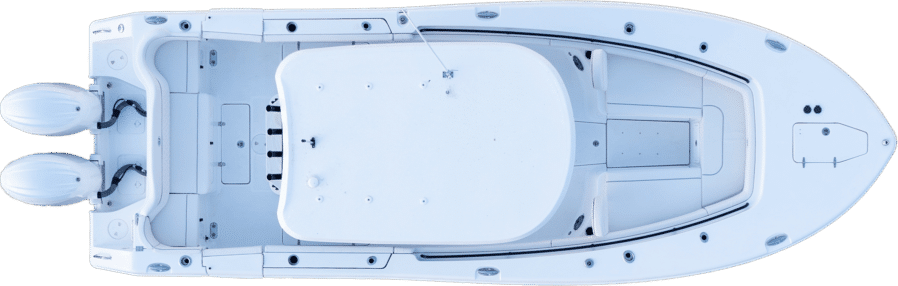
Layout. The 265 SE measures 26′ 5″ by 9′ 2″, with the Ultra mezzanine leaning post, dual side entry doors, bow backrests and a telescoping bow table. Its fishing gear is the same as the 255 SE's.
What comes standard. Twin Yamaha F150s on a 400 hp transom. The helm, T-top, toilet and windlass match the 255 SE, so the second engine is the big change.
On Florida water. Two changes make this a different boat from the 255. First, the twins give you a way home if one engine fails, which matters with kids aboard 10 miles out. Twins also make docking easier, because you can pivot the boat by running one engine ahead and the other astern. Second, it has a 21/24/60 deadrise, the same figure as the Gamefish 25 and 27 CB. A deeper V rides more softly into a head sea on the way back through an inlet. The cost is draft: at 21 inches, lagoon flats and the skinny Keys backcountry are off the menu.
Next to its neighbors. Its closest sibling is the Gamefish 25, on the same beam, fuel and engines. If you're between the two, count your trips. More days with four or more guests points to the 265 SE. More live-bait days points to the Gamefish 25 and its 35-gallon bait tank.
Twin power and 145 gallons, with the SE's seating and shade.
A 21-inch draft keeps you off the shallowest water.
9. Ultra 275 SE: Gamefish range with a family layout
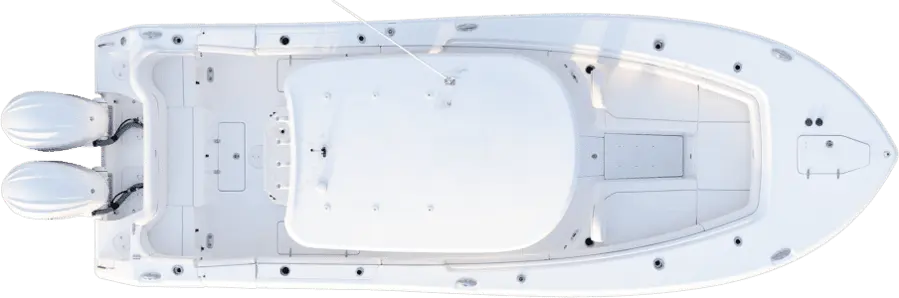
Layout. The 275 SE shares the Gamefish 27 CB's 27′ 6″ length and beam. It keeps the 265's family layout (bow table, side doors on both sides, backrests) and adds fishing room: a 20-gallon mezzanine livewell joins the 10-gallon well, for 30 gallons in all.
What comes standard. Twin Yamaha F200s on a 500 hp transom, with the same electronics and deck equipment as the 265.
On Florida water. With 180 gallons, the 275 SE has the same fuel as the Gamefish 27 CB, so it's the Ultra to pick when family days include real offshore runs: a wreck off the Space Coast, a reef trip out of Tampa Bay, or a reef day in the Keys. The extra length over the 265 also gives a crew of six more room to move around the console. At 6,600 pounds dry it isn't a driveway boat, so price out a lift, a slip or rack space before you commit.
Next to its neighbors. Same hull dimensions and engines as the Gamefish 27 CB. The Gamefish gives you 66 gallons of livewell and a coffin box; the 275 SE gives you seating and a table. Sea Hunt's next Ultra up, the 285 SE, adds a foot of length and a 600 hp rating.
180 gallons and twin F200s with the SE's seating and shade.
The Gamefish 27 CB puts the same hull into fishing room.
Which Sea Hunt fits your Florida water?
| Where you fish most | What matters | Start with |
|---|---|---|
| Indian River, Banana River, Mosquito Lagoon | Draft, shallow ramps, slow-speed zones | Ultra 219, 234 (13″) or 255 SE (14″) |
| Tampa Bay and other big open bays | Afternoon chop on open water, room for 3-4 | Ultra 234, 255 SE or Gamefish 25 |
| Nearshore Atlantic out of Ponce, Port Canaveral or Sebastian | Inlet conditions, deeper V, twin backup | Gamefish 25, Ultra 265 SE or 275 SE |
| Offshore Atlantic and Gulf | Fuel range, twins, fish storage | Gamefish 27, 28 or 30 CB |
| Keys reef and backcountry | Short reef runs, very shallow backcountry | Ultra 234 for the backcountry; Gamefish 25 or Ultra 265 SE for the reef |
Drafts from our model pages. A starting point for a test drive, not a rule.
Most regret comes from buying for the wrong water. A lagoon angler who buys a 21-inch-draft twin-engine boat ends up running channels while the redfish tail on flats he can't reach. An offshore crew in a 13-inch-draft bay boat turns back every time the forecast says 2 to 3 feet.
The lagoon system rewards draft and patience. FWC sets manatee protection zones that limit boat speed in parts of the Indian River Lagoon, so a long run north or south can mean miles at slow speed. A smaller, lighter Ultra launches easily at the shallow ramps along the lagoon and costs less fuel to idle.
Open bays and inlets reward deadrise. On many summer days in Tampa Bay, the sea breeze builds a short chop by early afternoon, and inlets get rough when the tide runs against the wind. A sharper V cuts through that chop instead of slamming on it. That is why the twin-engine boats here, with Sea Hunt's 21/24/60 figures, suit inlet runs better than the 219.
Offshore days reward range and redundancy. Summer storms build fast over Florida, so the boat that gets you home has to have fuel left after the detour around a cell. That is a case for 180 to 230 gallons and two engines.
The Keys are the special case: the reef is a short run, but the backcountry is very shallow. Many Keys anglers settle on one zone, and the boat follows that choice.
Before you buy: towing, storage, storms and fuel
Check these before you choose a size
Towing and storage. Florida law caps a vehicle and its load at 102 inches (8′ 6″) wide without a permit. Only the 219 and 234 fit, so they can live in a driveway. The rest usually go on a lift, in a slip or in dry storage. Our storage guide compares the options.
Storms. Hurricane season runs June 1 to November 30. Know who moves your boat and where it goes before you buy. The hurricane prep checklist covers the plan.
Fuel and the law. Plan offshore fuel by thirds, and tell someone ashore where you're going. FWC requires a Boating Safety Education ID card for anyone born on or after Jan. 1, 1988 who runs a boat of 10 hp or more. That covers every boat on this list. More in Florida boating laws.
Ask us which one fits
Tell us where you fish, who comes along and where the boat will live. We'll narrow it to two or three models, and walk you through them at the store.
Questions we hear
Are Sea Hunt boats good for fishing?
Sea Hunt builds saltwater center consoles, and every model in this guide has at least one livewell as standard. The Gamefish line is built around fishing: the 27, 28 and 30 CB carry a 40-gallon mezzanine livewell, pitch-bait and transom wells, two 200-quart fish boxes and a coffin box. The Ultra line still fishes, with a 15-gallon livewell on the 219 and 234 and 10 to 30 gallons on the SE models, but it gives more deck to seating. Match the line to how much of each trip is fishing.
What is the difference between Sea Hunt Ultra and Gamefish?
Gamefish boats put the deck into fishing: twin Yamahas on every model, mezzanine livewells, fish boxes and, on the CB models, a coffin box in the bow. Ultra boats put more of it into people, with bow backrests, side entry doors, bow tables on the bigger SE models and smaller livewells. Some pairs share a hull size, such as the Gamefish 27 CB and Ultra 275 SE, so the choice is about layout, not size.
What size Sea Hunt is best for offshore fishing in Florida?
For regular offshore trips, start at 25 feet with twin engines and at least 145 gallons of fuel: the Gamefish 25, 27 CB, 28 CB or 30 CB, or the Ultra 265 SE or 275 SE. Twins give you a way home if one engine fails. The 180-gallon and 230-gallon tanks on the bigger Gamefish give you more margin when you plan fuel by thirds, which matters on long Gulf runs where deep water is far from shore.
Can you tow a Sea Hunt in Florida without a permit?
It depends on the beam. Florida law limits a vehicle and its load to 102 inches (8′ 6″) wide without a permit. Of the boats here, the Ultra 219 (8′ 3″) and Ultra 234 (8′ 6″) fit within that limit. The rest are 8′ 9″ to 9′ 9″ wide and need an oversize permit on public roads, so most owners keep them on a lift, in a slip or at a dry-stack marina. Measure the whole rig, including trailer fenders.
Which Sea Hunt fishing boat has the biggest livewell?
The Gamefish 27, 28 and 30 CB each have a 40-gallon mezzanine livewell, plus a pitch-bait well (10 gallons on the 27, 15 on the 28 and 30) and a 16-gallon transom well. The Gamefish 25 has a 35-gallon bait tank in the leaning post and a 16-gallon transom well. Among the Ultras here, the 275 SE has the most, at 30 gallons across two wells. The 219 and 234 each carry 15 gallons.
Do Sea Hunt boats come with Yamaha engines?
Yes. Every model in this guide lists Yamaha outboards as standard power, from a single F150 on the Ultra 219 to twin F300s on the Gamefish 28 and 30 CB. Yamaha's CL5 touchscreen display also comes on the 255 SE and up, and on all four Gamefish. One engine brand across the lineup makes parts, service and gauges consistent if you move up a size later.