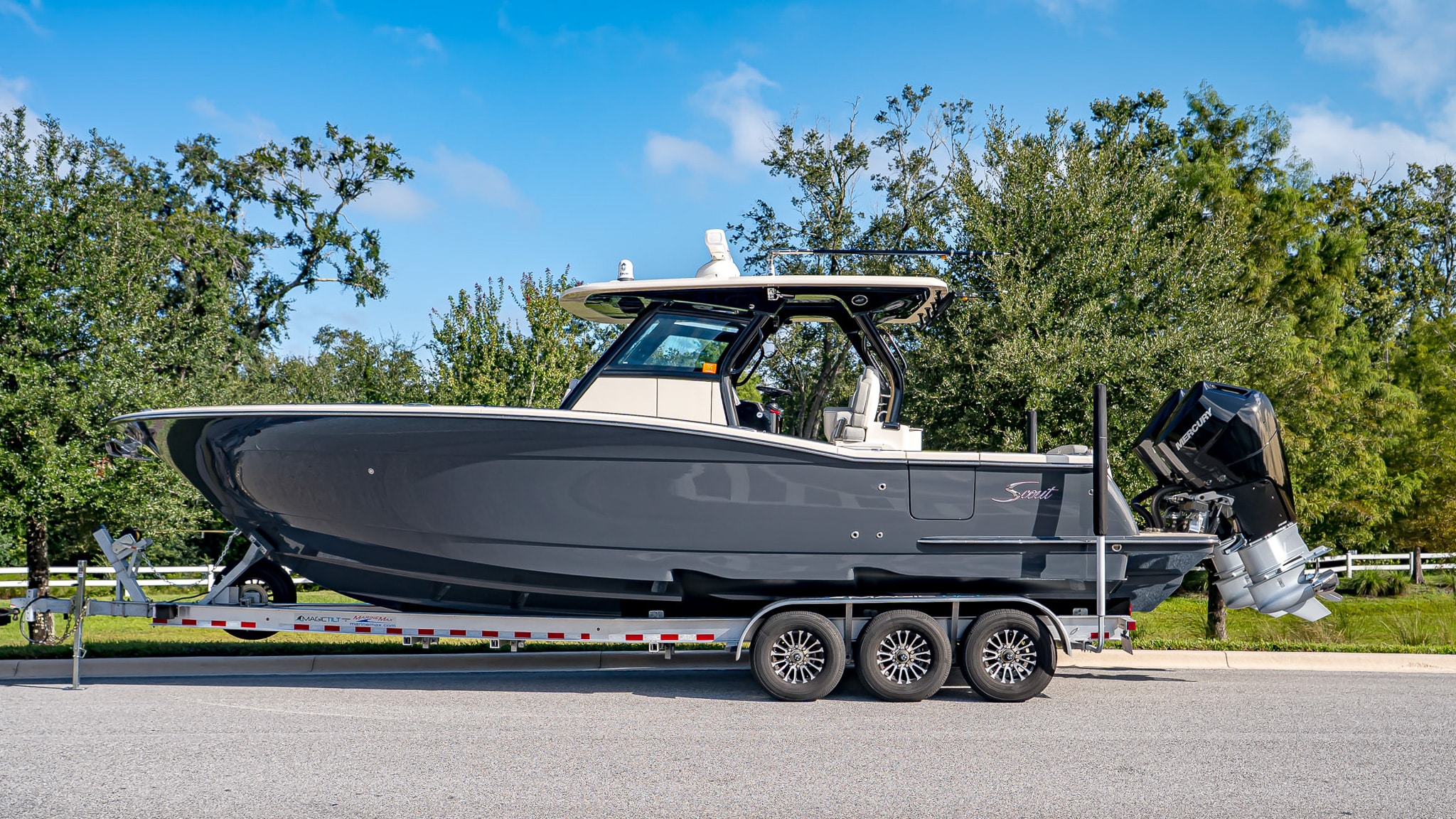
Short answer: Yes — Scout boats are worth the money for the buyer they’re built for, and the math is more favorable than the sticker price suggests. Scouts hold value better than the segment average because used supply is unusually thin: owners keep them, and when they do list, they sell fast. They’re built using epoxy infusion or aerospace-grade carbon-epoxy — construction methods used by roughly 3% and less than 1% of all production boats respectively — which translates into lighter, stiffer, more efficient hulls. They carry one of the longest combined warranties in the premium center console segment: a 10-year limited transferable structural hull warranty plus a 3-year stem-to-stern limited warranty. And at Ultimate Marine, Florida’s authorized Scout dealer, every Scout is backed by four certified service centers across the state. The premium up front buys a lower total cost of ownership across the next ten years. Below, the data behind every one of those claims — and the situations where the Scout premium genuinely isn’t worth it.
The Short Version: Why Scout Holds Its Value
Resale isn’t a marketing claim — it’s the market voting. The signal you want to see in a premium brand is this one: when used inventory is listed, it doesn’t sit. That’s the Scout pattern. Used Scout supply is consistently thin across Florida and the broader Southeast, and listings clear quickly relative to other premium center console brands. The buyer perception is that a five-year-old Scout drives like a five-year-old Scout, not like a five-year-old boat — and the resale market reflects that perception.
That single fact reframes the “worth the money” question. The right way to evaluate a premium boat isn’t sticker-to-sticker against a value brand. It’s net cost across an ownership cycle — purchase price, minus realized resale value, divided by years owned. On that math, Scout consistently outperforms most of what it’s cross-shopped against. The premium gets refunded at trade-in time.
How Scout Boats Are Actually Built (and Why That Matters)
There’s a reason Scouts cost what they cost. They aren’t built the way most boats are built.
Roughly 90% of production boats today are made with some form of chopper-gun fiberglass construction — a process that’s been the industry baseline for about 50 years. Chopper guns spray chopped fiberglass strands and resin into a mold simultaneously. It’s fast, it’s affordable (around $1.48 per pound in materials), and it works. It’s also heavier (~4.2 pounds per square foot), less stiff, and prone to ongoing cure variance over the life of the hull. It is, in plain terms, the cheap way to lay glass.
Scout doesn’t use it. Every Scout is 100% hand-laid fiberglass — no chopper guns, ever. On models from 33 to 35 feet, Scout uses epoxy infusion — a vacuum-bag process used by roughly 3% of all production boats. The hull is post-cured in the mold at 135 to 140°F for around eight hours, producing a structure that runs about $5.20 per pound in materials and weighs roughly 2.4 pounds per square foot — about 34% lighter than chopper-gun, and about four times stiffer. On the flagship 37-foot-and-above models, Scout steps up again to carbon-epoxy infusion — aerospace-grade carbon fiber and E-glass, used on less than 1% of all production boats, at roughly $8.70 per pound, ~1.7 pounds per square foot (~58% lighter than chopper-gun), and approximately five times stiffer.
Stiffer and lighter doesn’t just mean “feels nicer.” It means real performance differences that hold up at any speed, in any sea state:
- Lighter hulls plane faster and on less horsepower.
- Stiffer hulls flex less, fatigue less, and ride more predictably in chop.
- A lighter, stiffer hull running the same engine package burns less fuel — Scout claims double-digit-percentage fuel-economy improvements over comparable-class rivals, and the engineering supports the claim.
Add Scout’s other build standards — a chemically bonded reverse-shoebox hull-to-deck joint that eliminates the risk of hull/deck separation, no wood anywhere in the boat (rot-free composite stringers and transoms), tinned and heat-shrunk Deutsch-connected wiring instead of corrosion-prone alternatives, and completely finished bilges and undersides — and the picture sharpens. You’re not paying a premium for a logo. You’re paying for a boat that won’t have a chopper-gun boat’s problems in year seven.
(For the technical deep-dive on epoxy infusion specifically, we’ll go further in a dedicated post later in the cycle. The summary above is what matters for the buying decision.)
The Resale Reality — What “Holds Value” Actually Looks Like
A few specifics on the resale picture:
- Thin used inventory. At any given moment, the population of used Scouts listed across Florida is small relative to value-tier brands. Owners hold them, and dealer trades clear quickly.
- Faster sell-through. When used Scouts hit the market — through private listings, dealer trades, or brokerage — they typically move faster than the segment median.
- Stronger price retention. Across most center console segments, premium brands lose value more slowly than value brands as a percentage of original MSRP. Scout sits at or near the top of that retention curve.
For a buyer planning to keep the boat five to ten years before trading up, this is the single biggest financial argument for buying premium. You don’t realize the savings the day you buy. You realize them the day you trade in.
Warranty Coverage Longer Than Most Premium Rivals
Scout backs every boat with a 10-year limited transferable structural hull warranty plus a 3-year stem-to-stern limited warranty. The structural hull coverage is the headline — the hull is the part of the boat that has to last — and the fact that it’s transferable matters at resale: it travels with the boat to the second owner, which is part of why used Scouts hold value the way they do.
Three years of stem-to-stern coverage is also longer than what several premium peers offer on full-boat warranty terms. Combined with NMMA certification, ABYC standards compliance, and USCG conformance on every model, the warranty stack is part of what justifies the price tag.
The Service Objection — and What Ultimate Marine Does About It
Here’s the question every premium-boat buyer eventually asks: “This boat costs more. Won’t the service cost more, too?”
The honest answer: service for a premium center console isn’t dramatically more expensive than service for a value boat of the same length — engines and electronics drive most service costs, and the engine brands (Mercury, Yamaha, Suzuki) don’t care which hull they’re bolted to. What varies is the quality of the service relationship.
This is where Ultimate Marine changes the math. As Florida’s authorized Scout dealer, we back every Scout we sell with:
- Four factory-authorized service centers across Florida — Orlando, Tampa, New Smyrna Beach, and Key Largo — so wherever your Scout lives, certified service is close.
- Mercury, Yamaha, and Suzuki certified technicians at every location, authorized to perform warranty work on the engines that power Scout boats.
- Dockside service at all four locations, for every service we offer — a certified technician comes to your slip for routine maintenance, diagnostics, and electronics work.
- Documented service history that follows your Scout into the next ownership cycle — which is part of what protects resale value.
The Scout premium gets earned back in two ways: better resale at sale, and lower friction in ownership. The dealer relationship is the second half of the equation. Both halves matter.
Cost of Ownership: Premium Up Front, Cheaper Over Time
Add up the pieces and the cost-of-ownership math is genuinely different from what the sticker price suggests:
- Fuel. A lighter, stiffer hull on the same power burns less fuel. Across the run-hours of a Florida boating life — Atlantic runs off New Smyrna or Central Florida, Gulf days out of Tampa, bluewater work in the Keys — the savings compound.
- Maintenance. Composite stringers and corrosion-resistant wiring mean less of what wears out on lesser boats actually wears out on a Scout. Annual saltwater corrosion service still applies (it’s Florida — every boat needs it), but the systemic risks are lower.
- Insurance. Modestly higher on a premium boat in raw dollars, but often lower as a percentage of replacement value because Scouts are less likely to total in claims involving stringer or transom failure.
- Resale. Discussed above — the biggest variable, and the one that bends the curve in Scout’s favor.
Run the numbers across a ten-year ownership window and the gap between a Scout and a value-tier comparable is meaningfully smaller than the sticker-price gap. For some buyers, the lifecycle math actually favors Scout.
When a Scout Is Not Worth the Money
In the interest of telling you the smaller answer when it’s the right one — Scout isn’t the right boat for every buyer.
A Scout is genuinely not the best fit if:
- You’re a first-time buyer testing the lifestyle. A Carolina Skiff or Sea Hunt at half the price is the more rational way to find out whether you’ll actually be on the water 30 days a year. Trade up when the calendar proves you out.
- You plan to keep the boat less than three years. The Scout resale advantage compounds over time. Short-cycle buyers don’t capture it.
- Your primary use is freshwater lakes or short inshore runs. Scout’s construction and design advantages show up in offshore conditions, longer runs, and saltwater longevity. A weekend Tohopekaliga lake boat doesn’t need them.
- Your budget gets stretched to make it happen. A premium boat at the edge of affordability is a stressed boat in year two, and stressed boats get sold cheap — exactly the wrong outcome for the buyer who’d benefit most from premium resale.
If any of those describe you, Ultimate Marine carries Sea Hunt and Carolina Skiff for exactly those reasons. We’ll happily tell you the smaller boat is the right one.
For everyone else — the buyer planning to own the boat five to ten years, who runs it in saltwater, who values resale and a certified service relationship, and who can buy at a comfortable payment — yes, a Scout is worth the money. The data is on your side.
Frequently Asked Questions About Scout Boats and Value
Are Scout boats worth the money?
For buyers planning to own the boat five years or more in Florida saltwater, yes. Scouts hold resale value better than most center console brands because used supply is thin and demand is strong. Combined with longer warranty coverage and a lower cost of ownership over time, the premium typically pays itself back at trade-in.
Do Scout boats hold their value better than other brands?
Yes, generally. Used Scouts move faster than segment averages, listed inventory is thin, and price retention is among the strongest in the premium center console category. That’s the resale signal premium buyers should be looking for.
What makes Scout boats different from other premium center consoles?
Construction. Every Scout is 100% hand-laid fiberglass. On 33-to-35-foot models, Scout uses epoxy infusion (about 3% of production boats). On 37-foot-and-larger models, Scout uses carbon-epoxy infusion (less than 1% of production boats). That translates to lighter, stiffer, more efficient hulls that don’t fatigue the way chopper-gun construction does.
What’s the warranty on a Scout boat?
A 10-year limited transferable structural hull warranty plus a 3-year stem-to-stern limited warranty. The transferable structural coverage is part of what supports Scout resale.
Is Scout a reliable brand?
Founded in 1989 by Steve Potts in Summerville, South Carolina, Scout is family-owned, debt-free, and operates a 420,000-square-foot facility on 36 acres. The company has gained market share against far older competitors for three decades. Every Scout is NMMA-certified, built to ABYC standards, and USCG compliant.
Can I service a Scout in Florida if I bought it elsewhere?
Yes. Any boat is welcome at Ultimate Marine’s four Florida service centers — Orlando, Tampa, New Smyrna Beach, and Key Largo — regardless of where it was purchased. Our certified Mercury, Yamaha, and Suzuki technicians service Scout boats as part of standard service operations.
Are Scout boats made in America?
Yes. Every Scout is built in Summerville, South Carolina. Scout owns its land, buildings, and delivery fleet, and the company is debt-free and family-operated.
See the Scout Lineup at Ultimate Marine
Buying a premium boat is a decision that gets answered in year three, year five, and year ten — not on the showroom floor. As Florida’s authorized Scout dealer, Ultimate Marine sells the Scout LXF, LXS, XSF, Dorado, and XSS lineups across four locations, with four certified service centers backing every boat. Whether you’re stepping up from a value-tier boat or shopping the premium tier for the first time, we’ll talk you through the cost-of-ownership math honestly — including telling you when a different boat is the right boat.
Orlando — 3419 WD Judge Dr, Suite 150, Orlando, FL 32808
📞 (407) 783-7815
Tampa — 7501 N Dale Mabry Hwy, Tampa, FL 33614
📞 (813) 638-0570
New Smyrna Beach — 1701 FL-44, New Smyrna Beach, FL 32168
📞 (386) 284-4824
Key Largo — 106280 Overseas Highway, Key Largo, FL
📞 (786) 386-2847
🌐 ultimatemarine.com